

Part B | 12.7
364 Part B Tools and Methods in Marine Biotechnology
Cytryn et al. [12.62] integrated microscopic and
molecular microbial analyses to characterize rapidly
developing white filamentous tufts in an FBBR (used
earlier by Cytryn et al. [12.61]) for nitrate removal from
a marine recirculating aquaculture (fish culture) system – RAS. The dominant constituents of these tufts
were identified as filamentous, gram-negative bacteria
with densely packed intracellular sulfur granules belonging to the marine Thiothrix genus. Water from the
upper part of a double-drain fish basin (2:3 m
3 ), stocked
with Gilthead Seabream (fish) to a final density of
2050 kg m
3 , was recirculated at a rate of 12 fish
basin volumes per hour over a trickling filter. Simultaneously, water from the bottom center of the fish basin
flowed into a digestion basin (DB) (working volume
0:40:5 m
3 ) at a rate of 0:10:25 fish basin volumes
per hour. Water from the upper layers of the DB outlet
was pumped (57 L min
1 ) into the cylindrical FBBR
through a vertical pipe that extended from the top center to 3 cm above the base of the FBBR. The FBBR
(working volume 6:26 L) was filled with sand (average
diameter 0:7 mm), as carrier material for growth of microbial biofilm. Upflow from the inlet pipe caused the
flocs (biofilm-attached sand grains) to float within the
column. Water from the FBBR outlet at the top of the
cylinder was drained back to the fish basin after passing through a settler for removal of particulate matter,
which was funneled back into the DB.
Schramm et al. [12.63] analyzed the change of activity and abundance of Nitrosospira and Nitrospira
spp. along a bulk water gradient in a nitrifying FBBR,
by a combination of microsensor measurements and
fluorescence in situ hybridization (FISH), which facilitated a detailed analysis of the in situ structure and
function of the nitrifying bioreactor on a microscale.
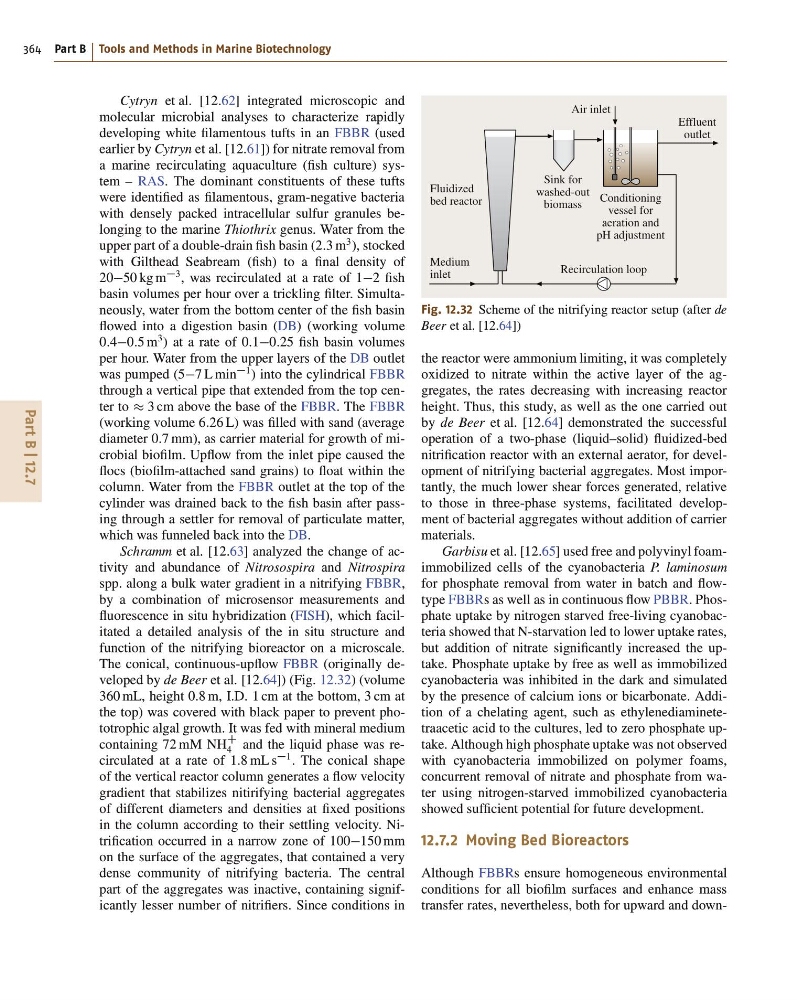
The conical, continuous-upflow FBBR (originally developed by de Beer et al. [12.64]) (Fig. 12.32) (volume
360 mL, height 0:8 m, I.D. 1 cm at the bottom, 3 cm at
the top) was covered with black paper to prevent phototrophic algal growth. It was fed with mineral medium
containing 72 mM NH
C
4 and the liquid phase was recirculated at a rate of 1:8 mL s
1 . The conical shape
of the vertical reactor column generates a flow velocity
gradient that stabilizes nitirifying bacterial aggregates
of different diameters and densities at fixed positions
in the column according to their settling velocity. Nitrification occurred in a narrow zone of 100150 mm
on the surface of the aggregates, that contained a very
dense community of nitrifying bacteria. The central
part of the aggregates was inactive, containing significantly lesser number of nitrifiers. Since conditions in
Effluent
outlet
Air inlet
Conditioning
vessel for
aeration and
pH adjustment
Sink for
washed-out
biomass
Fluidized
bed reactor
Medium
inlet
Recirculation loop
Fig. 12.32 Scheme of the nitrifying reactor setup (after de
Beer et al. [12.64])
the reactor were ammonium limiting, it was completely
oxidized to nitrate within the active layer of the aggregates, the rates decreasing with increasing reactor
height. Thus, this study, as well as the one carried out
by de Beer et al. [12.64] demonstrated the successful
operation of a two-phase (liquid–solid) fluidized-bed
nitrification reactor with an external aerator, for development of nitrifying bacterial aggregates. Most importantly, the much lower shear forces generated, relative
to those in three-phase systems, facilitated development of bacterial aggregates without addition of carrier
materials.
Garbisu et al. [12.65] used free and polyvinyl foamimmobilized cells of the cyanobacteria P. laminosum
for phosphate removal from water in batch and flowtype FBBRs as well as in continuous flow PBBR. Phosphate uptake by nitrogen starved free-living cyanobacteria showed that N-starvation led to lower uptake rates,
but addition of nitrate significantly increased the uptake. Phosphate uptake by free as well as immobilized
cyanobacteria was inhibited in the dark and simulated
by the presence of calcium ions or bicarbonate. Addition of a chelating agent, such as ethylenediaminetetraacetic acid to the cultures, led to zero phosphate uptake. Although high phosphate uptake was not observed
with cyanobacteria immobilized on polymer foams,
concurrent removal of nitrate and phosphate from water using nitrogen-starved immobilized cyanobacteria
showed sufficient potential for future development.
12.7.2 Moving Bed Bioreactors
Although FBBRs ensure homogeneous environmental
conditions for all biofilm surfaces and enhance mass
transfer rates, nevertheless, both for upward and down-
364 Part B Tools and Methods in Marine Biotechnology
Cytryn et al. [12.62] integrated microscopic and
molecular microbial analyses to characterize rapidly
developing white filamentous tufts in an FBBR (used
earlier by Cytryn et al. [12.61]) for nitrate removal from
a marine recirculating aquaculture (fish culture) system – RAS. The dominant constituents of these tufts
were identified as filamentous, gram-negative bacteria
with densely packed intracellular sulfur granules belonging to the marine Thiothrix genus. Water from the
upper part of a double-drain fish basin (2:3 m
3 ), stocked
with Gilthead Seabream (fish) to a final density of
2050 kg m
3 , was recirculated at a rate of 12 fish
basin volumes per hour over a trickling filter. Simultaneously, water from the bottom center of the fish basin
flowed into a digestion basin (DB) (working volume
0:40:5 m
3 ) at a rate of 0:10:25 fish basin volumes
per hour. Water from the upper layers of the DB outlet
was pumped (57 L min
1 ) into the cylindrical FBBR
through a vertical pipe that extended from the top center to 3 cm above the base of the FBBR. The FBBR
(working volume 6:26 L) was filled with sand (average
diameter 0:7 mm), as carrier material for growth of microbial biofilm. Upflow from the inlet pipe caused the
flocs (biofilm-attached sand grains) to float within the
column. Water from the FBBR outlet at the top of the
cylinder was drained back to the fish basin after passing through a settler for removal of particulate matter,
which was funneled back into the DB.
Schramm et al. [12.63] analyzed the change of activity and abundance of Nitrosospira and Nitrospira
spp. along a bulk water gradient in a nitrifying FBBR,
by a combination of microsensor measurements and
fluorescence in situ hybridization (FISH), which facilitated a detailed analysis of the in situ structure and
function of the nitrifying bioreactor on a microscale.
The conical, continuous-upflow FBBR (originally developed by de Beer et al. [12.64]) (Fig. 12.32) (volume
360 mL, height 0:8 m, I.D. 1 cm at the bottom, 3 cm at
the top) was covered with black paper to prevent phototrophic algal growth. It was fed with mineral medium
containing 72 mM NH
C
4 and the liquid phase was recirculated at a rate of 1:8 mL s
1 . The conical shape
of the vertical reactor column generates a flow velocity
gradient that stabilizes nitirifying bacterial aggregates
of different diameters and densities at fixed positions
in the column according to their settling velocity. Nitrification occurred in a narrow zone of 100150 mm
on the surface of the aggregates, that contained a very
dense community of nitrifying bacteria. The central
part of the aggregates was inactive, containing significantly lesser number of nitrifiers. Since conditions in
Effluent
outlet
Air inlet
Conditioning
vessel for
aeration and
pH adjustment
Sink for
washed-out
biomass
Fluidized
bed reactor
Medium
inlet
Recirculation loop
Fig. 12.32 Scheme of the nitrifying reactor setup (after de
Beer et al. [12.64])
the reactor were ammonium limiting, it was completely
oxidized to nitrate within the active layer of the aggregates, the rates decreasing with increasing reactor
height. Thus, this study, as well as the one carried out
by de Beer et al. [12.64] demonstrated the successful
operation of a two-phase (liquid–solid) fluidized-bed
nitrification reactor with an external aerator, for development of nitrifying bacterial aggregates. Most importantly, the much lower shear forces generated, relative
to those in three-phase systems, facilitated development of bacterial aggregates without addition of carrier
materials.
Garbisu et al. [12.65] used free and polyvinyl foamimmobilized cells of the cyanobacteria P. laminosum
for phosphate removal from water in batch and flowtype FBBRs as well as in continuous flow PBBR. Phosphate uptake by nitrogen starved free-living cyanobacteria showed that N-starvation led to lower uptake rates,
but addition of nitrate significantly increased the uptake. Phosphate uptake by free as well as immobilized
cyanobacteria was inhibited in the dark and simulated
by the presence of calcium ions or bicarbonate. Addition of a chelating agent, such as ethylenediaminetetraacetic acid to the cultures, led to zero phosphate uptake. Although high phosphate uptake was not observed
with cyanobacteria immobilized on polymer foams,
concurrent removal of nitrate and phosphate from water using nitrogen-starved immobilized cyanobacteria
showed sufficient potential for future development.
12.7.2 Moving Bed Bioreactors
Although FBBRs ensure homogeneous environmental
conditions for all biofilm surfaces and enhance mass
transfer rates, nevertheless, both for upward and down-