

Novel Bioreactors for Culturing Marine Organisms 12.7 Fluidized Bed and Moving Bed Bioreactors (FBBR and MBBR) 363
Part B | 12.7
12.7 Fluidized Bed and Moving Bed Bioreactors (FBBR and MBBR)
12.7.1 Fluidized Bed Bioreactors (FBBR)
An FBBR (Table 12.8) is a reactor consisting of a bed of
particles/carriers such that the particles are not in constant contact with each other (i. e., they are in motion
resembling that of fluid particles) due to the flow of
a fluid through them. If the component particles of the
bed are indeed in continuous contact with each other,
the bed is referred to as a packed bed. Often, the term
expanded bed is used to describe a bed that has expanded just marginally above the corresponding packed
bed height, i. e., above the settled height – the condition when the bed particles have settled down and
are NOT in motion. The term fluidized bed is usually
used for beds that have undergone significant expansion, so that fluidization of the bed has occurred – i. e.,
the bed particles are in continuous motion as in case
of a fluid. Fluidization involving liquids and solid particles is commonly particulate characterized by smooth
expansion of the bed, as opposed to aggregative characterized by violent bubbling and particle motion typical
of gas–solid fluidization. FBBRs are essentially immobilized-cell reactors. Individual cells being very small
and light and with a settling velocity less than the superficial liquid velocity are washed out, whereas carrier
particles with cells immobilized on them have much
larger settling velocity and are retained in the bed,
which allows operation of FBBRs at dilution rates much
higher than the cell specific growth rate. Compared with
stirred-tank immobilized reactors, the shear at the particle surface is much lower in an FBBR, which actually
poses a problem with bacteria and yeast because they
can continue to grow as a biofilm around the particle.
Increasing biofilm volumes forces the bed to expand
and the steady state, where cell growth equals the rate
that cells are washed off by surface shear is attained,
only with a very large bed height.
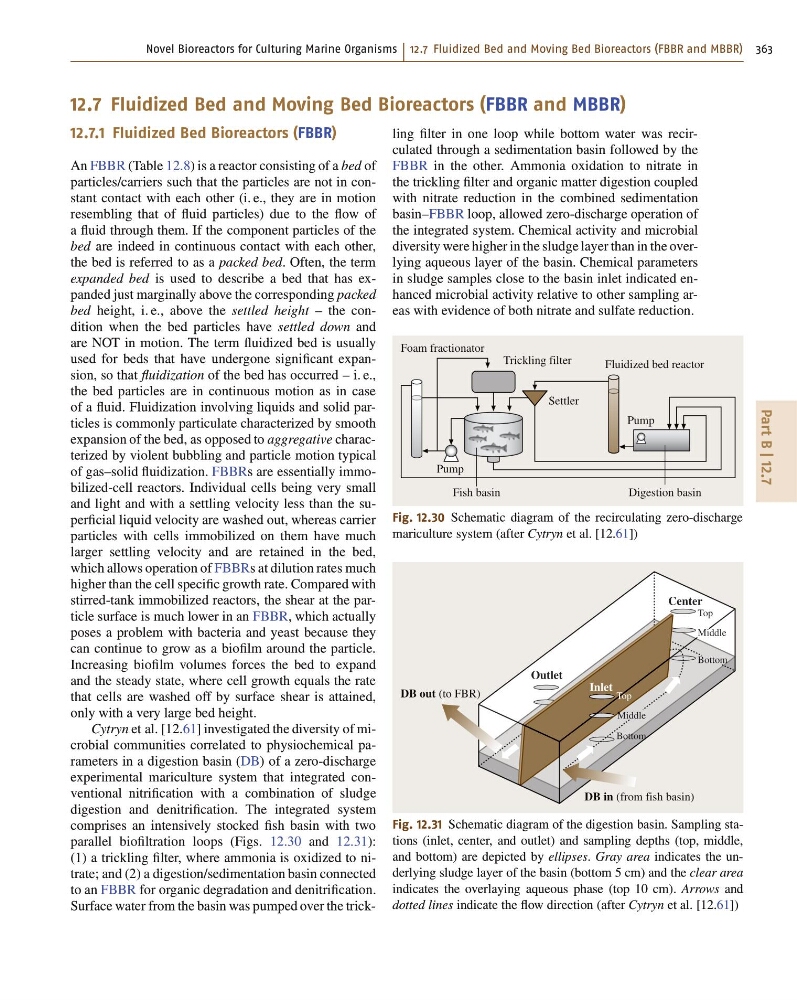
Cytryn et al. [12.61] investigated the diversity of microbial communities correlated to physiochemical parameters in a digestion basin (DB) of a zero-discharge
experimental mariculture system that integrated conventional nitrification with a combination of sludge
digestion and denitrification. The integrated system
comprises an intensively stocked fish basin with two
parallel biofiltration loops (Figs. 12.30 and 12.31):
(1) a trickling filter, where ammonia is oxidized to nitrate; and (2) a digestion/sedimentation basin connected
to an FBBR for organic degradation and denitrification.
Surface water from the basin was pumped over the trickling filter in one loop while bottom water was recirculated through a sedimentation basin followed by the
FBBR in the other. Ammonia oxidation to nitrate in
the trickling filter and organic matter digestion coupled
with nitrate reduction in the combined sedimentation
basin–FBBR loop, allowed zero-discharge operation of
the integrated system. Chemical activity and microbial
diversity were higher in the sludge layer than in the overlying aqueous layer of the basin. Chemical parameters
in sludge samples close to the basin inlet indicated enhanced microbial activity relative to other sampling areas with evidence of both nitrate and sulfate reduction.
Foam fractionator
Trickling filter
Fluidized bed reactor
Settler
Pump
Pump
Fish basin
Digestion basin
Fig. 12.30 Schematic diagram of the recirculating zero-discharge
mariculture system (after Cytryn et al. [12.61])
Center
Outlet
Top
Middle
Bottom
Inlet
DB in (from fish basin)
DB out (to FBR)
Top
Middle
Bottom
Fig. 12.31 Schematic diagram of the digestion basin. Sampling stations (inlet, center, and outlet) and sampling depths (top, middle,
and bottom) are depicted by ellipses. Gray area indicates the underlying sludge layer of the basin (bottom 5 cm) and the clear area
indicates the overlaying aqueous phase (top 10 cm). Arrows and
dotted lines indicate the flow direction (after Cytryn et al. [12.61])
Part B | 12.7
12.7 Fluidized Bed and Moving Bed Bioreactors (FBBR and MBBR)
12.7.1 Fluidized Bed Bioreactors (FBBR)
An FBBR (Table 12.8) is a reactor consisting of a bed of
particles/carriers such that the particles are not in constant contact with each other (i. e., they are in motion
resembling that of fluid particles) due to the flow of
a fluid through them. If the component particles of the
bed are indeed in continuous contact with each other,
the bed is referred to as a packed bed. Often, the term
expanded bed is used to describe a bed that has expanded just marginally above the corresponding packed
bed height, i. e., above the settled height – the condition when the bed particles have settled down and
are NOT in motion. The term fluidized bed is usually
used for beds that have undergone significant expansion, so that fluidization of the bed has occurred – i. e.,
the bed particles are in continuous motion as in case
of a fluid. Fluidization involving liquids and solid particles is commonly particulate characterized by smooth
expansion of the bed, as opposed to aggregative characterized by violent bubbling and particle motion typical
of gas–solid fluidization. FBBRs are essentially immobilized-cell reactors. Individual cells being very small
and light and with a settling velocity less than the superficial liquid velocity are washed out, whereas carrier
particles with cells immobilized on them have much
larger settling velocity and are retained in the bed,
which allows operation of FBBRs at dilution rates much
higher than the cell specific growth rate. Compared with
stirred-tank immobilized reactors, the shear at the particle surface is much lower in an FBBR, which actually
poses a problem with bacteria and yeast because they
can continue to grow as a biofilm around the particle.
Increasing biofilm volumes forces the bed to expand
and the steady state, where cell growth equals the rate
that cells are washed off by surface shear is attained,
only with a very large bed height.
Cytryn et al. [12.61] investigated the diversity of microbial communities correlated to physiochemical parameters in a digestion basin (DB) of a zero-discharge
experimental mariculture system that integrated conventional nitrification with a combination of sludge
digestion and denitrification. The integrated system
comprises an intensively stocked fish basin with two
parallel biofiltration loops (Figs. 12.30 and 12.31):
(1) a trickling filter, where ammonia is oxidized to nitrate; and (2) a digestion/sedimentation basin connected
to an FBBR for organic degradation and denitrification.
Surface water from the basin was pumped over the trickling filter in one loop while bottom water was recirculated through a sedimentation basin followed by the
FBBR in the other. Ammonia oxidation to nitrate in
the trickling filter and organic matter digestion coupled
with nitrate reduction in the combined sedimentation
basin–FBBR loop, allowed zero-discharge operation of
the integrated system. Chemical activity and microbial
diversity were higher in the sludge layer than in the overlying aqueous layer of the basin. Chemical parameters
in sludge samples close to the basin inlet indicated enhanced microbial activity relative to other sampling areas with evidence of both nitrate and sulfate reduction.
Foam fractionator
Trickling filter
Fluidized bed reactor
Settler
Pump
Pump
Fish basin
Digestion basin
Fig. 12.30 Schematic diagram of the recirculating zero-discharge
mariculture system (after Cytryn et al. [12.61])
Center
Outlet
Top
Middle
Bottom
Inlet
DB in (from fish basin)
DB out (to FBR)
Top
Middle
Bottom
Fig. 12.31 Schematic diagram of the digestion basin. Sampling stations (inlet, center, and outlet) and sampling depths (top, middle,
and bottom) are depicted by ellipses. Gray area indicates the underlying sludge layer of the basin (bottom 5 cm) and the clear area
indicates the overlaying aqueous phase (top 10 cm). Arrows and
dotted lines indicate the flow direction (after Cytryn et al. [12.61])