

Novel Bioreactors for Culturing Marine Organisms 12.6 Hollow Fiber Bioreactors (HFBR) 361
Part B | 12.6
cific microfibers were embedded in S.S. tubes (length
2 cm, I.D. 10 mm) using adhesive resin for holding the
fibers in place during reactor operation. Medium supply was through the shell-side port. Air was supplied in
a transverse mode through the fiber lumen. (It may be
noted that air supply may also be done in direct mode
through the shell side space.) Growth was evaluated by
using a pressure transducer, which monitors the pressure differential between the inside and outside of the
fibers and by measuring the protein content of fibers at
the end of an incubation.
Rombaut et al. [12.56] used a dense, nitrifying inoculum culture (ABIL) for stimulating growth of the
marine rotifer Brachionus plicatilis in several bioreactor systems, viz., batch culture, continuous bioreactors
packed with carrier materials (a PVC matrix, gravel
and CaCO 3 were evaluated separately) and a submerged
hollow-fiber membrane bioreactor (HF-MBR).
A series of rectangular shaped bioreactors
(Fig. 12.27) (total volume of one tank, 10 L) were
each filled with 4 dm
3 of carrier material and 4 L of
artificial seawater (25 g L
1 salinity). The bottom of
each tank was fitted with a cover (with holes drilled
on it) for retaining the carrier material, through which
two airlifts were installed for oxygen supply and for
recirculation of the aqueous phase. CaCO 3 stones
(2:0 ˙ 0:7 mm), gravel (16 ˙ 2 mm), a mixture of both
types of stones, and a PVC-based carrier material (viz.,
Bionet) were examined as biomass carrier materials,
however for the rotifer production periods, only the
crushed CaCO 3 stones were used. After the start-up
period of 11 d, water from the different bioreactors was
drained out of the system and replaced by new diluted
seawater. Except for the reactor packed with Bionet,
the bioreactors were connected to a cylindro-conical
culture tank of 10 L, well aerated to ensure good oxygenation and uniform distribution. The culture-rearing
tank was filled with artificial seawater and maintained
at a constant temperature (25 ˙ 1
ı C). A central nylon
screen (mesh size 33 m) sieve was installed in the
center of each tank to retain the rotifers and also to
enable pumping of the culture water (using a peristaltic
pump) to the bioreactors. The water returned by gravity
to the rotifer culture tanks.
For the experiments with HF-MBR, conical PVC
tanks were used for rotifer culture which were filled
with 10 L of artificial seawater. Hydrophilic hollow fibers (nominal pore size 0:2 m; wall thickness
450 m; inner diameter 1800 m), adjusted to pieces
of 1 m and 10 fibers (total surface area = 0:078 m
2 ),
were installed in each culture tank. The ends of the hollow fibers were connected to the ABIL reactor, inside
which filter cotton was placed at the bottom to collect large debris. Water and bacteria from the ABIL
reactor were pumped through the hollow fibers (using a peristaltic pump). The rotifer feed was stored
at temperatures < 10
ı C and was fed (15 min h
1 ) by
a peristaltic pump. The rotifer culture tanks were continuously aerated and the temperature was controlled
by a heater at 28
ı C. Results showed that concentrations of the major nitrogenous waste, viz., TAN in
the control batch culture was much higher than that
in the HF-MBR recirculating system. Since the principal objective of the bioreactor systems evaluated is the
removal of TAN, thereby facilitating vigorous rotifer
growth, the improved water quality obtained with the
HF-MBR system resulted in much higher rotifier densities compared to the normal batch culture.
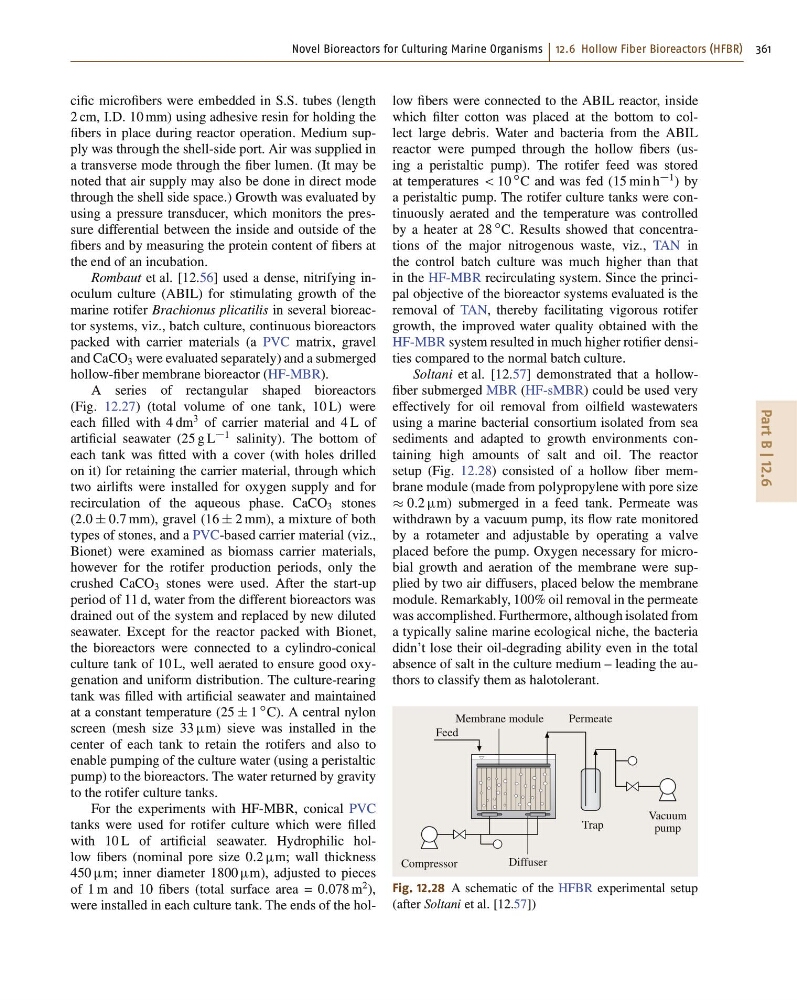
Soltani et al. [12.57] demonstrated that a hollowfiber submerged MBR (HF-sMBR) could be used very
effectively for oil removal from oilfield wastewaters
using a marine bacterial consortium isolated from sea
sediments and adapted to growth environments containing high amounts of salt and oil. The reactor
setup (Fig. 12.28) consisted of a hollow fiber membrane module (made from polypropylene with pore size
0:2 m) submerged in a feed tank. Permeate was
withdrawn by a vacuum pump, its flow rate monitored
by a rotameter and adjustable by operating a valve
placed before the pump. Oxygen necessary for microbial growth and aeration of the membrane were supplied by two air diffusers, placed below the membrane
module. Remarkably, 100% oil removal in the permeate
was accomplished. Furthermore, although isolated from
a typically saline marine ecological niche, the bacteria
didn’t lose their oil-degrading ability even in the total
absence of salt in the culture medium – leading the authors to classify them as halotolerant.
Compressor
Vacuum
pump
Diffuser
Trap
Permeate
Membrane module
Feed
Fig. 12.28 A schematic of the HFBR experimental setup
(after Soltani et al. [12.57])
Part B | 12.6
cific microfibers were embedded in S.S. tubes (length
2 cm, I.D. 10 mm) using adhesive resin for holding the
fibers in place during reactor operation. Medium supply was through the shell-side port. Air was supplied in
a transverse mode through the fiber lumen. (It may be
noted that air supply may also be done in direct mode
through the shell side space.) Growth was evaluated by
using a pressure transducer, which monitors the pressure differential between the inside and outside of the
fibers and by measuring the protein content of fibers at
the end of an incubation.
Rombaut et al. [12.56] used a dense, nitrifying inoculum culture (ABIL) for stimulating growth of the
marine rotifer Brachionus plicatilis in several bioreactor systems, viz., batch culture, continuous bioreactors
packed with carrier materials (a PVC matrix, gravel
and CaCO 3 were evaluated separately) and a submerged
hollow-fiber membrane bioreactor (HF-MBR).
A series of rectangular shaped bioreactors
(Fig. 12.27) (total volume of one tank, 10 L) were
each filled with 4 dm
3 of carrier material and 4 L of
artificial seawater (25 g L
1 salinity). The bottom of
each tank was fitted with a cover (with holes drilled
on it) for retaining the carrier material, through which
two airlifts were installed for oxygen supply and for
recirculation of the aqueous phase. CaCO 3 stones
(2:0 ˙ 0:7 mm), gravel (16 ˙ 2 mm), a mixture of both
types of stones, and a PVC-based carrier material (viz.,
Bionet) were examined as biomass carrier materials,
however for the rotifer production periods, only the
crushed CaCO 3 stones were used. After the start-up
period of 11 d, water from the different bioreactors was
drained out of the system and replaced by new diluted
seawater. Except for the reactor packed with Bionet,
the bioreactors were connected to a cylindro-conical
culture tank of 10 L, well aerated to ensure good oxygenation and uniform distribution. The culture-rearing
tank was filled with artificial seawater and maintained
at a constant temperature (25 ˙ 1
ı C). A central nylon
screen (mesh size 33 m) sieve was installed in the
center of each tank to retain the rotifers and also to
enable pumping of the culture water (using a peristaltic
pump) to the bioreactors. The water returned by gravity
to the rotifer culture tanks.
For the experiments with HF-MBR, conical PVC
tanks were used for rotifer culture which were filled
with 10 L of artificial seawater. Hydrophilic hollow fibers (nominal pore size 0:2 m; wall thickness
450 m; inner diameter 1800 m), adjusted to pieces
of 1 m and 10 fibers (total surface area = 0:078 m
2 ),
were installed in each culture tank. The ends of the hollow fibers were connected to the ABIL reactor, inside
which filter cotton was placed at the bottom to collect large debris. Water and bacteria from the ABIL
reactor were pumped through the hollow fibers (using a peristaltic pump). The rotifer feed was stored
at temperatures < 10
ı C and was fed (15 min h
1 ) by
a peristaltic pump. The rotifer culture tanks were continuously aerated and the temperature was controlled
by a heater at 28
ı C. Results showed that concentrations of the major nitrogenous waste, viz., TAN in
the control batch culture was much higher than that
in the HF-MBR recirculating system. Since the principal objective of the bioreactor systems evaluated is the
removal of TAN, thereby facilitating vigorous rotifer
growth, the improved water quality obtained with the
HF-MBR system resulted in much higher rotifier densities compared to the normal batch culture.
Soltani et al. [12.57] demonstrated that a hollowfiber submerged MBR (HF-sMBR) could be used very
effectively for oil removal from oilfield wastewaters
using a marine bacterial consortium isolated from sea
sediments and adapted to growth environments containing high amounts of salt and oil. The reactor
setup (Fig. 12.28) consisted of a hollow fiber membrane module (made from polypropylene with pore size
0:2 m) submerged in a feed tank. Permeate was
withdrawn by a vacuum pump, its flow rate monitored
by a rotameter and adjustable by operating a valve
placed before the pump. Oxygen necessary for microbial growth and aeration of the membrane were supplied by two air diffusers, placed below the membrane
module. Remarkably, 100% oil removal in the permeate
was accomplished. Furthermore, although isolated from
a typically saline marine ecological niche, the bacteria
didn’t lose their oil-degrading ability even in the total
absence of salt in the culture medium – leading the authors to classify them as halotolerant.
Compressor
Vacuum
pump
Diffuser
Trap
Permeate
Membrane module
Feed
Fig. 12.28 A schematic of the HFBR experimental setup
(after Soltani et al. [12.57])