

Part B | 12.6
360 Part B Tools and Methods in Marine Biotechnology
An HFBR permits high cell densities to be attained
in a practically nonshear environment with mild nutrient perfusion. Bacterial cell densities between 100
and 200 g L
1 have been commonly attained in HFBRs.
However, the exceptionally high density of 550 g L
1
was reported [12.60] for a rifamycin-producing strain
of Nocardia mediterranei (later renamed Amycolatopsis
rifamycinica) grown in a dual hollow-fiber bioreactor.
It is this ability to establish high cell densities while
operating with continuous nutrient supply and product
removal, that gives rise to higher product yields. HFBRs
have been shown to work well with bioprocesses that result in the synthesis of products from major metabolic
pathways, e.g., glycolysis, but, they do not work very
well with processes that involve metabolic pathways of
apparently less significance to the producer microbe.
Air lift water filtration
Filter cotton
Water temperature
27 °C
Water level control
Auto feeder
Air lift filter
Water flow
Air lift
Carrier
Heater
Peristaltic
pump
Central nylon
screen
Air
Bioreactor
Rotifer culture tank
ABIL
reactor
Rotifer culture tank
Main aeration
Hallow fibers
Heater
Aeration
Bottle cover
a)
c)
b)
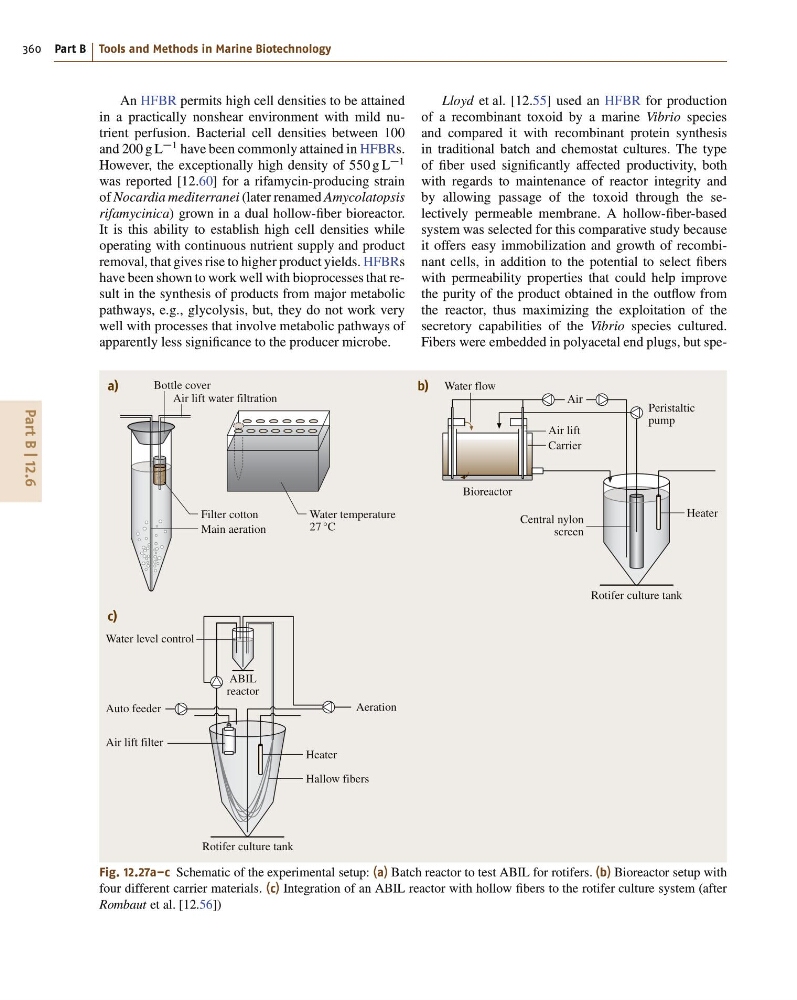
Fig. 12.27a–c Schematic of the experimental setup: (a) Batch reactor to test ABIL for rotifers. (b) Bioreactor setup with
four different carrier materials. (c) Integration of an ABIL reactor with hollow fibers to the rotifer culture system (after
Rombaut et al. [12.56])
Lloyd et al. [12.55] used an HFBR for production
of a recombinant toxoid by a marine Vibrio species
and compared it with recombinant protein synthesis
in traditional batch and chemostat cultures. The type
of fiber used significantly affected productivity, both
with regards to maintenance of reactor integrity and
by allowing passage of the toxoid through the selectively permeable membrane. A hollow-fiber-based
system was selected for this comparative study because
it offers easy immobilization and growth of recombinant cells, in addition to the potential to select fibers
with permeability properties that could help improve
the purity of the product obtained in the outflow from
the reactor, thus maximizing the exploitation of the
secretory capabilities of the Vibrio species cultured.
Fibers were embedded in polyacetal end plugs, but spe-
360 Part B Tools and Methods in Marine Biotechnology
An HFBR permits high cell densities to be attained
in a practically nonshear environment with mild nutrient perfusion. Bacterial cell densities between 100
and 200 g L
1 have been commonly attained in HFBRs.
However, the exceptionally high density of 550 g L
1
was reported [12.60] for a rifamycin-producing strain
of Nocardia mediterranei (later renamed Amycolatopsis
rifamycinica) grown in a dual hollow-fiber bioreactor.
It is this ability to establish high cell densities while
operating with continuous nutrient supply and product
removal, that gives rise to higher product yields. HFBRs
have been shown to work well with bioprocesses that result in the synthesis of products from major metabolic
pathways, e.g., glycolysis, but, they do not work very
well with processes that involve metabolic pathways of
apparently less significance to the producer microbe.
Air lift water filtration
Filter cotton
Water temperature
27 °C
Water level control
Auto feeder
Air lift filter
Water flow
Air lift
Carrier
Heater
Peristaltic
pump
Central nylon
screen
Air
Bioreactor
Rotifer culture tank
ABIL
reactor
Rotifer culture tank
Main aeration
Hallow fibers
Heater
Aeration
Bottle cover
a)
c)
b)
Fig. 12.27a–c Schematic of the experimental setup: (a) Batch reactor to test ABIL for rotifers. (b) Bioreactor setup with
four different carrier materials. (c) Integration of an ABIL reactor with hollow fibers to the rotifer culture system (after
Rombaut et al. [12.56])
Lloyd et al. [12.55] used an HFBR for production
of a recombinant toxoid by a marine Vibrio species
and compared it with recombinant protein synthesis
in traditional batch and chemostat cultures. The type
of fiber used significantly affected productivity, both
with regards to maintenance of reactor integrity and
by allowing passage of the toxoid through the selectively permeable membrane. A hollow-fiber-based
system was selected for this comparative study because
it offers easy immobilization and growth of recombinant cells, in addition to the potential to select fibers
with permeability properties that could help improve
the purity of the product obtained in the outflow from
the reactor, thus maximizing the exploitation of the
secretory capabilities of the Vibrio species cultured.
Fibers were embedded in polyacetal end plugs, but spe-