

Novel Bioreactors for Culturing Marine Organisms 12.6 Hollow Fiber Bioreactors (HFBR) 359
Part B | 12.6
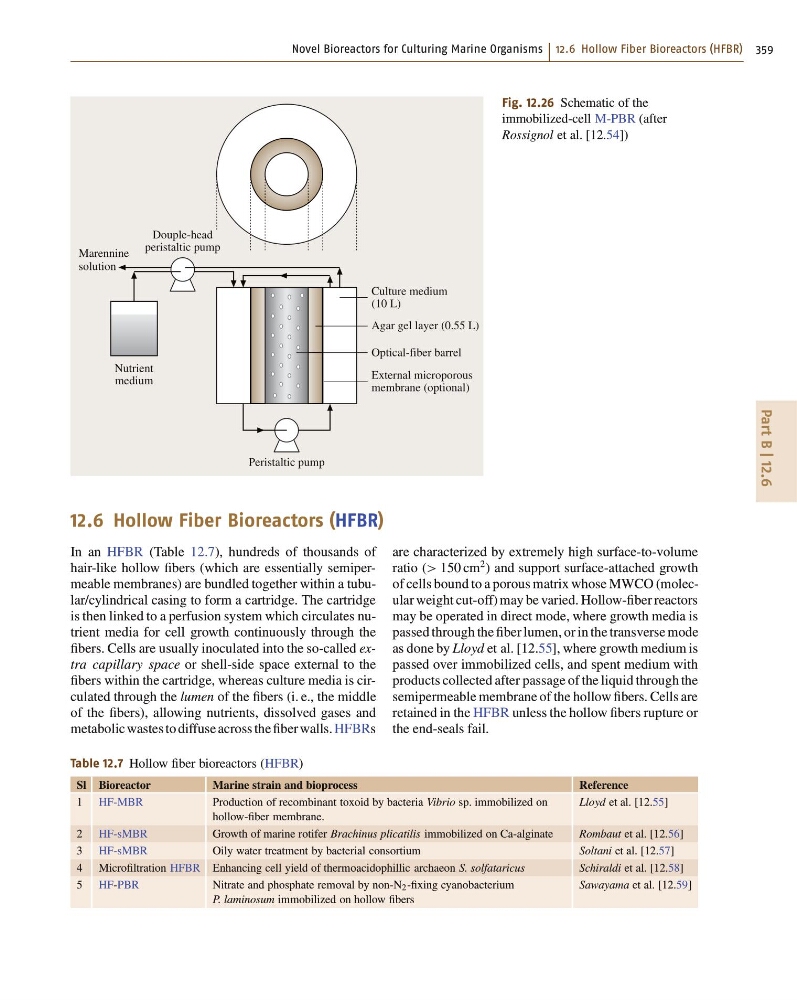
Nutrient
medium
Douple-head
peristaltic pump
External microporous
membrane (optional)
Culture medium
(10 L)
Agar gel layer (0.55 L)
Optical-fiber barrel
Peristaltic pump
Marennine
solution
Fig. 12.26 Schematic of the
immobilized-cell M-PBR (after
Rossignol et al. [12.54])
12.6 Hollow Fiber Bioreactors (HFBR)
In an HFBR (Table 12.7), hundreds of thousands of
hair-like hollow fibers (which are essentially semipermeable membranes) are bundled together within a tubular/cylindrical casing to form a cartridge. The cartridge
is then linked to a perfusion system which circulates nutrient media for cell growth continuously through the
fibers. Cells are usually inoculated into the so-called extra capillary space or shell-side space external to the
fibers within the cartridge, whereas culture media is circulated through the lumen of the fibers (i. e., the middle
of the fibers), allowing nutrients, dissolved gases and
metabolic wastes to diffuse across the fiber walls. HFBRs
Table 12.7 Hollow fiber bioreactors (HFBR)
Sl Bioreactor
Marine strain and bioprocess
Reference
1 HF-MBR
Production of recombinant toxoid by bacteria Vibrio sp. immobilized on
hollow-fiber membrane.
Lloyd et al. [12.55]
2 HF-sMBR
Growth of marine rotifer Brachinus plicatilis immobilized on Ca-alginate
Rombaut et al. [12.56]
3 HF-sMBR
Oily water treatment by bacterial consortium
Soltani et al. [12.57]
4 Microfiltration HFBR Enhancing cell yield of thermoacidophillic archaeon S. solfataricus
Schiraldi et al. [12.58]
5 HF-PBR
Nitrate and phosphate removal by non-N 2 -fixing cyanobacterium
P. laminosum immobilized on hollow fibers
Sawayama et al. [12.59]
are characterized by extremely high surface-to-volume
ratio (> 150 cm
2 ) and support surface-attached growth
of cells bound to a porous matrix whose MWCO (molecular weight cut-off) may be varied. Hollow-fiber reactors
may be operated in direct mode, where growth media is
passed through the fiber lumen, or in the transverse mode
as done by Lloyd et al. [12.55], where growth medium is
passed over immobilized cells, and spent medium with
products collected after passage of the liquid through the
semipermeable membrane of the hollow fibers. Cells are
retained in the HFBR unless the hollow fibers rupture or
the end-seals fail.
Part B | 12.6
Nutrient
medium
Douple-head
peristaltic pump
External microporous
membrane (optional)
Culture medium
(10 L)
Agar gel layer (0.55 L)
Optical-fiber barrel
Peristaltic pump
Marennine
solution
Fig. 12.26 Schematic of the
immobilized-cell M-PBR (after
Rossignol et al. [12.54])
12.6 Hollow Fiber Bioreactors (HFBR)
In an HFBR (Table 12.7), hundreds of thousands of
hair-like hollow fibers (which are essentially semipermeable membranes) are bundled together within a tubular/cylindrical casing to form a cartridge. The cartridge
is then linked to a perfusion system which circulates nutrient media for cell growth continuously through the
fibers. Cells are usually inoculated into the so-called extra capillary space or shell-side space external to the
fibers within the cartridge, whereas culture media is circulated through the lumen of the fibers (i. e., the middle
of the fibers), allowing nutrients, dissolved gases and
metabolic wastes to diffuse across the fiber walls. HFBRs
Table 12.7 Hollow fiber bioreactors (HFBR)
Sl Bioreactor
Marine strain and bioprocess
Reference
1 HF-MBR
Production of recombinant toxoid by bacteria Vibrio sp. immobilized on
hollow-fiber membrane.
Lloyd et al. [12.55]
2 HF-sMBR
Growth of marine rotifer Brachinus plicatilis immobilized on Ca-alginate
Rombaut et al. [12.56]
3 HF-sMBR
Oily water treatment by bacterial consortium
Soltani et al. [12.57]
4 Microfiltration HFBR Enhancing cell yield of thermoacidophillic archaeon S. solfataricus
Schiraldi et al. [12.58]
5 HF-PBR
Nitrate and phosphate removal by non-N 2 -fixing cyanobacterium
P. laminosum immobilized on hollow fibers
Sawayama et al. [12.59]
are characterized by extremely high surface-to-volume
ratio (> 150 cm
2 ) and support surface-attached growth
of cells bound to a porous matrix whose MWCO (molecular weight cut-off) may be varied. Hollow-fiber reactors
may be operated in direct mode, where growth media is
passed through the fiber lumen, or in the transverse mode
as done by Lloyd et al. [12.55], where growth medium is
passed over immobilized cells, and spent medium with
products collected after passage of the liquid through the
semipermeable membrane of the hollow fibers. Cells are
retained in the HFBR unless the hollow fibers rupture or
the end-seals fail.