

Part B | 12.5
352 Part B Tools and Methods in Marine Biotechnology
CH 4
Reduction
valve
MFC
4.8 L × d
–1
Gas
flow
meter
ZnCl 2
Effluent
Pressure
meter
Water bath
15 or 30 °C
Membranes (300 cm
2
)
Level
controller
Medium
20 mM
SO 4
2–
0.14 L × d
–1
Level sensor (1 L)
pH sensor
(7.2–7.5)
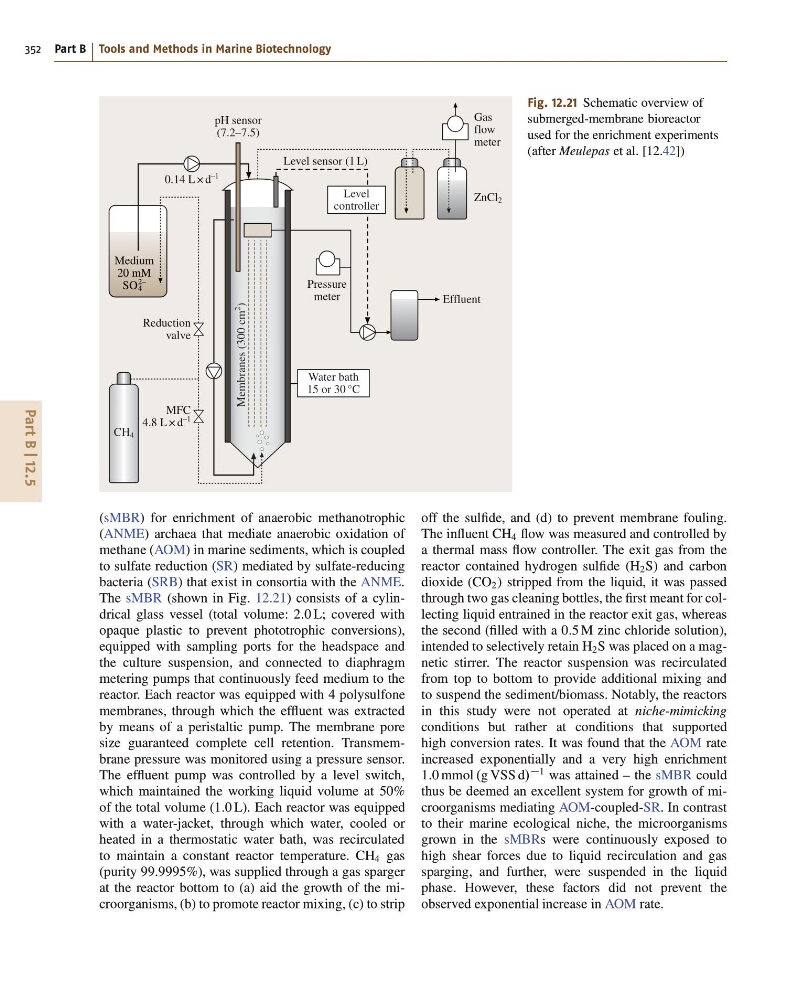
Fig. 12.21 Schematic overview of
submerged-membrane bioreactor
used for the enrichment experiments
(after Meulepas et al. [12.42])
(sMBR) for enrichment of anaerobic methanotrophic
(ANME) archaea that mediate anaerobic oxidation of
methane (AOM) in marine sediments, which is coupled
to sulfate reduction (SR) mediated by sulfate-reducing
bacteria (SRB) that exist in consortia with the ANME.
The sMBR (shown in Fig. 12.21) consists of a cylindrical glass vessel (total volume: 2:0 L; covered with
opaque plastic to prevent phototrophic conversions),
equipped with sampling ports for the headspace and
the culture suspension, and connected to diaphragm
metering pumps that continuously feed medium to the
reactor. Each reactor was equipped with 4 polysulfone
membranes, through which the effluent was extracted
by means of a peristaltic pump. The membrane pore
size guaranteed complete cell retention. Transmembrane pressure was monitored using a pressure sensor.
The effluent pump was controlled by a level switch,
which maintained the working liquid volume at 50%
of the total volume (1:0 L). Each reactor was equipped
with a water-jacket, through which water, cooled or
heated in a thermostatic water bath, was recirculated
to maintain a constant reactor temperature. CH 4 gas
(purity 99:9995%), was supplied through a gas sparger
at the reactor bottom to (a) aid the growth of the microorganisms, (b) to promote reactor mixing, (c) to strip
off the sulfide, and (d) to prevent membrane fouling.
The influent CH 4 flow was measured and controlled by
a thermal mass flow controller. The exit gas from the
reactor contained hydrogen sulfide (H 2 S) and carbon
dioxide (CO 2 ) stripped from the liquid, it was passed
through two gas cleaning bottles, the first meant for collecting liquid entrained in the reactor exit gas, whereas
the second (filled with a 0:5 M zinc chloride solution),
intended to selectively retain H 2 S was placed on a magnetic stirrer. The reactor suspension was recirculated
from top to bottom to provide additional mixing and
to suspend the sediment/biomass. Notably, the reactors
in this study were not operated at niche-mimicking
conditions but rather at conditions that supported
high conversion rates. It was found that the AOM rate
increased exponentially and a very high enrichment
1:0 mmol .g VSS d/
1 was attained – the sMBR could
thus be deemed an excellent system for growth of microorganisms mediating AOM-coupled-SR. In contrast
to their marine ecological niche, the microorganisms
grown in the sMBRs were continuously exposed to
high shear forces due to liquid recirculation and gas
sparging, and further, were suspended in the liquid
phase. However, these factors did not prevent the
observed exponential increase in AOM rate.
352 Part B Tools and Methods in Marine Biotechnology
CH 4
Reduction
valve
MFC
4.8 L × d
–1
Gas
flow
meter
ZnCl 2
Effluent
Pressure
meter
Water bath
15 or 30 °C
Membranes (300 cm
2
)
Level
controller
Medium
20 mM
SO 4
2–
0.14 L × d
–1
Level sensor (1 L)
pH sensor
(7.2–7.5)
Fig. 12.21 Schematic overview of
submerged-membrane bioreactor
used for the enrichment experiments
(after Meulepas et al. [12.42])
(sMBR) for enrichment of anaerobic methanotrophic
(ANME) archaea that mediate anaerobic oxidation of
methane (AOM) in marine sediments, which is coupled
to sulfate reduction (SR) mediated by sulfate-reducing
bacteria (SRB) that exist in consortia with the ANME.
The sMBR (shown in Fig. 12.21) consists of a cylindrical glass vessel (total volume: 2:0 L; covered with
opaque plastic to prevent phototrophic conversions),
equipped with sampling ports for the headspace and
the culture suspension, and connected to diaphragm
metering pumps that continuously feed medium to the
reactor. Each reactor was equipped with 4 polysulfone
membranes, through which the effluent was extracted
by means of a peristaltic pump. The membrane pore
size guaranteed complete cell retention. Transmembrane pressure was monitored using a pressure sensor.
The effluent pump was controlled by a level switch,
which maintained the working liquid volume at 50%
of the total volume (1:0 L). Each reactor was equipped
with a water-jacket, through which water, cooled or
heated in a thermostatic water bath, was recirculated
to maintain a constant reactor temperature. CH 4 gas
(purity 99:9995%), was supplied through a gas sparger
at the reactor bottom to (a) aid the growth of the microorganisms, (b) to promote reactor mixing, (c) to strip
off the sulfide, and (d) to prevent membrane fouling.
The influent CH 4 flow was measured and controlled by
a thermal mass flow controller. The exit gas from the
reactor contained hydrogen sulfide (H 2 S) and carbon
dioxide (CO 2 ) stripped from the liquid, it was passed
through two gas cleaning bottles, the first meant for collecting liquid entrained in the reactor exit gas, whereas
the second (filled with a 0:5 M zinc chloride solution),
intended to selectively retain H 2 S was placed on a magnetic stirrer. The reactor suspension was recirculated
from top to bottom to provide additional mixing and
to suspend the sediment/biomass. Notably, the reactors
in this study were not operated at niche-mimicking
conditions but rather at conditions that supported
high conversion rates. It was found that the AOM rate
increased exponentially and a very high enrichment
1:0 mmol .g VSS d/
1 was attained – the sMBR could
thus be deemed an excellent system for growth of microorganisms mediating AOM-coupled-SR. In contrast
to their marine ecological niche, the microorganisms
grown in the sMBRs were continuously exposed to
high shear forces due to liquid recirculation and gas
sparging, and further, were suspended in the liquid
phase. However, these factors did not prevent the
observed exponential increase in AOM rate.