

Novel Bioreactors for Culturing Marine Organisms 12.4 Membrane Bioreactors (MBR) 351
Part B | 12.4
Anion exchange
membrane
CO 2 + N 2
NO 3
–
NO 3
–
Treated water
Na
+
Na
+
Biofilm
Cl
–
Cl
–
4
II
I
1
3
2
a)
b)
Biocompartment
Water compartment
Oceanarium water + ethanol
Polluted water
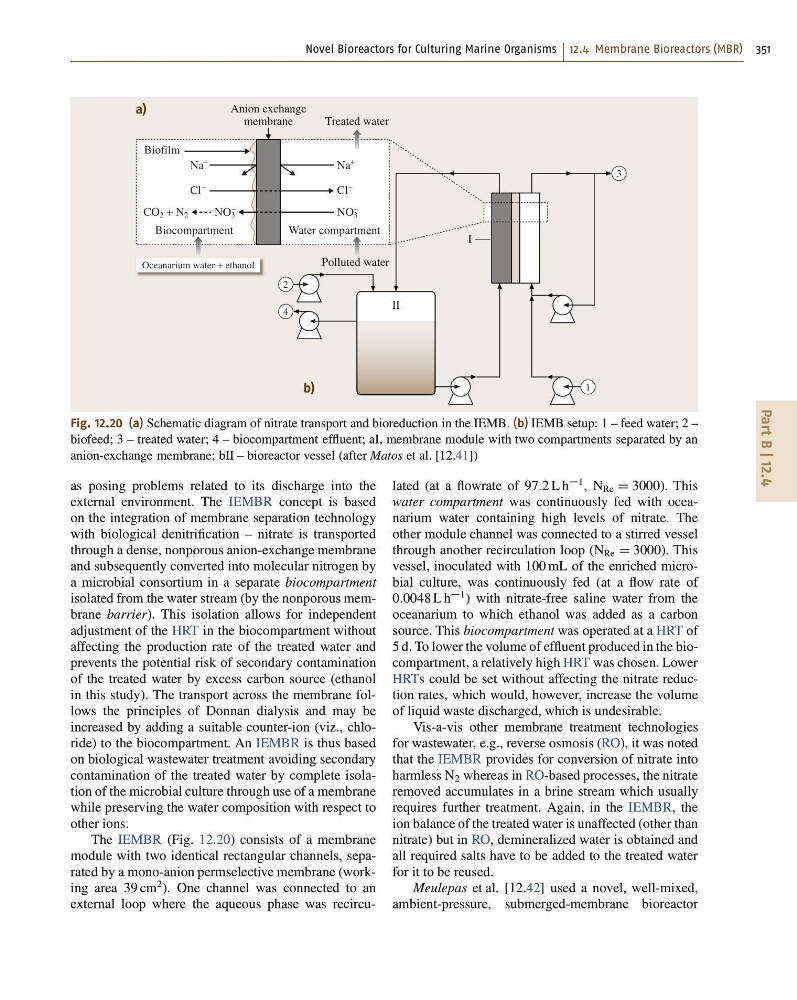
Fig. 12.20 (a) Schematic diagram of nitrate transport and bioreduction in the IEMB. (b) IEMB setup: 1 – feed water; 2 –
biofeed; 3 – treated water; 4 – biocompartment effluent; aI, membrane module with two compartments separated by an
anion-exchange membrane; bII – bioreactor vessel (after Matos et al. [12.41])
as posing problems related to its discharge into the
external environment. The IEMBR concept is based
on the integration of membrane separation technology
with biological denitrification – nitrate is transported
through a dense, nonporous anion-exchange membrane
and subsequently converted into molecular nitrogen by
a microbial consortium in a separate biocompartment
isolated from the water stream (by the nonporous membrane barrier). This isolation allows for independent
adjustment of the HRT in the biocompartment without
affecting the production rate of the treated water and
prevents the potential risk of secondary contamination
of the treated water by excess carbon source (ethanol
in this study). The transport across the membrane follows the principles of Donnan dialysis and may be
increased by adding a suitable counter-ion (viz., chloride) to the biocompartment. An IEMBR is thus based
on biological wastewater treatment avoiding secondary
contamination of the treated water by complete isolation of the microbial culture through use of a membrane
while preserving the water composition with respect to
other ions.
The IEMBR (Fig. 12.20) consists of a membrane
module with two identical rectangular channels, separated by a mono-anion permselective membrane (working area 39 cm
2 ). One channel was connected to an
external loop where the aqueous phase was recirculated (at a flowrate of 97:2 L h
1 , N Re D 3000). This
water compartment was continuously fed with oceanarium water containing high levels of nitrate. The
other module channel was connected to a stirred vessel
through another recirculation loop (N Re D 3000). This
vessel, inoculated with 100 mL of the enriched microbial culture, was continuously fed (at a flow rate of
0:0048 L h
1 ) with nitrate-free saline water from the
oceanarium to which ethanol was added as a carbon
source. This biocompartment was operated at a HRT of
5 d. To lower the volume of effluent produced in the biocompartment, a relatively high HRT was chosen. Lower
HRTs could be set without affecting the nitrate reduction rates, which would, however, increase the volume
of liquid waste discharged, which is undesirable.
Vis-a-vis other membrane treatment technologies
for wastewater, e.g., reverse osmosis (RO), it was noted
that the IEMBR provides for conversion of nitrate into
harmless N 2 whereas in RO-based processes, the nitrate
removed accumulates in a brine stream which usually
requires further treatment. Again, in the IEMBR, the
ion balance of the treated water is unaffected (other than
nitrate) but in RO, demineralized water is obtained and
all required salts have to be added to the treated water
for it to be reused.
Meulepas et al. [12.42] used a novel, well-mixed,
ambient-pressure, submerged-membrane bioreactor
Part B | 12.4
Anion exchange
membrane
CO 2 + N 2
NO 3
–
NO 3
–
Treated water
Na
+
Na
+
Biofilm
Cl
–
Cl
–
4
II
I
1
3
2
a)
b)
Biocompartment
Water compartment
Oceanarium water + ethanol
Polluted water
Fig. 12.20 (a) Schematic diagram of nitrate transport and bioreduction in the IEMB. (b) IEMB setup: 1 – feed water; 2 –
biofeed; 3 – treated water; 4 – biocompartment effluent; aI, membrane module with two compartments separated by an
anion-exchange membrane; bII – bioreactor vessel (after Matos et al. [12.41])
as posing problems related to its discharge into the
external environment. The IEMBR concept is based
on the integration of membrane separation technology
with biological denitrification – nitrate is transported
through a dense, nonporous anion-exchange membrane
and subsequently converted into molecular nitrogen by
a microbial consortium in a separate biocompartment
isolated from the water stream (by the nonporous membrane barrier). This isolation allows for independent
adjustment of the HRT in the biocompartment without
affecting the production rate of the treated water and
prevents the potential risk of secondary contamination
of the treated water by excess carbon source (ethanol
in this study). The transport across the membrane follows the principles of Donnan dialysis and may be
increased by adding a suitable counter-ion (viz., chloride) to the biocompartment. An IEMBR is thus based
on biological wastewater treatment avoiding secondary
contamination of the treated water by complete isolation of the microbial culture through use of a membrane
while preserving the water composition with respect to
other ions.
The IEMBR (Fig. 12.20) consists of a membrane
module with two identical rectangular channels, separated by a mono-anion permselective membrane (working area 39 cm
2 ). One channel was connected to an
external loop where the aqueous phase was recirculated (at a flowrate of 97:2 L h
1 , N Re D 3000). This
water compartment was continuously fed with oceanarium water containing high levels of nitrate. The
other module channel was connected to a stirred vessel
through another recirculation loop (N Re D 3000). This
vessel, inoculated with 100 mL of the enriched microbial culture, was continuously fed (at a flow rate of
0:0048 L h
1 ) with nitrate-free saline water from the
oceanarium to which ethanol was added as a carbon
source. This biocompartment was operated at a HRT of
5 d. To lower the volume of effluent produced in the biocompartment, a relatively high HRT was chosen. Lower
HRTs could be set without affecting the nitrate reduction rates, which would, however, increase the volume
of liquid waste discharged, which is undesirable.
Vis-a-vis other membrane treatment technologies
for wastewater, e.g., reverse osmosis (RO), it was noted
that the IEMBR provides for conversion of nitrate into
harmless N 2 whereas in RO-based processes, the nitrate
removed accumulates in a brine stream which usually
requires further treatment. Again, in the IEMBR, the
ion balance of the treated water is unaffected (other than
nitrate) but in RO, demineralized water is obtained and
all required salts have to be added to the treated water
for it to be reused.
Meulepas et al. [12.42] used a novel, well-mixed,
ambient-pressure, submerged-membrane bioreactor