

Part B | 12.4
350 Part B Tools and Methods in Marine Biotechnology
Table 12.5 Membrane bioreactors (MBR)
Sl Bioreactor
Marine strain and bioprocess
Reference
1 Anaerobic membrane biorector
(AnMBR)
Biomethanation of microalgae P. tricornutum
Zamalloa et al. [12.39]
2 AnMBR
Biohydrogen production by bacterial consortia
Oh et al. [12.40]
3 Ion-exchange MBR (IEMBR)
Nitrate removal from saline water by bacterial consortium
Matos et al. [12.41]
4 Submerged-MBR (sMBR)
Harvesting anaerobic methanotrophic archaea (ANME)
Meulepas et al. [12.42]
by means of a gas meter. Transmembrane pressure
(TMP) was measured with an analogical gauge installed between the membrane module and the permeate
pump.
Oh et al. [12.40] studied biohydrogen production
by bacterial consortia dominated by marine (viz.,
Clostridiaceae) and nonmarine (viz., Flexibacteraceae)
bacterial families in an anaerobic MBR (AnMBR) –
basically a cross-flow membrane coupled to a chemostat. According to the authors, this was the pioneering
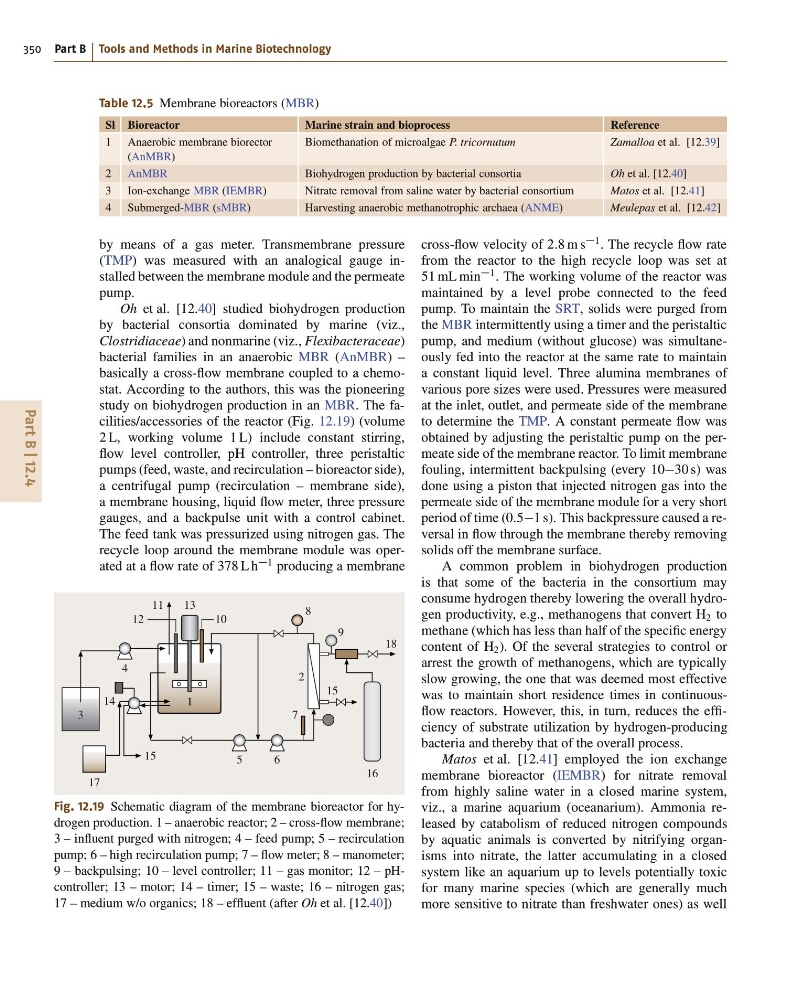
study on biohydrogen production in an MBR. The facilities/accessories of the reactor (Fig. 12.19) (volume
2 L, working volume 1 L) include constant stirring,
flow level controller, pH controller, three peristaltic
pumps (feed, waste, and recirculation – bioreactor side),
a centrifugal pump (recirculation – membrane side),
a membrane housing, liquid flow meter, three pressure
gauges, and a backpulse unit with a control cabinet.
The feed tank was pressurized using nitrogen gas. The
recycle loop around the membrane module was operated at a flow rate of 378 L h
1 producing a membrane
8
2
7
13
1
10
12
4
14
3
11
17
15
5
6
9
18
15
16
Fig. 12.19 Schematic diagram of the membrane bioreactor for hydrogen production. 1 – anaerobic reactor; 2 – cross-flow membrane;
3 – influent purged with nitrogen; 4 – feed pump; 5 – recirculation
pump; 6 – high recirculation pump; 7 – flow meter; 8 – manometer;
9 – backpulsing; 10 – level controller; 11 – gas monitor; 12 – pHcontroller; 13 – motor; 14 – timer; 15 – waste; 16 – nitrogen gas;
17 – medium w/o organics; 18 – effluent (after Oh et al. [12.40])
cross-flow velocity of 2:8 m s
1 . The recycle flow rate
from the reactor to the high recycle loop was set at
51 mL min
. The working volume of the reactor was
maintained by a level probe connected to the feed
pump. To maintain the SRT, solids were purged from
the MBR intermittently using a timer and the peristaltic
pump, and medium (without glucose) was simultaneously fed into the reactor at the same rate to maintain
a constant liquid level. Three alumina membranes of
various pore sizes were used. Pressures were measured
at the inlet, outlet, and permeate side of the membrane
to determine the TMP. A constant permeate flow was
obtained by adjusting the peristaltic pump on the permeate side of the membrane reactor. To limit membrane
fouling, intermittent backpulsing (every 1030 s) was
done using a piston that injected nitrogen gas into the
permeate side of the membrane module for a very short
period of time (0:51 s). This backpressure caused a reversal in flow through the membrane thereby removing
solids off the membrane surface.
A common problem in biohydrogen production
is that some of the bacteria in the consortium may
consume hydrogen thereby lowering the overall hydrogen productivity, e.g., methanogens that convert H 2 to
methane (which has less than half of the specific energy
content of H 2 ). Of the several strategies to control or
arrest the growth of methanogens, which are typically
slow growing, the one that was deemed most effective
was to maintain short residence times in continuousflow reactors. However, this, in turn, reduces the efficiency of substrate utilization by hydrogen-producing
bacteria and thereby that of the overall process.
Matos et al. [12.41] employed the ion exchange
membrane bioreactor (IEMBR) for nitrate removal
from highly saline water in a closed marine system,
viz., a marine aquarium (oceanarium). Ammonia released by catabolism of reduced nitrogen compounds
by aquatic animals is converted by nitrifying organisms into nitrate, the latter accumulating in a closed
system like an aquarium up to levels potentially toxic
for many marine species (which are generally much
more sensitive to nitrate than freshwater ones) as well
350 Part B Tools and Methods in Marine Biotechnology
Table 12.5 Membrane bioreactors (MBR)
Sl Bioreactor
Marine strain and bioprocess
Reference
1 Anaerobic membrane biorector
(AnMBR)
Biomethanation of microalgae P. tricornutum
Zamalloa et al. [12.39]
2 AnMBR
Biohydrogen production by bacterial consortia
Oh et al. [12.40]
3 Ion-exchange MBR (IEMBR)
Nitrate removal from saline water by bacterial consortium
Matos et al. [12.41]
4 Submerged-MBR (sMBR)
Harvesting anaerobic methanotrophic archaea (ANME)
Meulepas et al. [12.42]
by means of a gas meter. Transmembrane pressure
(TMP) was measured with an analogical gauge installed between the membrane module and the permeate
pump.
Oh et al. [12.40] studied biohydrogen production
by bacterial consortia dominated by marine (viz.,
Clostridiaceae) and nonmarine (viz., Flexibacteraceae)
bacterial families in an anaerobic MBR (AnMBR) –
basically a cross-flow membrane coupled to a chemostat. According to the authors, this was the pioneering
study on biohydrogen production in an MBR. The facilities/accessories of the reactor (Fig. 12.19) (volume
2 L, working volume 1 L) include constant stirring,
flow level controller, pH controller, three peristaltic
pumps (feed, waste, and recirculation – bioreactor side),
a centrifugal pump (recirculation – membrane side),
a membrane housing, liquid flow meter, three pressure
gauges, and a backpulse unit with a control cabinet.
The feed tank was pressurized using nitrogen gas. The
recycle loop around the membrane module was operated at a flow rate of 378 L h
1 producing a membrane
8
2
7
13
1
10
12
4
14
3
11
17
15
5
6
9
18
15
16
Fig. 12.19 Schematic diagram of the membrane bioreactor for hydrogen production. 1 – anaerobic reactor; 2 – cross-flow membrane;
3 – influent purged with nitrogen; 4 – feed pump; 5 – recirculation
pump; 6 – high recirculation pump; 7 – flow meter; 8 – manometer;
9 – backpulsing; 10 – level controller; 11 – gas monitor; 12 – pHcontroller; 13 – motor; 14 – timer; 15 – waste; 16 – nitrogen gas;
17 – medium w/o organics; 18 – effluent (after Oh et al. [12.40])
cross-flow velocity of 2:8 m s
1 . The recycle flow rate
from the reactor to the high recycle loop was set at
51 mL min
. The working volume of the reactor was
maintained by a level probe connected to the feed
pump. To maintain the SRT, solids were purged from
the MBR intermittently using a timer and the peristaltic
pump, and medium (without glucose) was simultaneously fed into the reactor at the same rate to maintain
a constant liquid level. Three alumina membranes of
various pore sizes were used. Pressures were measured
at the inlet, outlet, and permeate side of the membrane
to determine the TMP. A constant permeate flow was
obtained by adjusting the peristaltic pump on the permeate side of the membrane reactor. To limit membrane
fouling, intermittent backpulsing (every 1030 s) was
done using a piston that injected nitrogen gas into the
permeate side of the membrane module for a very short
period of time (0:51 s). This backpressure caused a reversal in flow through the membrane thereby removing
solids off the membrane surface.
A common problem in biohydrogen production
is that some of the bacteria in the consortium may
consume hydrogen thereby lowering the overall hydrogen productivity, e.g., methanogens that convert H 2 to
methane (which has less than half of the specific energy
content of H 2 ). Of the several strategies to control or
arrest the growth of methanogens, which are typically
slow growing, the one that was deemed most effective
was to maintain short residence times in continuousflow reactors. However, this, in turn, reduces the efficiency of substrate utilization by hydrogen-producing
bacteria and thereby that of the overall process.
Matos et al. [12.41] employed the ion exchange
membrane bioreactor (IEMBR) for nitrate removal
from highly saline water in a closed marine system,
viz., a marine aquarium (oceanarium). Ammonia released by catabolism of reduced nitrogen compounds
by aquatic animals is converted by nitrifying organisms into nitrate, the latter accumulating in a closed
system like an aquarium up to levels potentially toxic
for many marine species (which are generally much
more sensitive to nitrate than freshwater ones) as well