

Novel Bioreactors for Culturing Marine Organisms 12.5 Immobilized-Cell Bioreactors 353
Part B | 12.5
12.5 Immobilized-Cell Bioreactors
An immobilized cell may be defined as one that, by natural or artificial means is constrained in space such that
it cannot independently be in motion relative to cells
in its immediate vicinity. The common immobilization
techniques are covalent coupling, affinity immobilization, adsorption, confinement in liquid–liquid emulsion,
retention by semipermeable membranes and entrapment, of which the last named is the most frequently
adopted technique for all immobilization. In immobilization by entrapment, cells are confined in a threedimensional gel lattice made of either synthetic (e.g.,
acrylic, polyurethane, polyvinyl etc.) or natural polymer (e.g., collagen, agar, agarose, cellulose, alginate,
carrageenan etc.). Substrate/nutrients and products can
diffuse through the lattice to/from the cells. The microorganisms are entrapped onto the surfaces of the gel
beads or carrier particles which are normally crosslinked (to obtain a stable immobilization matrix) by
polymerization or by other means, e.g., carrageenan
droplets are typically cross-linked with K
C .
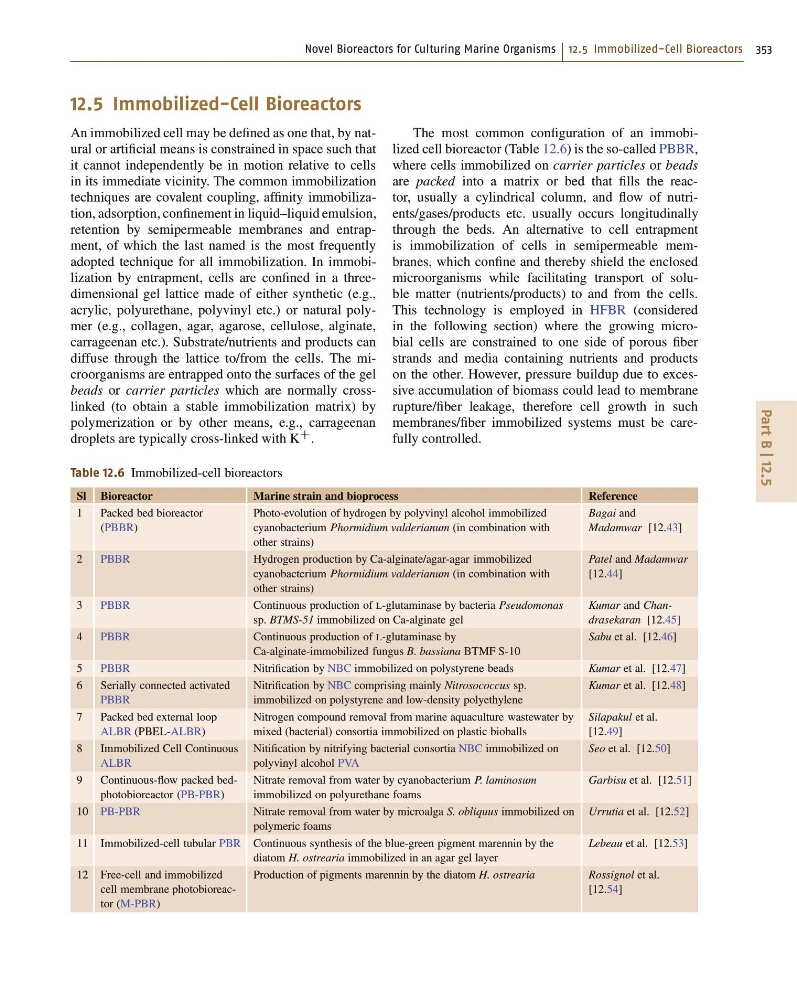
Table 12.6 Immobilized-cell bioreactors
Sl Bioreactor
Marine strain and bioprocess
Reference
1
Packed bed bioreactor
(PBBR)
Photo-evolution of hydrogen by polyvinyl alcohol immobilized
cyanobacterium Phormidium valderianum (in combination with
other strains)
Bagai and
Madamwar [12.43]
2
PBBR
Hydrogen production by Ca-alginate/agar-agar immobilized
cyanobacterium Phormidium valderianum (in combination with
other strains)
Patel and Madamwar
[12.44]
3
PBBR
Continuous production of L-glutaminase by bacteria Pseudomonas
sp. BTMS-51 immobilized on Ca-alginate gel
Kumar and Chandrasekaran [12.45]
4
PBBR
Continuous production of L-glutaminase by
Ca-alginate-immobilized fungus B. bassiana BTMF S-10
Sabu et al. [12.46]
5
PBBR
Nitrification by NBC immobilized on polystyrene beads
Kumar et al. [12.47]
6
Serially connected activated
PBBR
Nitrification by NBC comprising mainly Nitrosococcus sp.
immobilized on polystyrene and low-density polyethylene
Kumar et al. [12.48]
7
Packed bed external loop
ALBR (PBEL-ALBR)
Nitrogen compound removal from marine aquaculture wastewater by
mixed (bacterial) consortia immobilized on plastic bioballs
Silapakul et al.
[12.49]
8
Immobilized Cell Continuous
ALBR
Nitification by nitrifying bacterial consortia NBC immobilized on
polyvinyl alcohol PVA
Seo et al. [12.50]
9
Continuous-flow packed bedphotobioreactor (PB-PBR)
Nitrate removal from water by cyanobacterium P. laminosum
immobilized on polyurethane foams
Garbisu et al. [12.51]
10 PB-PBR
Nitrate removal from water by microalga S. obliquus immobilized on
polymeric foams
Urrutia et al. [12.52]
11 Immobilized-cell tubular PBR Continuous synthesis of the blue-green pigment marennin by the
diatom H. ostrearia immobilized in an agar gel layer
Lebeau et al. [12.53]
12 Free-cell and immobilized
cell membrane photobioreactor (M-PBR)
Production of pigments marennin by the diatom H. ostrearia
Rossignol et al.
[12.54]
The most common configuration of an immobilized cell bioreactor (Table 12.6) is the so-called PBBR,
where cells immobilized on carrier particles or beads
are packed into a matrix or bed that fills the reactor, usually a cylindrical column, and flow of nutrients/gases/products etc. usually occurs longitudinally
through the beds. An alternative to cell entrapment
is immobilization of cells in semipermeable membranes, which confine and thereby shield the enclosed
microorganisms while facilitating transport of soluble matter (nutrients/products) to and from the cells.
This technology is employed in HFBR (considered
in the following section) where the growing microbial cells are constrained to one side of porous fiber
strands and media containing nutrients and products
on the other. However, pressure buildup due to excessive accumulation of biomass could lead to membrane
rupture/fiber leakage, therefore cell growth in such
membranes/fiber immobilized systems must be carefully controlled.
Part B | 12.5
12.5 Immobilized-Cell Bioreactors
An immobilized cell may be defined as one that, by natural or artificial means is constrained in space such that
it cannot independently be in motion relative to cells
in its immediate vicinity. The common immobilization
techniques are covalent coupling, affinity immobilization, adsorption, confinement in liquid–liquid emulsion,
retention by semipermeable membranes and entrapment, of which the last named is the most frequently
adopted technique for all immobilization. In immobilization by entrapment, cells are confined in a threedimensional gel lattice made of either synthetic (e.g.,
acrylic, polyurethane, polyvinyl etc.) or natural polymer (e.g., collagen, agar, agarose, cellulose, alginate,
carrageenan etc.). Substrate/nutrients and products can
diffuse through the lattice to/from the cells. The microorganisms are entrapped onto the surfaces of the gel
beads or carrier particles which are normally crosslinked (to obtain a stable immobilization matrix) by
polymerization or by other means, e.g., carrageenan
droplets are typically cross-linked with K
C .
Table 12.6 Immobilized-cell bioreactors
Sl Bioreactor
Marine strain and bioprocess
Reference
1
Packed bed bioreactor
(PBBR)
Photo-evolution of hydrogen by polyvinyl alcohol immobilized
cyanobacterium Phormidium valderianum (in combination with
other strains)
Bagai and
Madamwar [12.43]
2
PBBR
Hydrogen production by Ca-alginate/agar-agar immobilized
cyanobacterium Phormidium valderianum (in combination with
other strains)
Patel and Madamwar
[12.44]
3
PBBR
Continuous production of L-glutaminase by bacteria Pseudomonas
sp. BTMS-51 immobilized on Ca-alginate gel
Kumar and Chandrasekaran [12.45]
4
PBBR
Continuous production of L-glutaminase by
Ca-alginate-immobilized fungus B. bassiana BTMF S-10
Sabu et al. [12.46]
5
PBBR
Nitrification by NBC immobilized on polystyrene beads
Kumar et al. [12.47]
6
Serially connected activated
PBBR
Nitrification by NBC comprising mainly Nitrosococcus sp.
immobilized on polystyrene and low-density polyethylene
Kumar et al. [12.48]
7
Packed bed external loop
ALBR (PBEL-ALBR)
Nitrogen compound removal from marine aquaculture wastewater by
mixed (bacterial) consortia immobilized on plastic bioballs
Silapakul et al.
[12.49]
8
Immobilized Cell Continuous
ALBR
Nitification by nitrifying bacterial consortia NBC immobilized on
polyvinyl alcohol PVA
Seo et al. [12.50]
9
Continuous-flow packed bedphotobioreactor (PB-PBR)
Nitrate removal from water by cyanobacterium P. laminosum
immobilized on polyurethane foams
Garbisu et al. [12.51]
10 PB-PBR
Nitrate removal from water by microalga S. obliquus immobilized on
polymeric foams
Urrutia et al. [12.52]
11 Immobilized-cell tubular PBR Continuous synthesis of the blue-green pigment marennin by the
diatom H. ostrearia immobilized in an agar gel layer
Lebeau et al. [12.53]
12 Free-cell and immobilized
cell membrane photobioreactor (M-PBR)
Production of pigments marennin by the diatom H. ostrearia
Rossignol et al.
[12.54]
The most common configuration of an immobilized cell bioreactor (Table 12.6) is the so-called PBBR,
where cells immobilized on carrier particles or beads
are packed into a matrix or bed that fills the reactor, usually a cylindrical column, and flow of nutrients/gases/products etc. usually occurs longitudinally
through the beds. An alternative to cell entrapment
is immobilization of cells in semipermeable membranes, which confine and thereby shield the enclosed
microorganisms while facilitating transport of soluble matter (nutrients/products) to and from the cells.
This technology is employed in HFBR (considered
in the following section) where the growing microbial cells are constrained to one side of porous fiber
strands and media containing nutrients and products
on the other. However, pressure buildup due to excessive accumulation of biomass could lead to membrane
rupture/fiber leakage, therefore cell growth in such
membranes/fiber immobilized systems must be carefully controlled.