

Novel Bioreactors for Culturing Marine Organisms 12.3 Airlift Bioreactors (ALBR) and Bubble Column Bioreactors (BCBR) 339
Part B | 12.3
(800 mm 100 mm 3 mm) and is fitted with a glass
condenser to arrest any outgoing moisture. Air is introduced through a chamber (length 100 mm) connecter
by a flange to the distributer. 28 holes (1 mm diameter)
were drilled (on a square pitch, 6 mm center-to-center)
on half of the S.S. sparger that works as a riser. A condenser (area 0:2 m
2 ) is included to arrest any outgoing
moisture.
Munoz et al. [12.25] employed an ALBR fitted with
a fiber optic spectrophotometer, for filamentous callus induction and microplantlet culture propagation of
the macroalga Kappaphycus alvarezii (Doty) which is
the largest source of Ä-carrageenan in the global phycocolloid industry. Now, ALBRs are usually preferred
for macroalgal cell cultivation because they facilitate
enhanced gas exchange and light transfer on the one
hand and reduced shear damage on the other. Mixing
in ALBRs is obtained by pneumatic and/or mechanical
agitation in order to maintain a uniform concentration
of chemical species in the bulk phase and enhance mass
transfer. Since proper mixing is crucial for adequate
distribution of cells and nutrients in the liquid phase,
a realistic estimation of liquid-phase mixing times is
necessary for effective ALBR design. For this purpose,
a fiber optic spectrophotometer is used for mixingtime evaluation which has several advantages over other
traditional methods viz. faster response without data
loss, minimal measurement error, operational flexibility through use of several solutions as tracers, faster in
situ measurements and reduced frictional resistance. It
is noted that liquid circulation is very sensitive to bioreactor geometry and, on this count, the ALBR described
here could provide adequate liquid circulation of the
culture media.
The ALBR (effective working volume 1:5 L) externally illuminated with fluorescent lamps, consisted
of an acrylic pipe (height 30 cm, I.D. 10 cm) and
a draught tube (height 22:5 cm, I.D. 3:8 cm), with inlet air pumped through a flow meter. A fiber optic
spectrophotometer was placed 5 cm below the water
surface, and a tracer of 1:0 ˙ 0:3 mL saturated aniline
blue aqueous solution was injected over the optical
fiber through a Pasteur pipette. Mixing time (defined
as the time required to attain a specified mixing intensity at a given scale), was measured from the time at
which maximum absorbance was recorded, to the time
of minimum absorbance, assuming a completely homogenized medium. It was concluded that filamentous
callus production from axenic K. alvarezii explants was
effectively promoted in the ALBR (with the tested plant
growth regulator).
Polzin and Rorrer [12.26] used a perfusion airlift
photobioreactor, i. e., with continuous liquid medium
perfusion, for synthesis of halogenated monoterpenes
by regenerated microplantlet suspension cultures of the
macrophytic marine red alga (seaweed) Ochtodes secundiramea, claimed as the first successful bioreactor
production of halogenated monoterpenes from a marine
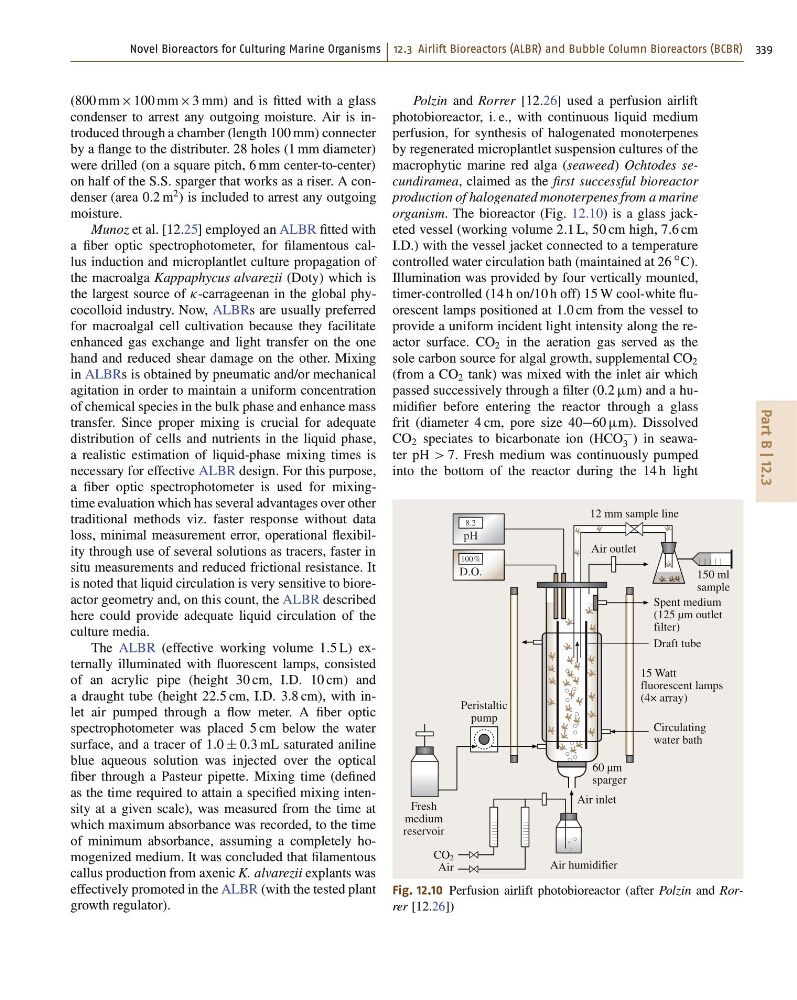
organism. The bioreactor (Fig. 12.10) is a glass jacketed vessel (working volume 2:1 L, 50 cm high, 7:6 cm
I.D.) with the vessel jacket connected to a temperature
controlled water circulation bath (maintained at 26
ı C).
Illumination was provided by four vertically mounted,
timer-controlled (14 h on/10 h off) 15 W cool-white fluorescent lamps positioned at 1:0 cm from the vessel to
provide a uniform incident light intensity along the reactor surface. CO 2 in the aeration gas served as the
sole carbon source for algal growth, supplemental CO 2
(from a CO 2 tank) was mixed with the inlet air which
passed successively through a filter (0:2 m) and a humidifier before entering the reactor through a glass
frit (diameter 4 cm, pore size 4060 m). Dissolved
CO 2 speciates to bicarbonate ion (HCO
3 ) in seawater pH > 7. Fresh medium was continuously pumped
into the bottom of the reactor during the 14 h light
150 ml
sample
60 µm
sparger
Air inlet
Draft tube
15 Watt
fluorescent lamps
(4× array)
Circulating
water bath
CO 2
Air
12 mm sample line
Air outlet
Spent medium
(125 µm outlet
filter)
Air humidifier
Fresh
medium
reservoir
Peristaltic
pump
pH
8.2
D.O.
100%
Fig. 12.10 Perfusion airlift photobioreactor (after Polzin and Rorrer [12.26])
Part B | 12.3
(800 mm 100 mm 3 mm) and is fitted with a glass
condenser to arrest any outgoing moisture. Air is introduced through a chamber (length 100 mm) connecter
by a flange to the distributer. 28 holes (1 mm diameter)
were drilled (on a square pitch, 6 mm center-to-center)
on half of the S.S. sparger that works as a riser. A condenser (area 0:2 m
2 ) is included to arrest any outgoing
moisture.
Munoz et al. [12.25] employed an ALBR fitted with
a fiber optic spectrophotometer, for filamentous callus induction and microplantlet culture propagation of
the macroalga Kappaphycus alvarezii (Doty) which is
the largest source of Ä-carrageenan in the global phycocolloid industry. Now, ALBRs are usually preferred
for macroalgal cell cultivation because they facilitate
enhanced gas exchange and light transfer on the one
hand and reduced shear damage on the other. Mixing
in ALBRs is obtained by pneumatic and/or mechanical
agitation in order to maintain a uniform concentration
of chemical species in the bulk phase and enhance mass
transfer. Since proper mixing is crucial for adequate
distribution of cells and nutrients in the liquid phase,
a realistic estimation of liquid-phase mixing times is
necessary for effective ALBR design. For this purpose,
a fiber optic spectrophotometer is used for mixingtime evaluation which has several advantages over other
traditional methods viz. faster response without data
loss, minimal measurement error, operational flexibility through use of several solutions as tracers, faster in
situ measurements and reduced frictional resistance. It
is noted that liquid circulation is very sensitive to bioreactor geometry and, on this count, the ALBR described
here could provide adequate liquid circulation of the
culture media.
The ALBR (effective working volume 1:5 L) externally illuminated with fluorescent lamps, consisted
of an acrylic pipe (height 30 cm, I.D. 10 cm) and
a draught tube (height 22:5 cm, I.D. 3:8 cm), with inlet air pumped through a flow meter. A fiber optic
spectrophotometer was placed 5 cm below the water
surface, and a tracer of 1:0 ˙ 0:3 mL saturated aniline
blue aqueous solution was injected over the optical
fiber through a Pasteur pipette. Mixing time (defined
as the time required to attain a specified mixing intensity at a given scale), was measured from the time at
which maximum absorbance was recorded, to the time
of minimum absorbance, assuming a completely homogenized medium. It was concluded that filamentous
callus production from axenic K. alvarezii explants was
effectively promoted in the ALBR (with the tested plant
growth regulator).
Polzin and Rorrer [12.26] used a perfusion airlift
photobioreactor, i. e., with continuous liquid medium
perfusion, for synthesis of halogenated monoterpenes
by regenerated microplantlet suspension cultures of the
macrophytic marine red alga (seaweed) Ochtodes secundiramea, claimed as the first successful bioreactor
production of halogenated monoterpenes from a marine
organism. The bioreactor (Fig. 12.10) is a glass jacketed vessel (working volume 2:1 L, 50 cm high, 7:6 cm
I.D.) with the vessel jacket connected to a temperature
controlled water circulation bath (maintained at 26
ı C).
Illumination was provided by four vertically mounted,
timer-controlled (14 h on/10 h off) 15 W cool-white fluorescent lamps positioned at 1:0 cm from the vessel to
provide a uniform incident light intensity along the reactor surface. CO 2 in the aeration gas served as the
sole carbon source for algal growth, supplemental CO 2
(from a CO 2 tank) was mixed with the inlet air which
passed successively through a filter (0:2 m) and a humidifier before entering the reactor through a glass
frit (diameter 4 cm, pore size 4060 m). Dissolved
CO 2 speciates to bicarbonate ion (HCO
3 ) in seawater pH > 7. Fresh medium was continuously pumped
into the bottom of the reactor during the 14 h light
150 ml
sample
60 µm
sparger
Air inlet
Draft tube
15 Watt
fluorescent lamps
(4× array)
Circulating
water bath
CO 2
Air
12 mm sample line
Air outlet
Spent medium
(125 µm outlet
filter)
Air humidifier
Fresh
medium
reservoir
Peristaltic
pump
pH
8.2
D.O.
100%
Fig. 12.10 Perfusion airlift photobioreactor (after Polzin and Rorrer [12.26])