

Part B | 12.3
338 Part B Tools and Methods in Marine Biotechnology
Table 12.4 ALBR and BCBR and/or other PBR – comparative studies
Sl Bioreactors Compared
Marine strain and bioprocess
Reference
1 ALBR, BCBR
NOx removal by green microalga D. tertiolecta
Nagase et al. [12.33]
2 AL-PBR, BC-PBR
Harvesting diatom S. costatum
Monkonsit et al. [12.34]
3 BC-PBR, AL-PBR
Cultivation of red macroalga Porphyridium sp.
Merchuk et al. [12.12]
4 BC-PBR, AL-PBR
Cultivation of diatom C. calcitrans
Krichnavaruk et al. [12.35]
5 BC-PBR, split cylinder
AL-PBR, draft tube
sparged AL-PBR
Harvesting microalga P. tricornutum
Sanchez-Miron et al. [12.36]
6 BC-PBR, AL-PBR,
AL-PBR C helical flow
promoter (HFP)
Cultivation of red microalga Porphyridium sp.
Merchuk et al. [12.37]
7 BC-PBR, AL-PBR, externally illuminated stirred
tank PBR, tubular recycle
PBR
Culture of red macroalga A. subulata
Rorrer and Chenny [12.38]
tous marine bacteria Thiothrix species in a limited
filamentous bulking (LFB) state – a repeatable and
controllable state that brings about a balance between
floc forming and filamentous bacteria. The ALBR with
a low height-to-diameter ratio (overall height 1000 mm)
consists of a reaction zone (I.D. 160 mm) and an upright settling zone (I.D. 220 mm). Two draft tubes, an
upper tube (height 160 mm, dia 130 mm) and a lower
tube (height 850 mm, dia 100 mm) were concentrically
placed in the ALBR. For sparging gas, 120 holes (dia
Culture
broth
Air compressor
Air filter
Regulator
Medium
Circulator
Out
Water in
Thermal sensor
Antifoam sensor
Exhaust gas
Feed
Out
Sparger
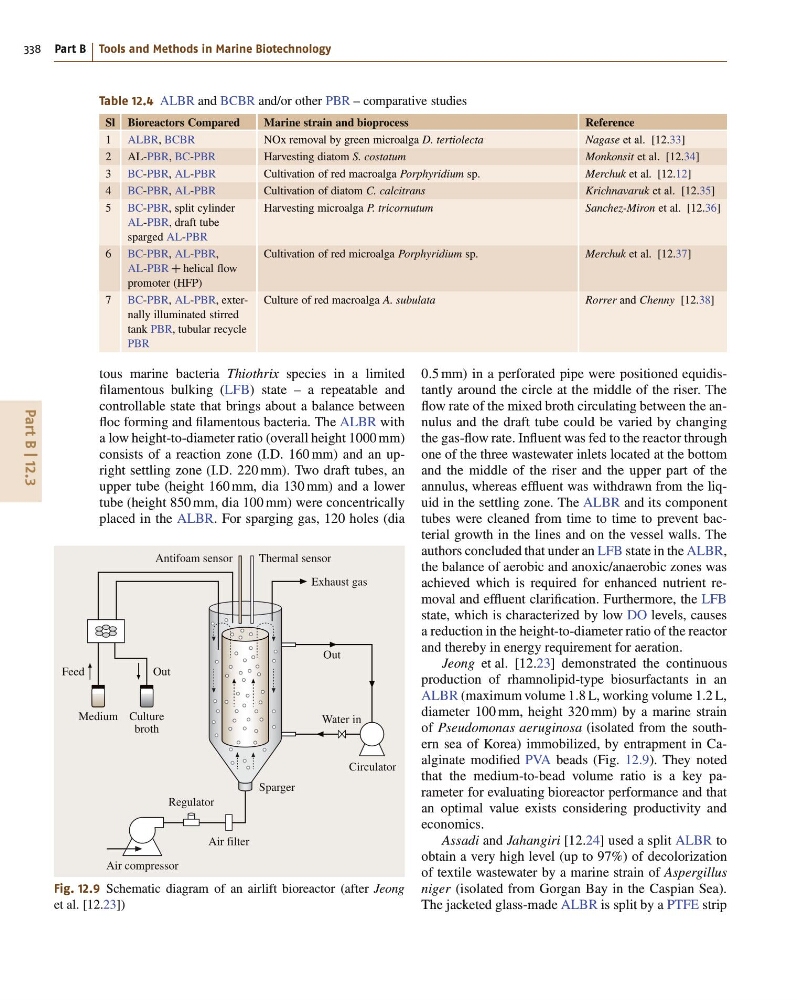
Fig. 12.9 Schematic diagram of an airlift bioreactor (after Jeong
et al. [12.23])
0:5 mm) in a perforated pipe were positioned equidistantly around the circle at the middle of the riser. The
flow rate of the mixed broth circulating between the annulus and the draft tube could be varied by changing
the gas-flow rate. Influent was fed to the reactor through
one of the three wastewater inlets located at the bottom
and the middle of the riser and the upper part of the
annulus, whereas effluent was withdrawn from the liquid in the settling zone. The ALBR and its component
tubes were cleaned from time to time to prevent bacterial growth in the lines and on the vessel walls. The
authors concluded that under an LFB state in the ALBR,
the balance of aerobic and anoxic/anaerobic zones was
achieved which is required for enhanced nutrient removal and effluent clarification. Furthermore, the LFB
state, which is characterized by low DO levels, causes
a reduction in the height-to-diameter ratio of the reactor
and thereby in energy requirement for aeration.
Jeong et al. [12.23] demonstrated the continuous
production of rhamnolipid-type biosurfactants in an
ALBR (maximum volume 1:8 L, working volume 1:2 L,
diameter 100 mm, height 320 mm) by a marine strain
of Pseudomonas aeruginosa (isolated from the southern sea of Korea) immobilized, by entrapment in Caalginate modified PVA beads (Fig. 12.9). They noted
that the medium-to-bead volume ratio is a key parameter for evaluating bioreactor performance and that
an optimal value exists considering productivity and
economics.
Assadi and Jahangiri [12.24] used a split ALBR to
obtain a very high level (up to 97%) of decolorization
of textile wastewater by a marine strain of Aspergillus
niger (isolated from Gorgan Bay in the Caspian Sea).
The jacketed glass-made ALBR is split by a PTFE strip
338 Part B Tools and Methods in Marine Biotechnology
Table 12.4 ALBR and BCBR and/or other PBR – comparative studies
Sl Bioreactors Compared
Marine strain and bioprocess
Reference
1 ALBR, BCBR
NOx removal by green microalga D. tertiolecta
Nagase et al. [12.33]
2 AL-PBR, BC-PBR
Harvesting diatom S. costatum
Monkonsit et al. [12.34]
3 BC-PBR, AL-PBR
Cultivation of red macroalga Porphyridium sp.
Merchuk et al. [12.12]
4 BC-PBR, AL-PBR
Cultivation of diatom C. calcitrans
Krichnavaruk et al. [12.35]
5 BC-PBR, split cylinder
AL-PBR, draft tube
sparged AL-PBR
Harvesting microalga P. tricornutum
Sanchez-Miron et al. [12.36]
6 BC-PBR, AL-PBR,
AL-PBR C helical flow
promoter (HFP)
Cultivation of red microalga Porphyridium sp.
Merchuk et al. [12.37]
7 BC-PBR, AL-PBR, externally illuminated stirred
tank PBR, tubular recycle
PBR
Culture of red macroalga A. subulata
Rorrer and Chenny [12.38]
tous marine bacteria Thiothrix species in a limited
filamentous bulking (LFB) state – a repeatable and
controllable state that brings about a balance between
floc forming and filamentous bacteria. The ALBR with
a low height-to-diameter ratio (overall height 1000 mm)
consists of a reaction zone (I.D. 160 mm) and an upright settling zone (I.D. 220 mm). Two draft tubes, an
upper tube (height 160 mm, dia 130 mm) and a lower
tube (height 850 mm, dia 100 mm) were concentrically
placed in the ALBR. For sparging gas, 120 holes (dia
Culture
broth
Air compressor
Air filter
Regulator
Medium
Circulator
Out
Water in
Thermal sensor
Antifoam sensor
Exhaust gas
Feed
Out
Sparger
Fig. 12.9 Schematic diagram of an airlift bioreactor (after Jeong
et al. [12.23])
0:5 mm) in a perforated pipe were positioned equidistantly around the circle at the middle of the riser. The
flow rate of the mixed broth circulating between the annulus and the draft tube could be varied by changing
the gas-flow rate. Influent was fed to the reactor through
one of the three wastewater inlets located at the bottom
and the middle of the riser and the upper part of the
annulus, whereas effluent was withdrawn from the liquid in the settling zone. The ALBR and its component
tubes were cleaned from time to time to prevent bacterial growth in the lines and on the vessel walls. The
authors concluded that under an LFB state in the ALBR,
the balance of aerobic and anoxic/anaerobic zones was
achieved which is required for enhanced nutrient removal and effluent clarification. Furthermore, the LFB
state, which is characterized by low DO levels, causes
a reduction in the height-to-diameter ratio of the reactor
and thereby in energy requirement for aeration.
Jeong et al. [12.23] demonstrated the continuous
production of rhamnolipid-type biosurfactants in an
ALBR (maximum volume 1:8 L, working volume 1:2 L,
diameter 100 mm, height 320 mm) by a marine strain
of Pseudomonas aeruginosa (isolated from the southern sea of Korea) immobilized, by entrapment in Caalginate modified PVA beads (Fig. 12.9). They noted
that the medium-to-bead volume ratio is a key parameter for evaluating bioreactor performance and that
an optimal value exists considering productivity and
economics.
Assadi and Jahangiri [12.24] used a split ALBR to
obtain a very high level (up to 97%) of decolorization
of textile wastewater by a marine strain of Aspergillus
niger (isolated from Gorgan Bay in the Caspian Sea).
The jacketed glass-made ALBR is split by a PTFE strip