

Novel Bioreactors for Culturing Marine Organisms 12.2 Photobioreactors (PBR)-Tubular, Plate/Panel and Stirred Tank Configurations 335
Part B | 12.2
Stirrer control
CO 2
Air or N 2
250
pH meter
8.5
Air out
To chilling
circulator
9 W Dulux
lamps
Sample
vial
Illumination stage
Fluorescent
light bank
(front view)
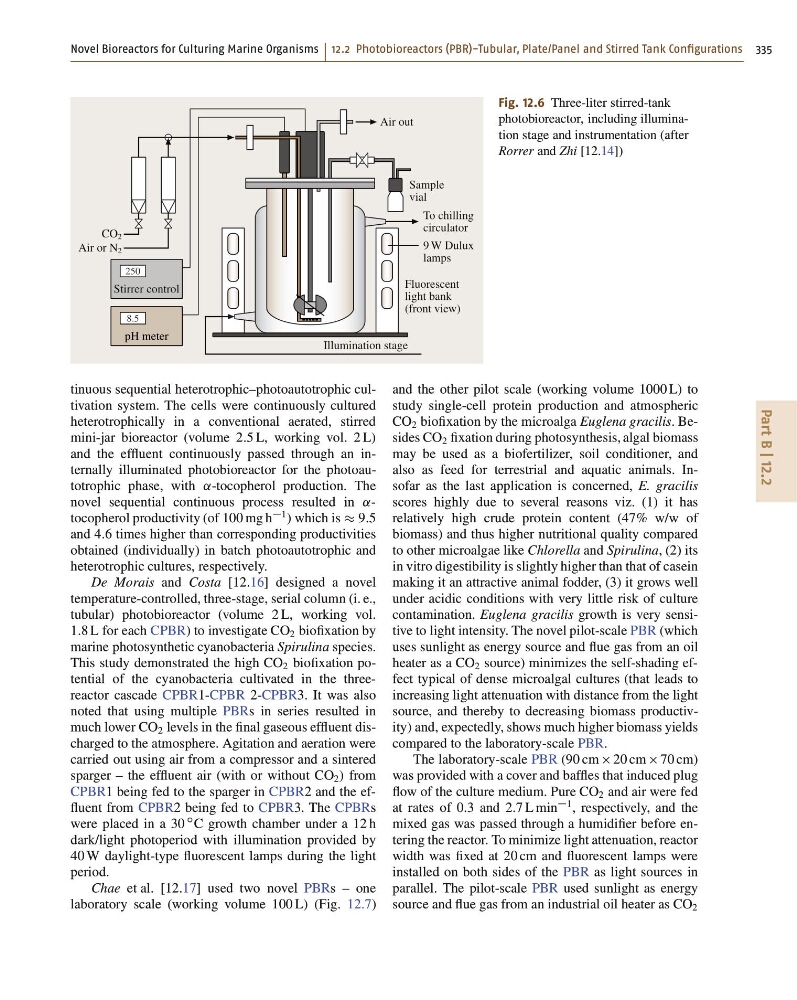
Fig. 12.6 Three-liter stirred-tank
photobioreactor, including illumination stage and instrumentation (after
Rorrer and Zhi [12.14])
tinuous sequential heterotrophic–photoautotrophic cultivation system. The cells were continuously cultured
heterotrophically in a conventional aerated, stirred
mini-jar bioreactor (volume 2:5 L, working vol. 2 L)
and the effluent continuously passed through an internally illuminated photobioreactor for the photoautotrophic phase, with ˛-tocopherol production. The
novel sequential continuous process resulted in ˛tocopherol productivity (of 100 mg h
1 ) which is 9:5
and 4:6 times higher than corresponding productivities
obtained (individually) in batch photoautotrophic and
heterotrophic cultures, respectively.
De Morais and Costa [12.16] designed a novel
temperature-controlled, three-stage, serial column (i. e.,
tubular) photobioreactor (volume 2 L, working vol.
1:8 L for each CPBR) to investigate CO 2 biofixation by
marine photosynthetic cyanobacteria Spirulina species.
This study demonstrated the high CO 2 biofixation potential of the cyanobacteria cultivated in the threereactor cascade CPBR1-CPBR 2-CPBR3. It was also
noted that using multiple PBRs in series resulted in
much lower CO 2 levels in the final gaseous effluent discharged to the atmosphere. Agitation and aeration were
carried out using air from a compressor and a sintered
sparger – the effluent air (with or without CO 2 ) from
CPBR1 being fed to the sparger in CPBR2 and the effluent from CPBR2 being fed to CPBR3. The CPBRs
were placed in a 30
ı C growth chamber under a 12 h
dark/light photoperiod with illumination provided by
40 W daylight-type fluorescent lamps during the light
period.
Chae et al. [12.17] used two novel PBRs – one
laboratory scale (working volume 100 L) (Fig. 12.7)
and the other pilot scale (working volume 1000 L) to
study single-cell protein production and atmospheric
CO 2 biofixation by the microalga Euglena gracilis. Besides CO 2 fixation during photosynthesis, algal biomass
may be used as a biofertilizer, soil conditioner, and
also as feed for terrestrial and aquatic animals. Insofar as the last application is concerned, E. gracilis
scores highly due to several reasons viz. (1) it has
relatively high crude protein content (47% w/w of
biomass) and thus higher nutritional quality compared
to other microalgae like Chlorella and Spirulina, (2) its
in vitro digestibility is slightly higher than that of casein
making it an attractive animal fodder, (3) it grows well
under acidic conditions with very little risk of culture
contamination. Euglena gracilis growth is very sensitive to light intensity. The novel pilot-scale PBR (which
uses sunlight as energy source and flue gas from an oil
heater as a CO 2 source) minimizes the self-shading effect typical of dense microalgal cultures (that leads to
increasing light attenuation with distance from the light
source, and thereby to decreasing biomass productivity) and, expectedly, shows much higher biomass yields
compared to the laboratory-scale PBR.
The laboratory-scale PBR (90 cm 20 cm 70 cm)
was provided with a cover and baffles that induced plug
flow of the culture medium. Pure CO 2 and air were fed
at rates of 0:3 and 2:7 L min
1 , respectively, and the
mixed gas was passed through a humidifier before entering the reactor. To minimize light attenuation, reactor
width was fixed at 20 cm and fluorescent lamps were
installed on both sides of the PBR as light sources in
parallel. The pilot-scale PBR used sunlight as energy
source and flue gas from an industrial oil heater as CO 2
Part B | 12.2
Stirrer control
CO 2
Air or N 2
250
pH meter
8.5
Air out
To chilling
circulator
9 W Dulux
lamps
Sample
vial
Illumination stage
Fluorescent
light bank
(front view)
Fig. 12.6 Three-liter stirred-tank
photobioreactor, including illumination stage and instrumentation (after
Rorrer and Zhi [12.14])
tinuous sequential heterotrophic–photoautotrophic cultivation system. The cells were continuously cultured
heterotrophically in a conventional aerated, stirred
mini-jar bioreactor (volume 2:5 L, working vol. 2 L)
and the effluent continuously passed through an internally illuminated photobioreactor for the photoautotrophic phase, with ˛-tocopherol production. The
novel sequential continuous process resulted in ˛tocopherol productivity (of 100 mg h
1 ) which is 9:5
and 4:6 times higher than corresponding productivities
obtained (individually) in batch photoautotrophic and
heterotrophic cultures, respectively.
De Morais and Costa [12.16] designed a novel
temperature-controlled, three-stage, serial column (i. e.,
tubular) photobioreactor (volume 2 L, working vol.
1:8 L for each CPBR) to investigate CO 2 biofixation by
marine photosynthetic cyanobacteria Spirulina species.
This study demonstrated the high CO 2 biofixation potential of the cyanobacteria cultivated in the threereactor cascade CPBR1-CPBR 2-CPBR3. It was also
noted that using multiple PBRs in series resulted in
much lower CO 2 levels in the final gaseous effluent discharged to the atmosphere. Agitation and aeration were
carried out using air from a compressor and a sintered
sparger – the effluent air (with or without CO 2 ) from
CPBR1 being fed to the sparger in CPBR2 and the effluent from CPBR2 being fed to CPBR3. The CPBRs
were placed in a 30
ı C growth chamber under a 12 h
dark/light photoperiod with illumination provided by
40 W daylight-type fluorescent lamps during the light
period.
Chae et al. [12.17] used two novel PBRs – one
laboratory scale (working volume 100 L) (Fig. 12.7)
and the other pilot scale (working volume 1000 L) to
study single-cell protein production and atmospheric
CO 2 biofixation by the microalga Euglena gracilis. Besides CO 2 fixation during photosynthesis, algal biomass
may be used as a biofertilizer, soil conditioner, and
also as feed for terrestrial and aquatic animals. Insofar as the last application is concerned, E. gracilis
scores highly due to several reasons viz. (1) it has
relatively high crude protein content (47% w/w of
biomass) and thus higher nutritional quality compared
to other microalgae like Chlorella and Spirulina, (2) its
in vitro digestibility is slightly higher than that of casein
making it an attractive animal fodder, (3) it grows well
under acidic conditions with very little risk of culture
contamination. Euglena gracilis growth is very sensitive to light intensity. The novel pilot-scale PBR (which
uses sunlight as energy source and flue gas from an oil
heater as a CO 2 source) minimizes the self-shading effect typical of dense microalgal cultures (that leads to
increasing light attenuation with distance from the light
source, and thereby to decreasing biomass productivity) and, expectedly, shows much higher biomass yields
compared to the laboratory-scale PBR.
The laboratory-scale PBR (90 cm 20 cm 70 cm)
was provided with a cover and baffles that induced plug
flow of the culture medium. Pure CO 2 and air were fed
at rates of 0:3 and 2:7 L min
1 , respectively, and the
mixed gas was passed through a humidifier before entering the reactor. To minimize light attenuation, reactor
width was fixed at 20 cm and fluorescent lamps were
installed on both sides of the PBR as light sources in
parallel. The pilot-scale PBR used sunlight as energy
source and flue gas from an industrial oil heater as CO 2