

Novel Bioreactors for Culturing Marine Organisms 12.1 Biofilm Reactors (BFR) 329
Part B | 12.1
Table 12.1 Biofilm reactors (BFR)
Sl Bioreactor
Marine strain and bioprocess
Reference
1 Modified roller bottle
cultivation (MRBC)
Antimicrobial compound production by bacterial strains Bacillus lichenformis EI-34-6 and B. subtilis II-111-5
Yan et al. [12.1]
2 Air-membrane surface
bioreactor (AMSBR)
Antimicrobial compound production by bacteria B. licheniformis EI-34-6
Yan et al. [12.2]
3 Ultralow speed rotating
disk bioreactor (ULS-RDBR)
Antimicrobial synthesis by three estuarine/intertidal actinobacteria MS 310,
MS 3/20, MS 1/7
Sarkar et al. [12.3]
4 ULS-RDBR
Actinomycin-D production by estuarine isolate Streptomyces sp. MS 310
Sarkar et al. [12.4]
5 ULS-RDBR
Antimicrobial synthesis by estuarine Streptomyces sp. MS 1/7
Sarkar et al. [12.5]
6 Extended surface shaken
vessel (ESSV)
Protease production by intertidal estuarine gamma proteobacterium (DG II) Sarkar et al. [12.6]
7 ESSV
Melanin synthesis by S. colwelliana and antibiotic production by P. rubra
(both bacteria)
Mitra et al. [12.7]
8 ESSV
Cellulase and xylanase production by two intertidal filamentous fungi,
C. crispatum and G. viride, respectively
Mitra et al. [12.8]
the possibility of either induction mechanisms other
than quorum-sensing regulating antibiotic production
by the attached cells or mere sensing of the physical
attachment by these cells triggering changes in gene
expression associated with antibiotic synthesis. The periodic exposure of the growing biofilm to the liquid
medium and to air mimics the marine ecological niche
of the biofilm-forming microbes on intertidal seaweed,
hence the term niche-mimic bioreactor for the modified
roller bottle cultures.
Yan et al. [12.2], designed a novel bioreactor – the
air membrane surface (AMS) bioreactor, that allows the
growth of bacteria as biofilms attached/anchored to the
surface of a semipermeable membrane disk in contact
with air, to investigate the production of antimicrobial
compounds by the marine bacterium B. licheniformis,
strain EI-34-6 (used earlier by Yan et al. [12.1]) isolated from the surface of a marine seaweed P. palmata.
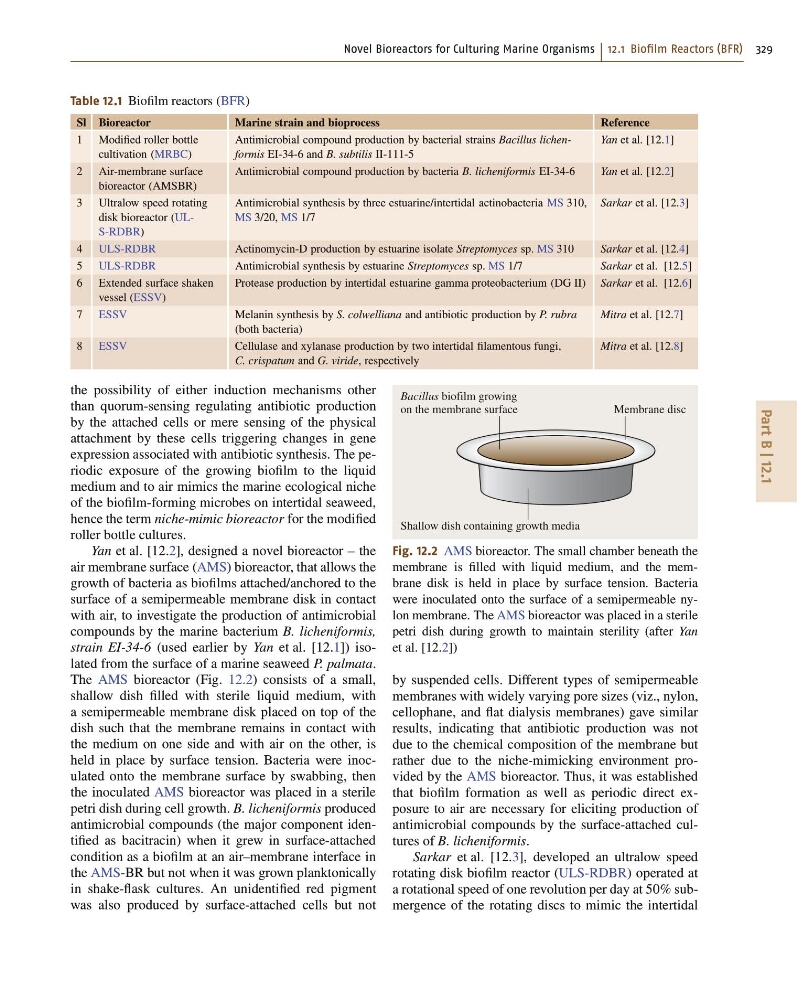
The AMS bioreactor (Fig. 12.2) consists of a small,
shallow dish filled with sterile liquid medium, with
a semipermeable membrane disk placed on top of the
dish such that the membrane remains in contact with
the medium on one side and with air on the other, is
held in place by surface tension. Bacteria were inoculated onto the membrane surface by swabbing, then
the inoculated AMS bioreactor was placed in a sterile
petri dish during cell growth. B. licheniformis produced
antimicrobial compounds (the major component identified as bacitracin) when it grew in surface-attached
condition as a biofilm at an air–membrane interface in
the AMS-BR but not when it was grown planktonically
in shake-flask cultures. An unidentified red pigment
was also produced by surface-attached cells but not
Bacillus biofilm growing
on the membrane surface
Shallow dish containing growth media
Membrane disc
Fig. 12.2 AMS bioreactor. The small chamber beneath the
membrane is filled with liquid medium, and the membrane disk is held in place by surface tension. Bacteria
were inoculated onto the surface of a semipermeable nylon membrane. The AMS bioreactor was placed in a sterile
petri dish during growth to maintain sterility (after Yan
et al. [12.2])
by suspended cells. Different types of semipermeable
membranes with widely varying pore sizes (viz., nylon,
cellophane, and flat dialysis membranes) gave similar
results, indicating that antibiotic production was not
due to the chemical composition of the membrane but
rather due to the niche-mimicking environment provided by the AMS bioreactor. Thus, it was established
that biofilm formation as well as periodic direct exposure to air are necessary for eliciting production of
antimicrobial compounds by the surface-attached cultures of B. licheniformis.
Sarkar et al. [12.3], developed an ultralow speed
rotating disk biofilm reactor (ULS-RDBR) operated at
a rotational speed of one revolution per day at 50% submergence of the rotating discs to mimic the intertidal
Part B | 12.1
Table 12.1 Biofilm reactors (BFR)
Sl Bioreactor
Marine strain and bioprocess
Reference
1 Modified roller bottle
cultivation (MRBC)
Antimicrobial compound production by bacterial strains Bacillus lichenformis EI-34-6 and B. subtilis II-111-5
Yan et al. [12.1]
2 Air-membrane surface
bioreactor (AMSBR)
Antimicrobial compound production by bacteria B. licheniformis EI-34-6
Yan et al. [12.2]
3 Ultralow speed rotating
disk bioreactor (ULS-RDBR)
Antimicrobial synthesis by three estuarine/intertidal actinobacteria MS 310,
MS 3/20, MS 1/7
Sarkar et al. [12.3]
4 ULS-RDBR
Actinomycin-D production by estuarine isolate Streptomyces sp. MS 310
Sarkar et al. [12.4]
5 ULS-RDBR
Antimicrobial synthesis by estuarine Streptomyces sp. MS 1/7
Sarkar et al. [12.5]
6 Extended surface shaken
vessel (ESSV)
Protease production by intertidal estuarine gamma proteobacterium (DG II) Sarkar et al. [12.6]
7 ESSV
Melanin synthesis by S. colwelliana and antibiotic production by P. rubra
(both bacteria)
Mitra et al. [12.7]
8 ESSV
Cellulase and xylanase production by two intertidal filamentous fungi,
C. crispatum and G. viride, respectively
Mitra et al. [12.8]
the possibility of either induction mechanisms other
than quorum-sensing regulating antibiotic production
by the attached cells or mere sensing of the physical
attachment by these cells triggering changes in gene
expression associated with antibiotic synthesis. The periodic exposure of the growing biofilm to the liquid
medium and to air mimics the marine ecological niche
of the biofilm-forming microbes on intertidal seaweed,
hence the term niche-mimic bioreactor for the modified
roller bottle cultures.
Yan et al. [12.2], designed a novel bioreactor – the
air membrane surface (AMS) bioreactor, that allows the
growth of bacteria as biofilms attached/anchored to the
surface of a semipermeable membrane disk in contact
with air, to investigate the production of antimicrobial
compounds by the marine bacterium B. licheniformis,
strain EI-34-6 (used earlier by Yan et al. [12.1]) isolated from the surface of a marine seaweed P. palmata.
The AMS bioreactor (Fig. 12.2) consists of a small,
shallow dish filled with sterile liquid medium, with
a semipermeable membrane disk placed on top of the
dish such that the membrane remains in contact with
the medium on one side and with air on the other, is
held in place by surface tension. Bacteria were inoculated onto the membrane surface by swabbing, then
the inoculated AMS bioreactor was placed in a sterile
petri dish during cell growth. B. licheniformis produced
antimicrobial compounds (the major component identified as bacitracin) when it grew in surface-attached
condition as a biofilm at an air–membrane interface in
the AMS-BR but not when it was grown planktonically
in shake-flask cultures. An unidentified red pigment
was also produced by surface-attached cells but not
Bacillus biofilm growing
on the membrane surface
Shallow dish containing growth media
Membrane disc
Fig. 12.2 AMS bioreactor. The small chamber beneath the
membrane is filled with liquid medium, and the membrane disk is held in place by surface tension. Bacteria
were inoculated onto the surface of a semipermeable nylon membrane. The AMS bioreactor was placed in a sterile
petri dish during growth to maintain sterility (after Yan
et al. [12.2])
by suspended cells. Different types of semipermeable
membranes with widely varying pore sizes (viz., nylon,
cellophane, and flat dialysis membranes) gave similar
results, indicating that antibiotic production was not
due to the chemical composition of the membrane but
rather due to the niche-mimicking environment provided by the AMS bioreactor. Thus, it was established
that biofilm formation as well as periodic direct exposure to air are necessary for eliciting production of
antimicrobial compounds by the surface-attached cultures of B. licheniformis.
Sarkar et al. [12.3], developed an ultralow speed
rotating disk biofilm reactor (ULS-RDBR) operated at
a rotational speed of one revolution per day at 50% submergence of the rotating discs to mimic the intertidal