

Part B | 12.1
328 Part B Tools and Methods in Marine Biotechnology
of microbial processes. Surface attachment and biofilm
formation possibly also induce metabolic changes resulting in the production of different metabolites under
attached growth conditions. Furthermore, many bacteria, including Bacillus species, are known to produce
signal molecules that are used by the cells to monitor cell density, a phenomenon termed quorum sensing,
which also controls cell metabolism. Cells in biofilms
usually grow at much higher cell densities (up to 10 000
times higher) than in liquid suspension cultures, and
quorum-sensing mechanisms could affect the production of secondary metabolites by these biofilm cells.
Biofilm Reactors essentially promote surface-attched
growth of biofilms (Table 12.1).
Yan et al. [12.1] examined the possibility whether
allowing biofilm forming bacteria to grow under conditions that mimicked their marine ecological niche could
elicit the production of antimicrobial compounds that
they do not synthesize in the planktonic state, using
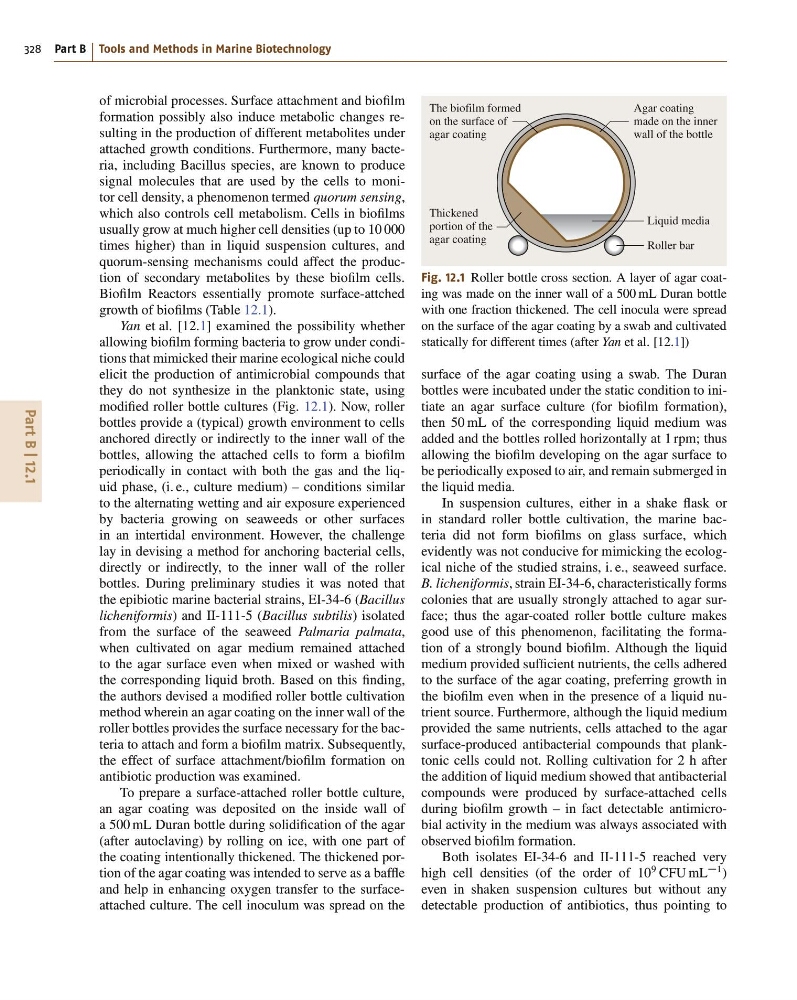
modified roller bottle cultures (Fig. 12.1). Now, roller
bottles provide a (typical) growth environment to cells
anchored directly or indirectly to the inner wall of the
bottles, allowing the attached cells to form a biofilm
periodically in contact with both the gas and the liquid phase, (i. e., culture medium) – conditions similar
to the alternating wetting and air exposure experienced
by bacteria growing on seaweeds or other surfaces
in an intertidal environment. However, the challenge
lay in devising a method for anchoring bacterial cells,
directly or indirectly, to the inner wall of the roller
bottles. During preliminary studies it was noted that
the epibiotic marine bacterial strains, EI-34-6 (Bacillus
licheniformis) and II-111-5 (Bacillus subtilis) isolated
from the surface of the seaweed Palmaria palmata,
when cultivated on agar medium remained attached
to the agar surface even when mixed or washed with
the corresponding liquid broth. Based on this finding,
the authors devised a modified roller bottle cultivation
method wherein an agar coating on the inner wall of the
roller bottles provides the surface necessary for the bacteria to attach and form a biofilm matrix. Subsequently,
the effect of surface attachment/biofilm formation on
antibiotic production was examined.
To prepare a surface-attached roller bottle culture,
an agar coating was deposited on the inside wall of
a 500 mL Duran bottle during solidification of the agar
(after autoclaving) by rolling on ice, with one part of
the coating intentionally thickened. The thickened portion of the agar coating was intended to serve as a baffle
and help in enhancing oxygen transfer to the surfaceattached culture. The cell inoculum was spread on the
The biofilm formed
on the surface of
agar coating
Thickened
portion of the
agar coating
Agar coating
made on the inner
wall of the bottle
Liquid media
Roller bar
Fig. 12.1 Roller bottle cross section. A layer of agar coating was made on the inner wall of a 500 mL Duran bottle
with one fraction thickened. The cell inocula were spread
on the surface of the agar coating by a swab and cultivated
statically for different times (after Yan et al. [12.1])
surface of the agar coating using a swab. The Duran
bottles were incubated under the static condition to initiate an agar surface culture (for biofilm formation),
then 50 mL of the corresponding liquid medium was
added and the bottles rolled horizontally at 1 rpm; thus
allowing the biofilm developing on the agar surface to
be periodically exposed to air, and remain submerged in
the liquid media.
In suspension cultures, either in a shake flask or
in standard roller bottle cultivation, the marine bacteria did not form biofilms on glass surface, which
evidently was not conducive for mimicking the ecological niche of the studied strains, i. e., seaweed surface.
B. licheniformis, strain EI-34-6, characteristically forms
colonies that are usually strongly attached to agar surface; thus the agar-coated roller bottle culture makes
good use of this phenomenon, facilitating the formation of a strongly bound biofilm. Although the liquid
medium provided sufficient nutrients, the cells adhered
to the surface of the agar coating, preferring growth in
the biofilm even when in the presence of a liquid nutrient source. Furthermore, although the liquid medium
provided the same nutrients, cells attached to the agar
surface-produced antibacterial compounds that planktonic cells could not. Rolling cultivation for 2 h after
the addition of liquid medium showed that antibacterial
compounds were produced by surface-attached cells
during biofilm growth – in fact detectable antimicrobial activity in the medium was always associated with
observed biofilm formation.
Both isolates EI-34-6 and II-111-5 reached very
high cell densities (of the order of 10
9 CFU mL
1 )
even in shaken suspension cultures but without any
detectable production of antibiotics, thus pointing to
328 Part B Tools and Methods in Marine Biotechnology
of microbial processes. Surface attachment and biofilm
formation possibly also induce metabolic changes resulting in the production of different metabolites under
attached growth conditions. Furthermore, many bacteria, including Bacillus species, are known to produce
signal molecules that are used by the cells to monitor cell density, a phenomenon termed quorum sensing,
which also controls cell metabolism. Cells in biofilms
usually grow at much higher cell densities (up to 10 000
times higher) than in liquid suspension cultures, and
quorum-sensing mechanisms could affect the production of secondary metabolites by these biofilm cells.
Biofilm Reactors essentially promote surface-attched
growth of biofilms (Table 12.1).
Yan et al. [12.1] examined the possibility whether
allowing biofilm forming bacteria to grow under conditions that mimicked their marine ecological niche could
elicit the production of antimicrobial compounds that
they do not synthesize in the planktonic state, using
modified roller bottle cultures (Fig. 12.1). Now, roller
bottles provide a (typical) growth environment to cells
anchored directly or indirectly to the inner wall of the
bottles, allowing the attached cells to form a biofilm
periodically in contact with both the gas and the liquid phase, (i. e., culture medium) – conditions similar
to the alternating wetting and air exposure experienced
by bacteria growing on seaweeds or other surfaces
in an intertidal environment. However, the challenge
lay in devising a method for anchoring bacterial cells,
directly or indirectly, to the inner wall of the roller
bottles. During preliminary studies it was noted that
the epibiotic marine bacterial strains, EI-34-6 (Bacillus
licheniformis) and II-111-5 (Bacillus subtilis) isolated
from the surface of the seaweed Palmaria palmata,
when cultivated on agar medium remained attached
to the agar surface even when mixed or washed with
the corresponding liquid broth. Based on this finding,
the authors devised a modified roller bottle cultivation
method wherein an agar coating on the inner wall of the
roller bottles provides the surface necessary for the bacteria to attach and form a biofilm matrix. Subsequently,
the effect of surface attachment/biofilm formation on
antibiotic production was examined.
To prepare a surface-attached roller bottle culture,
an agar coating was deposited on the inside wall of
a 500 mL Duran bottle during solidification of the agar
(after autoclaving) by rolling on ice, with one part of
the coating intentionally thickened. The thickened portion of the agar coating was intended to serve as a baffle
and help in enhancing oxygen transfer to the surfaceattached culture. The cell inoculum was spread on the
The biofilm formed
on the surface of
agar coating
Thickened
portion of the
agar coating
Agar coating
made on the inner
wall of the bottle
Liquid media
Roller bar
Fig. 12.1 Roller bottle cross section. A layer of agar coating was made on the inner wall of a 500 mL Duran bottle
with one fraction thickened. The cell inocula were spread
on the surface of the agar coating by a swab and cultivated
statically for different times (after Yan et al. [12.1])
surface of the agar coating using a swab. The Duran
bottles were incubated under the static condition to initiate an agar surface culture (for biofilm formation),
then 50 mL of the corresponding liquid medium was
added and the bottles rolled horizontally at 1 rpm; thus
allowing the biofilm developing on the agar surface to
be periodically exposed to air, and remain submerged in
the liquid media.
In suspension cultures, either in a shake flask or
in standard roller bottle cultivation, the marine bacteria did not form biofilms on glass surface, which
evidently was not conducive for mimicking the ecological niche of the studied strains, i. e., seaweed surface.
B. licheniformis, strain EI-34-6, characteristically forms
colonies that are usually strongly attached to agar surface; thus the agar-coated roller bottle culture makes
good use of this phenomenon, facilitating the formation of a strongly bound biofilm. Although the liquid
medium provided sufficient nutrients, the cells adhered
to the surface of the agar coating, preferring growth in
the biofilm even when in the presence of a liquid nutrient source. Furthermore, although the liquid medium
provided the same nutrients, cells attached to the agar
surface-produced antibacterial compounds that planktonic cells could not. Rolling cultivation for 2 h after
the addition of liquid medium showed that antibacterial
compounds were produced by surface-attached cells
during biofilm growth – in fact detectable antimicrobial activity in the medium was always associated with
observed biofilm formation.
Both isolates EI-34-6 and II-111-5 reached very
high cell densities (of the order of 10
9 CFU mL
1 )
even in shaken suspension cultures but without any
detectable production of antibiotics, thus pointing to