

Part B | 9.3
272 Part B Tools and Methods in Marine Biotechnology
Sparger
Transparent
vessel
Air in
Illumination
source
Air out
a)
b)
Sparger
Draft tube
Air in
Illumination
source
Air out
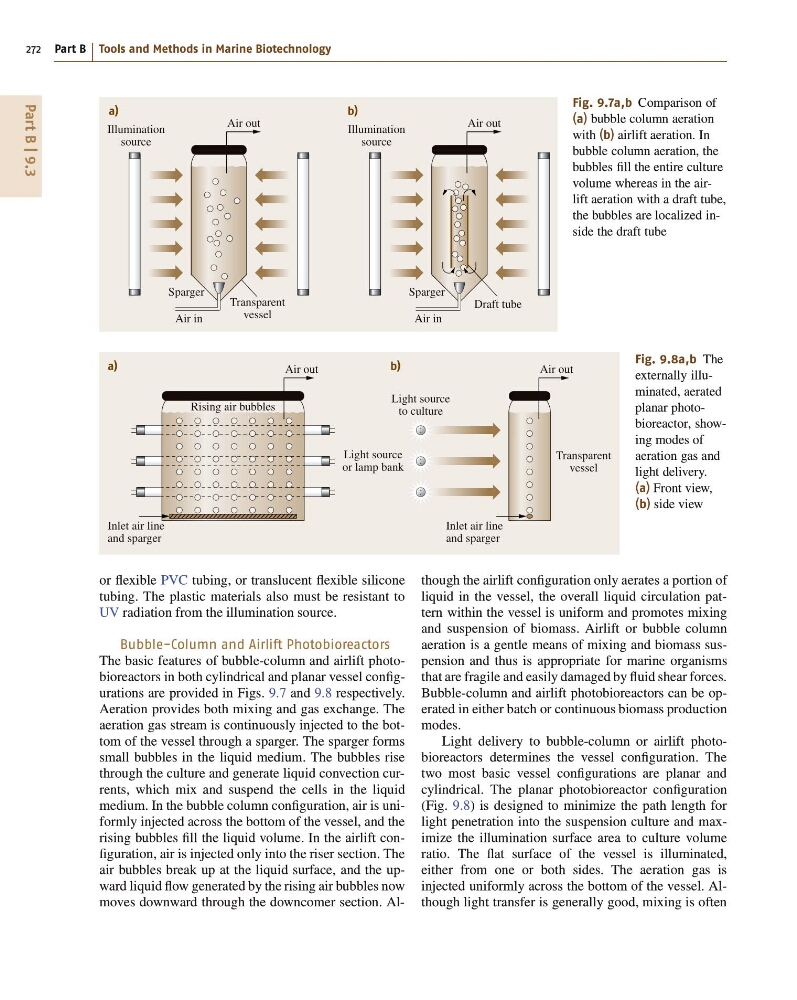
Fig. 9.7a,b Comparison of
(a) bubble column aeration
with (b) airlift aeration. In
bubble column aeration, the
bubbles fill the entire culture
volume whereas in the airlift aeration with a draft tube,
the bubbles are localized inside the draft tube
Inlet air line
and sparger
Inlet air line
and sparger
Rising air bubbles
Light source
or lamp bank
Transparent
vessel
Light source
to culture
Air out
Air out
b)
a)
Fig. 9.8a,b The
externally illuminated, aerated
planar photobioreactor, showing modes of
aeration gas and
light delivery.
(a) Front view,
(b) side view
or flexible PVC tubing, or translucent flexible silicone
tubing. The plastic materials also must be resistant to
UV radiation from the illumination source.
Bubble-Column and Airlift Photobioreactors
The basic features of bubble-column and airlift photobioreactors in both cylindrical and planar vessel configurations are provided in Figs. 9.7 and 9.8 respectively.
Aeration provides both mixing and gas exchange. The
aeration gas stream is continuously injected to the bottom of the vessel through a sparger. The sparger forms
small bubbles in the liquid medium. The bubbles rise
through the culture and generate liquid convection currents, which mix and suspend the cells in the liquid
medium. In the bubble column configuration, air is uniformly injected across the bottom of the vessel, and the
rising bubbles fill the liquid volume. In the airlift configuration, air is injected only into the riser section. The
air bubbles break up at the liquid surface, and the upward liquid flow generated by the rising air bubbles now
moves downward through the downcomer section. Although the airlift configuration only aerates a portion of
liquid in the vessel, the overall liquid circulation pattern within the vessel is uniform and promotes mixing
and suspension of biomass. Airlift or bubble column
aeration is a gentle means of mixing and biomass suspension and thus is appropriate for marine organisms
that are fragile and easily damaged by fluid shear forces.
Bubble-column and airlift photobioreactors can be operated in either batch or continuous biomass production
modes.
Light delivery to bubble-column or airlift photobioreactors determines the vessel configuration. The
two most basic vessel configurations are planar and
cylindrical. The planar photobioreactor configuration
(Fig. 9.8) is designed to minimize the path length for
light penetration into the suspension culture and maximize the illumination surface area to culture volume
ratio. The flat surface of the vessel is illuminated,
either from one or both sides. The aeration gas is
injected uniformly across the bottom of the vessel. Although light transfer is generally good, mixing is often
272 Part B Tools and Methods in Marine Biotechnology
Sparger
Transparent
vessel
Air in
Illumination
source
Air out
a)
b)
Sparger
Draft tube
Air in
Illumination
source
Air out
Fig. 9.7a,b Comparison of
(a) bubble column aeration
with (b) airlift aeration. In
bubble column aeration, the
bubbles fill the entire culture
volume whereas in the airlift aeration with a draft tube,
the bubbles are localized inside the draft tube
Inlet air line
and sparger
Inlet air line
and sparger
Rising air bubbles
Light source
or lamp bank
Transparent
vessel
Light source
to culture
Air out
Air out
b)
a)
Fig. 9.8a,b The
externally illuminated, aerated
planar photobioreactor, showing modes of
aeration gas and
light delivery.
(a) Front view,
(b) side view
or flexible PVC tubing, or translucent flexible silicone
tubing. The plastic materials also must be resistant to
UV radiation from the illumination source.
Bubble-Column and Airlift Photobioreactors
The basic features of bubble-column and airlift photobioreactors in both cylindrical and planar vessel configurations are provided in Figs. 9.7 and 9.8 respectively.
Aeration provides both mixing and gas exchange. The
aeration gas stream is continuously injected to the bottom of the vessel through a sparger. The sparger forms
small bubbles in the liquid medium. The bubbles rise
through the culture and generate liquid convection currents, which mix and suspend the cells in the liquid
medium. In the bubble column configuration, air is uniformly injected across the bottom of the vessel, and the
rising bubbles fill the liquid volume. In the airlift configuration, air is injected only into the riser section. The
air bubbles break up at the liquid surface, and the upward liquid flow generated by the rising air bubbles now
moves downward through the downcomer section. Although the airlift configuration only aerates a portion of
liquid in the vessel, the overall liquid circulation pattern within the vessel is uniform and promotes mixing
and suspension of biomass. Airlift or bubble column
aeration is a gentle means of mixing and biomass suspension and thus is appropriate for marine organisms
that are fragile and easily damaged by fluid shear forces.
Bubble-column and airlift photobioreactors can be operated in either batch or continuous biomass production
modes.
Light delivery to bubble-column or airlift photobioreactors determines the vessel configuration. The
two most basic vessel configurations are planar and
cylindrical. The planar photobioreactor configuration
(Fig. 9.8) is designed to minimize the path length for
light penetration into the suspension culture and maximize the illumination surface area to culture volume
ratio. The flat surface of the vessel is illuminated,
either from one or both sides. The aeration gas is
injected uniformly across the bottom of the vessel. Although light transfer is generally good, mixing is often