

Bioprocess Engineering of Phototrophic Marine Organisms 9.3 Basic Elements of Photobioreactor Design and Operation 271
Part B | 9.3
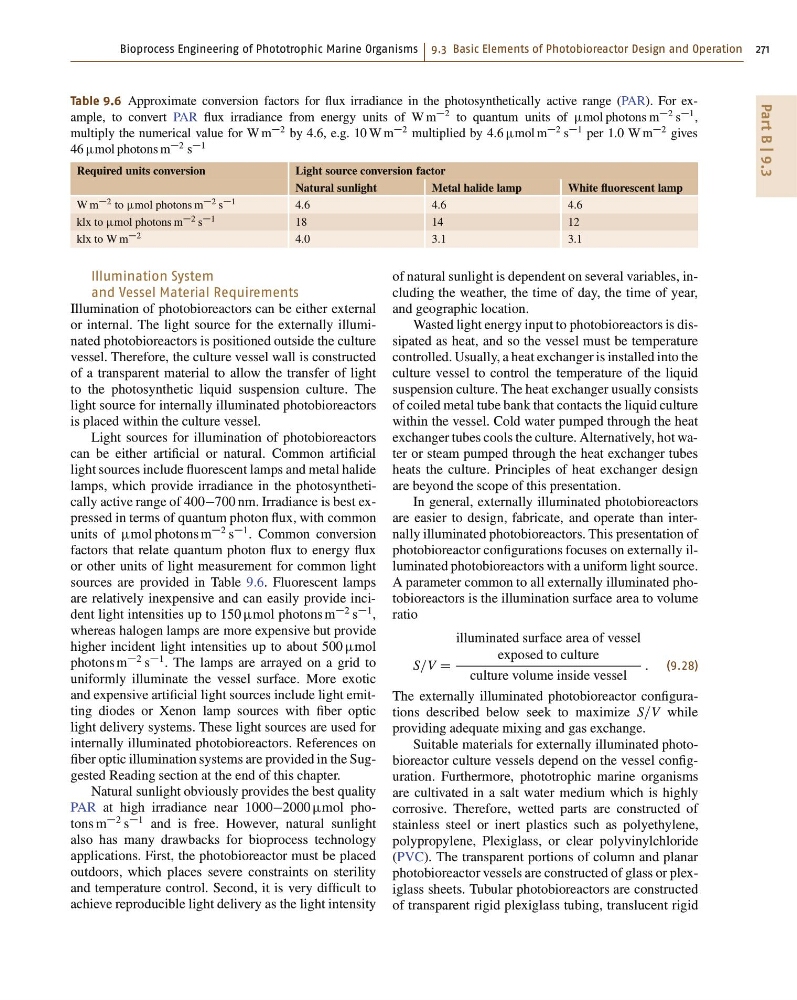
Table 9.6 Approximate conversion factors for flux irradiance in the photosynthetically active range (PAR). For example, to convert PAR flux irradiance from energy units of W m
2 to quantum units of mol photons m
2 s
1 ,
multiply the numerical value for W m
2 by 4:6, e.g. 10 W m
2 multiplied by 4:6 mol m
2 s
1 per 1.0 W m
2 gives
46 mol photons m
2 s
1
Required units conversion
Light source conversion factor
Natural sunlight
Metal halide lamp
White fluorescent lamp
W m 2 to mol photons m 2 s 1
4.6
4.6
4.6
klx to mol photons m 2 s 1
18
14
12
klx to W m 2
4.0
3.1
3.1
Illumination System
and Vessel Material Requirements
Illumination of photobioreactors can be either external
or internal. The light source for the externally illuminated photobioreactors is positioned outside the culture
vessel. Therefore, the culture vessel wall is constructed
of a transparent material to allow the transfer of light
to the photosynthetic liquid suspension culture. The
light source for internally illuminated photobioreactors
is placed within the culture vessel.
Light sources for illumination of photobioreactors
can be either artificial or natural. Common artificial
light sources include fluorescent lamps and metal halide
lamps, which provide irradiance in the photosynthetically active range of 400700 nm. Irradiance is best expressed in terms of quantum photon flux, with common
units of mol photons m
2 s
1 . Common conversion
factors that relate quantum photon flux to energy flux
or other units of light measurement for common light
sources are provided in Table 9.6. Fluorescent lamps
are relatively inexpensive and can easily provide incident light intensities up to 150 mol photons m
2 s
1 ,
whereas halogen lamps are more expensive but provide
higher incident light intensities up to about 500 mol
photons m
2 s
1 . The lamps are arrayed on a grid to
uniformly illuminate the vessel surface. More exotic
and expensive artificial light sources include light emitting diodes or Xenon lamp sources with fiber optic
light delivery systems. These light sources are used for
internally illuminated photobioreactors. References on
fiber optic illumination systems are provided in the Suggested Reading section at the end of this chapter.
Natural sunlight obviously provides the best quality
PAR at high irradiance near 10002000 mol photons m
2 s
1 and is free. However, natural sunlight
also has many drawbacks for bioprocess technology
applications. First, the photobioreactor must be placed
outdoors, which places severe constraints on sterility
and temperature control. Second, it is very difficult to
achieve reproducible light delivery as the light intensity
of natural sunlight is dependent on several variables, including the weather, the time of day, the time of year,
and geographic location.
Wasted light energy input to photobioreactors is dissipated as heat, and so the vessel must be temperature
controlled. Usually, a heat exchanger is installed into the
culture vessel to control the temperature of the liquid
suspension culture. The heat exchanger usually consists
of coiled metal tube bank that contacts the liquid culture
within the vessel. Cold water pumped through the heat
exchanger tubes cools the culture. Alternatively, hot water or steam pumped through the heat exchanger tubes
heats the culture. Principles of heat exchanger design
are beyond the scope of this presentation.
In general, externally illuminated photobioreactors
are easier to design, fabricate, and operate than internally illuminated photobioreactors. This presentation of
photobioreactor configurations focuses on externally illuminated photobioreactors with a uniform light source.
A parameter common to all externally illuminated photobioreactors is the illumination surface area to volume
ratio
S=V D
illuminated surface area of vessel
exposed to culture
culture volume inside vessel
: (9.28)
The externally illuminated photobioreactor configurations described below seek to maximize S=V while
providing adequate mixing and gas exchange.
Suitable materials for externally illuminated photobioreactor culture vessels depend on the vessel configuration. Furthermore, phototrophic marine organisms
are cultivated in a salt water medium which is highly
corrosive. Therefore, wetted parts are constructed of
stainless steel or inert plastics such as polyethylene,
polypropylene, Plexiglass, or clear polyvinylchloride
(PVC). The transparent portions of column and planar
photobioreactor vessels are constructed of glass or plexiglass sheets. Tubular photobioreactors are constructed
of transparent rigid plexiglass tubing, translucent rigid
Part B | 9.3
Table 9.6 Approximate conversion factors for flux irradiance in the photosynthetically active range (PAR). For example, to convert PAR flux irradiance from energy units of W m
2 to quantum units of mol photons m
2 s
1 ,
multiply the numerical value for W m
2 by 4:6, e.g. 10 W m
2 multiplied by 4:6 mol m
2 s
1 per 1.0 W m
2 gives
46 mol photons m
2 s
1
Required units conversion
Light source conversion factor
Natural sunlight
Metal halide lamp
White fluorescent lamp
W m 2 to mol photons m 2 s 1
4.6
4.6
4.6
klx to mol photons m 2 s 1
18
14
12
klx to W m 2
4.0
3.1
3.1
Illumination System
and Vessel Material Requirements
Illumination of photobioreactors can be either external
or internal. The light source for the externally illuminated photobioreactors is positioned outside the culture
vessel. Therefore, the culture vessel wall is constructed
of a transparent material to allow the transfer of light
to the photosynthetic liquid suspension culture. The
light source for internally illuminated photobioreactors
is placed within the culture vessel.
Light sources for illumination of photobioreactors
can be either artificial or natural. Common artificial
light sources include fluorescent lamps and metal halide
lamps, which provide irradiance in the photosynthetically active range of 400700 nm. Irradiance is best expressed in terms of quantum photon flux, with common
units of mol photons m
2 s
1 . Common conversion
factors that relate quantum photon flux to energy flux
or other units of light measurement for common light
sources are provided in Table 9.6. Fluorescent lamps
are relatively inexpensive and can easily provide incident light intensities up to 150 mol photons m
2 s
1 ,
whereas halogen lamps are more expensive but provide
higher incident light intensities up to about 500 mol
photons m
2 s
1 . The lamps are arrayed on a grid to
uniformly illuminate the vessel surface. More exotic
and expensive artificial light sources include light emitting diodes or Xenon lamp sources with fiber optic
light delivery systems. These light sources are used for
internally illuminated photobioreactors. References on
fiber optic illumination systems are provided in the Suggested Reading section at the end of this chapter.
Natural sunlight obviously provides the best quality
PAR at high irradiance near 10002000 mol photons m
2 s
1 and is free. However, natural sunlight
also has many drawbacks for bioprocess technology
applications. First, the photobioreactor must be placed
outdoors, which places severe constraints on sterility
and temperature control. Second, it is very difficult to
achieve reproducible light delivery as the light intensity
of natural sunlight is dependent on several variables, including the weather, the time of day, the time of year,
and geographic location.
Wasted light energy input to photobioreactors is dissipated as heat, and so the vessel must be temperature
controlled. Usually, a heat exchanger is installed into the
culture vessel to control the temperature of the liquid
suspension culture. The heat exchanger usually consists
of coiled metal tube bank that contacts the liquid culture
within the vessel. Cold water pumped through the heat
exchanger tubes cools the culture. Alternatively, hot water or steam pumped through the heat exchanger tubes
heats the culture. Principles of heat exchanger design
are beyond the scope of this presentation.
In general, externally illuminated photobioreactors
are easier to design, fabricate, and operate than internally illuminated photobioreactors. This presentation of
photobioreactor configurations focuses on externally illuminated photobioreactors with a uniform light source.
A parameter common to all externally illuminated photobioreactors is the illumination surface area to volume
ratio
S=V D
illuminated surface area of vessel
exposed to culture
culture volume inside vessel
: (9.28)
The externally illuminated photobioreactor configurations described below seek to maximize S=V while
providing adequate mixing and gas exchange.
Suitable materials for externally illuminated photobioreactor culture vessels depend on the vessel configuration. Furthermore, phototrophic marine organisms
are cultivated in a salt water medium which is highly
corrosive. Therefore, wetted parts are constructed of
stainless steel or inert plastics such as polyethylene,
polypropylene, Plexiglass, or clear polyvinylchloride
(PVC). The transparent portions of column and planar
photobioreactor vessels are constructed of glass or plexiglass sheets. Tubular photobioreactors are constructed
of transparent rigid plexiglass tubing, translucent rigid