

Corals 7.2 Potential Pharmaceuticals from Soft Corals 193
Part A | 7.2
CH 3
CH 3
H 3 C
H 3 C
OH
OH
OH
OAc
O
R' = H
OR'
Riisein A: R =
OAc
OAc
OH
OH
O
R' = H
Riisein B: R =
RO
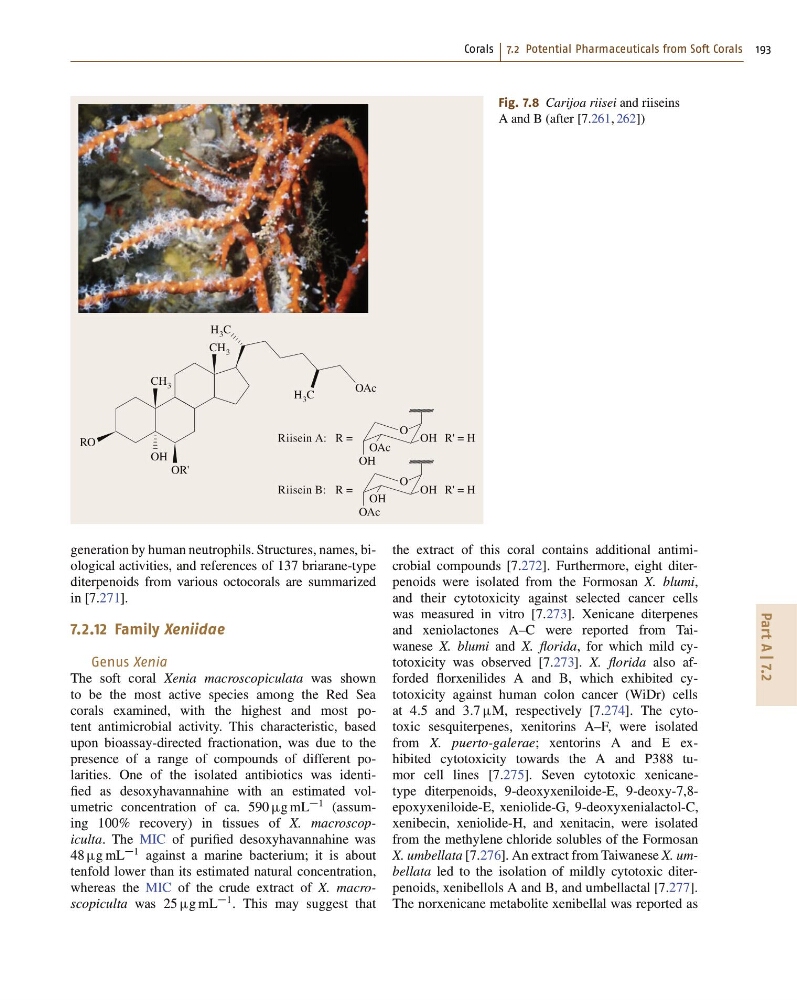
Fig. 7.8 Carijoa riisei and riiseins
A and B (after [7.261, 262])
generation by human neutrophils. Structures, names, biological activities, and references of 137 briarane-type
diterpenoids from various octocorals are summarized
in [7.271].
7.2.12 Family Xeniidae
Genus Xenia
The soft coral Xenia macroscopiculata was shown
to be the most active species among the Red Sea
corals examined, with the highest and most potent antimicrobial activity. This characteristic, based
upon bioassay-directed fractionation, was due to the
presence of a range of compounds of different polarities. One of the isolated antibiotics was identified as desoxyhavannahine with an estimated volumetric concentration of ca. 590 g mL
1 (assuming 100% recovery) in tissues of X. macroscopiculta. The MIC of purified desoxyhavannahine was
48 g mL
1 against a marine bacterium; it is about
tenfold lower than its estimated natural concentration,
whereas the MIC of the crude extract of X. macroscopiculta was 25 g mL
1 . This may suggest that
the extract of this coral contains additional antimicrobial compounds [7.272]. Furthermore, eight diterpenoids were isolated from the Formosan X. blumi,
and their cytotoxicity against selected cancer cells
was measured in vitro [7.273]. Xenicane diterpenes
and xeniolactones A–C were reported from Taiwanese X. blumi and X. florida, for which mild cytotoxicity was observed [7.273]. X. florida also afforded florxenilides A and B, which exhibited cytotoxicity against human colon cancer (WiDr) cells
at 4:5 and 3:7 M, respectively [7.274]. The cytotoxic sesquiterpenes, xenitorins A–F, were isolated
from X. puerto-galerae; xentorins A and E exhibited cytotoxicity towards the A and P388 tumor cell lines [7.275]. Seven cytotoxic xenicanetype diterpenoids, 9-deoxyxeniloide-E, 9-deoxy-7,8epoxyxeniloide-E, xeniolide-G, 9-deoxyxenialactol-C,
xenibecin, xeniolide-H, and xenitacin, were isolated
from the methylene chloride solubles of the Formosan
X. umbellata [7.276]. An extract from Taiwanese X. umbellata led to the isolation of mildly cytotoxic diterpenoids, xenibellols A and B, and umbellactal [7.277].
The norxenicane metabolite xenibellal was reported as
Part A | 7.2
CH 3
CH 3
H 3 C
H 3 C
OH
OH
OH
OAc
O
R' = H
OR'
Riisein A: R =
OAc
OAc
OH
OH
O
R' = H
Riisein B: R =
RO
Fig. 7.8 Carijoa riisei and riiseins
A and B (after [7.261, 262])
generation by human neutrophils. Structures, names, biological activities, and references of 137 briarane-type
diterpenoids from various octocorals are summarized
in [7.271].
7.2.12 Family Xeniidae
Genus Xenia
The soft coral Xenia macroscopiculata was shown
to be the most active species among the Red Sea
corals examined, with the highest and most potent antimicrobial activity. This characteristic, based
upon bioassay-directed fractionation, was due to the
presence of a range of compounds of different polarities. One of the isolated antibiotics was identified as desoxyhavannahine with an estimated volumetric concentration of ca. 590 g mL
1 (assuming 100% recovery) in tissues of X. macroscopiculta. The MIC of purified desoxyhavannahine was
48 g mL
1 against a marine bacterium; it is about
tenfold lower than its estimated natural concentration,
whereas the MIC of the crude extract of X. macroscopiculta was 25 g mL
1 . This may suggest that
the extract of this coral contains additional antimicrobial compounds [7.272]. Furthermore, eight diterpenoids were isolated from the Formosan X. blumi,
and their cytotoxicity against selected cancer cells
was measured in vitro [7.273]. Xenicane diterpenes
and xeniolactones A–C were reported from Taiwanese X. blumi and X. florida, for which mild cytotoxicity was observed [7.273]. X. florida also afforded florxenilides A and B, which exhibited cytotoxicity against human colon cancer (WiDr) cells
at 4:5 and 3:7 M, respectively [7.274]. The cytotoxic sesquiterpenes, xenitorins A–F, were isolated
from X. puerto-galerae; xentorins A and E exhibited cytotoxicity towards the A and P388 tumor cell lines [7.275]. Seven cytotoxic xenicanetype diterpenoids, 9-deoxyxeniloide-E, 9-deoxy-7,8epoxyxeniloide-E, xeniolide-G, 9-deoxyxenialactol-C,
xenibecin, xeniolide-H, and xenitacin, were isolated
from the methylene chloride solubles of the Formosan
X. umbellata [7.276]. An extract from Taiwanese X. umbellata led to the isolation of mildly cytotoxic diterpenoids, xenibellols A and B, and umbellactal [7.277].
The norxenicane metabolite xenibellal was reported as