

Part A | 7.2
192 Part A Marine Flora and Fauna
H
H H
H 3 C
H 3 C
CH 3
CH 2
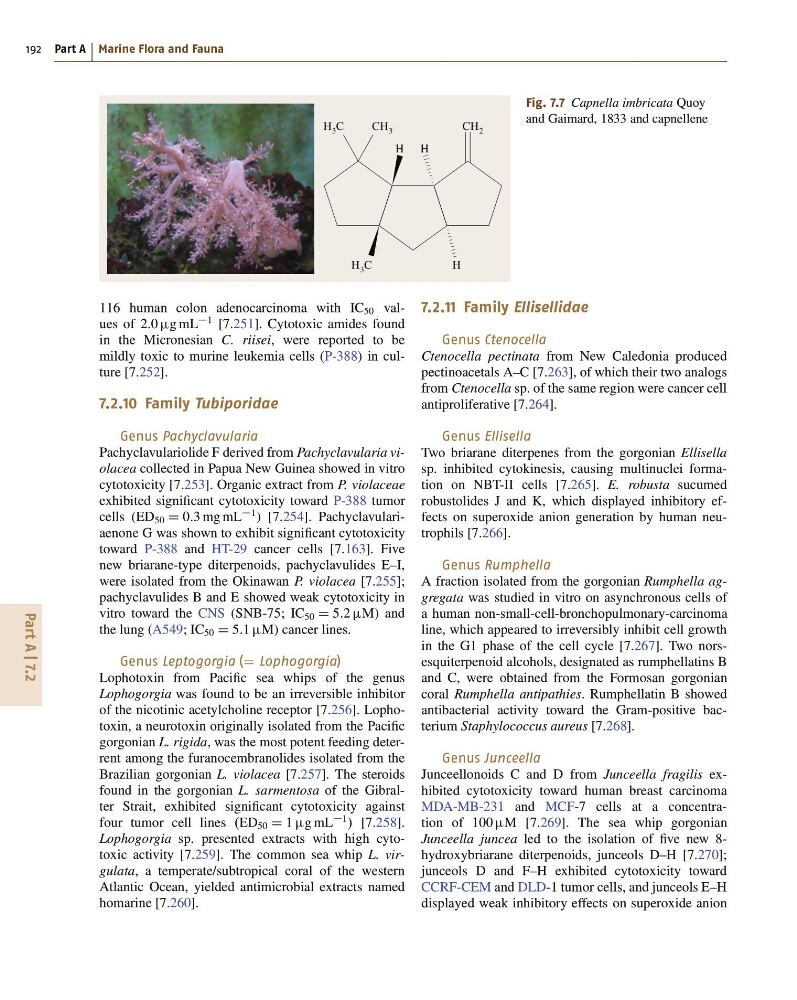
Fig. 7.7 Capnella imbricata Quoy
and Gaimard, 1833 and capnellene
116 human colon adenocarcinoma with IC 50 values of 2:0 g mL
1 [7.251]. Cytotoxic amides found
in the Micronesian C. riisei, were reported to be
mildly toxic to murine leukemia cells (P-388) in culture [7.252].
7.2.10 Family Tubiporidae
Genus Pachyclavularia
Pachyclavulariolide F derived from Pachyclavularia violacea collected in Papua New Guinea showed in vitro
cytotoxicity [7.253]. Organic extract from P. violaceae
exhibited significant cytotoxicity toward P-388 tumor
cells (ED 50 D 0:3 mg mL
1 ) [7.254]. Pachyclavulariaenone G was shown to exhibit significant cytotoxicity
toward P-388 and HT-29 cancer cells [7.163]. Five
new briarane-type diterpenoids, pachyclavulides E–I,
were isolated from the Okinawan P. violacea [7.255];
pachyclavulides B and E showed weak cytotoxicity in
vitro toward the CNS (SNB-75; IC 50 D 5:2 M) and
the lung (A549; IC 50 D 5:1 M) cancer lines.
Genus Leptogorgia (D Lophogorgia)
Lophotoxin from Pacific sea whips of the genus
Lophogorgia was found to be an irreversible inhibitor
of the nicotinic acetylcholine receptor [7.256]. Lophotoxin, a neurotoxin originally isolated from the Pacific
gorgonian L. rigida, was the most potent feeding deterrent among the furanocembranolides isolated from the
Brazilian gorgonian L. violacea [7.257]. The steroids
found in the gorgonian L. sarmentosa of the Gibralter Strait, exhibited significant cytotoxicity against
four tumor cell lines .ED 50 D 1 g mL
1
/ [7.258].
Lophogorgia sp. presented extracts with high cytotoxic activity [7.259]. The common sea whip L. virgulata, a temperate/subtropical coral of the western
Atlantic Ocean, yielded antimicrobial extracts named
homarine [7.260].
7.2.11 Family Ellisellidae
Genus Ctenocella
Ctenocella pectinata from New Caledonia produced
pectinoacetals A–C [7.263], of which their two analogs
from Ctenocella sp. of the same region were cancer cell
antiproliferative [7.264].
Genus Ellisella
Two briarane diterpenes from the gorgonian Ellisella
sp. inhibited cytokinesis, causing multinuclei formation on NBT-II cells [7.265]. E. robusta sucumed
robustolides J and K, which displayed inhibitory effects on superoxide anion generation by human neutrophils [7.266].
Genus Rumphella
A fraction isolated from the gorgonian Rumphella aggregata was studied in vitro on asynchronous cells of
a human non-small-cell-bronchopulmonary-carcinoma
line, which appeared to irreversibly inhibit cell growth
in the G1 phase of the cell cycle [7.267]. Two norsesquiterpenoid alcohols, designated as rumphellatins B
and C, were obtained from the Formosan gorgonian
coral Rumphella antipathies. Rumphellatin B showed
antibacterial activity toward the Gram-positive bacterium Staphylococcus aureus [7.268].
Genus Junceella
Junceellonoids C and D from Junceella fragilis exhibited cytotoxicity toward human breast carcinoma
MDA-MB-231 and MCF-7 cells at a concentration of 100 M [7.269]. The sea whip gorgonian
Junceella juncea led to the isolation of five new 8hydroxybriarane diterpenoids, junceols D–H [7.270];
junceols D and F–H exhibited cytotoxicity toward
CCRF-CEM and DLD-1 tumor cells, and junceols E–H
displayed weak inhibitory effects on superoxide anion
192 Part A Marine Flora and Fauna
H
H H
H 3 C
H 3 C
CH 3
CH 2
Fig. 7.7 Capnella imbricata Quoy
and Gaimard, 1833 and capnellene
116 human colon adenocarcinoma with IC 50 values of 2:0 g mL
1 [7.251]. Cytotoxic amides found
in the Micronesian C. riisei, were reported to be
mildly toxic to murine leukemia cells (P-388) in culture [7.252].
7.2.10 Family Tubiporidae
Genus Pachyclavularia
Pachyclavulariolide F derived from Pachyclavularia violacea collected in Papua New Guinea showed in vitro
cytotoxicity [7.253]. Organic extract from P. violaceae
exhibited significant cytotoxicity toward P-388 tumor
cells (ED 50 D 0:3 mg mL
1 ) [7.254]. Pachyclavulariaenone G was shown to exhibit significant cytotoxicity
toward P-388 and HT-29 cancer cells [7.163]. Five
new briarane-type diterpenoids, pachyclavulides E–I,
were isolated from the Okinawan P. violacea [7.255];
pachyclavulides B and E showed weak cytotoxicity in
vitro toward the CNS (SNB-75; IC 50 D 5:2 M) and
the lung (A549; IC 50 D 5:1 M) cancer lines.
Genus Leptogorgia (D Lophogorgia)
Lophotoxin from Pacific sea whips of the genus
Lophogorgia was found to be an irreversible inhibitor
of the nicotinic acetylcholine receptor [7.256]. Lophotoxin, a neurotoxin originally isolated from the Pacific
gorgonian L. rigida, was the most potent feeding deterrent among the furanocembranolides isolated from the
Brazilian gorgonian L. violacea [7.257]. The steroids
found in the gorgonian L. sarmentosa of the Gibralter Strait, exhibited significant cytotoxicity against
four tumor cell lines .ED 50 D 1 g mL
1
/ [7.258].
Lophogorgia sp. presented extracts with high cytotoxic activity [7.259]. The common sea whip L. virgulata, a temperate/subtropical coral of the western
Atlantic Ocean, yielded antimicrobial extracts named
homarine [7.260].
7.2.11 Family Ellisellidae
Genus Ctenocella
Ctenocella pectinata from New Caledonia produced
pectinoacetals A–C [7.263], of which their two analogs
from Ctenocella sp. of the same region were cancer cell
antiproliferative [7.264].
Genus Ellisella
Two briarane diterpenes from the gorgonian Ellisella
sp. inhibited cytokinesis, causing multinuclei formation on NBT-II cells [7.265]. E. robusta sucumed
robustolides J and K, which displayed inhibitory effects on superoxide anion generation by human neutrophils [7.266].
Genus Rumphella
A fraction isolated from the gorgonian Rumphella aggregata was studied in vitro on asynchronous cells of
a human non-small-cell-bronchopulmonary-carcinoma
line, which appeared to irreversibly inhibit cell growth
in the G1 phase of the cell cycle [7.267]. Two norsesquiterpenoid alcohols, designated as rumphellatins B
and C, were obtained from the Formosan gorgonian
coral Rumphella antipathies. Rumphellatin B showed
antibacterial activity toward the Gram-positive bacterium Staphylococcus aureus [7.268].
Genus Junceella
Junceellonoids C and D from Junceella fragilis exhibited cytotoxicity toward human breast carcinoma
MDA-MB-231 and MCF-7 cells at a concentration of 100 M [7.269]. The sea whip gorgonian
Junceella juncea led to the isolation of five new 8hydroxybriarane diterpenoids, junceols D–H [7.270];
junceols D and F–H exhibited cytotoxicity toward
CCRF-CEM and DLD-1 tumor cells, and junceols E–H
displayed weak inhibitory effects on superoxide anion