

Seaweed Flora of the European North Atlantic and Mediterranean 6.3 Seaweeds Biodiversity and Potential 131
Part A | 6.3
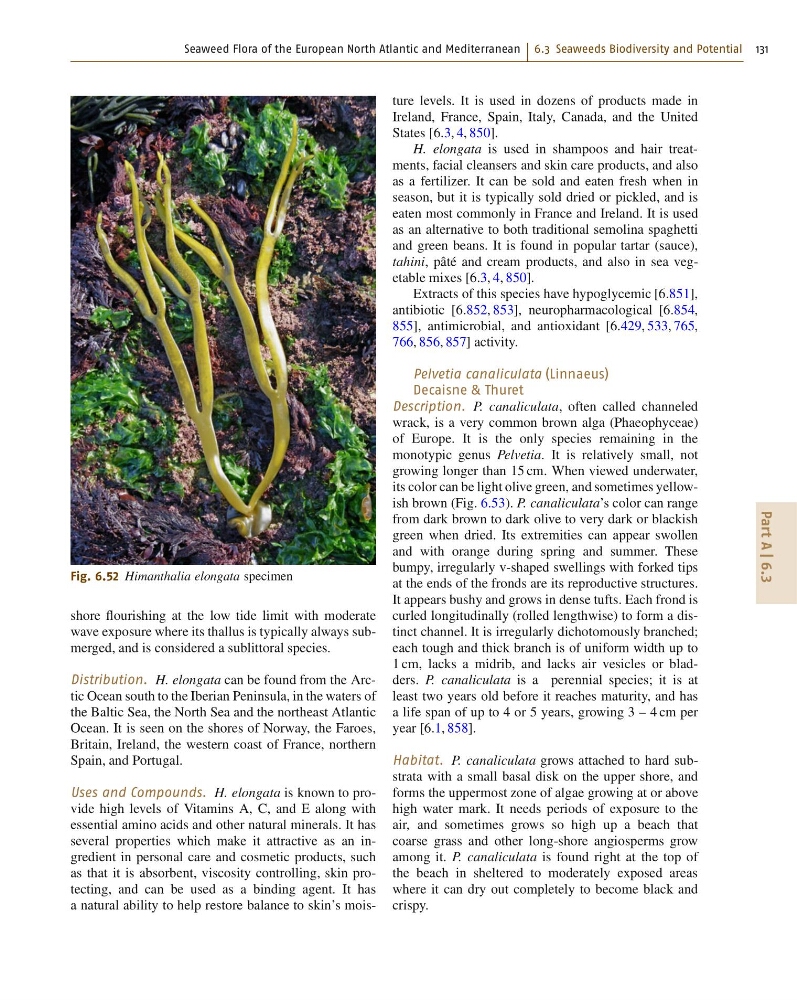
Fig. 6.52 Himanthalia elongata specimen
shore flourishing at the low tide limit with moderate
wave exposure where its thallus is typically always submerged, and is considered a sublittoral species.
Distribution. H. elongata can be found from the Arctic Ocean south to the Iberian Peninsula, in the waters of
the Baltic Sea, the North Sea and the northeast Atlantic
Ocean. It is seen on the shores of Norway, the Faroes,
Britain, Ireland, the western coast of France, northern
Spain, and Portugal.
Uses and Compounds. H. elongata is known to provide high levels of Vitamins A, C, and E along with
essential amino acids and other natural minerals. It has
several properties which make it attractive as an ingredient in personal care and cosmetic products, such
as that it is absorbent, viscosity controlling, skin protecting, and can be used as a binding agent. It has
a natural ability to help restore balance to skin’s moisture levels. It is used in dozens of products made in
Ireland, France, Spain, Italy, Canada, and the United
States [6.3, 4, 850].
H. elongata is used in shampoos and hair treatments, facial cleansers and skin care products, and also
as a fertilizer. It can be sold and eaten fresh when in
season, but it is typically sold dried or pickled, and is
eaten most commonly in France and Ireland. It is used
as an alternative to both traditional semolina spaghetti
and green beans. It is found in popular tartar (sauce),
tahini, pâté and cream products, and also in sea vegetable mixes [6.3, 4, 850].
Extracts of this species have hypoglycemic [6.851],
antibiotic [6.852, 853], neuropharmacological [6.854,
855], antimicrobial, and antioxidant [6.429, 533, 765,
766, 856, 857] activity.
Pelvetia canaliculata (Linnaeus)
Decaisne & Thuret
Description. P. canaliculata, often called channeled
wrack, is a very common brown alga (Phaeophyceae)
of Europe. It is the only species remaining in the
monotypic genus Pelvetia. It is relatively small, not
growing longer than 15 cm. When viewed underwater,
its color can be light olive green, and sometimes yellowish brown (Fig. 6.53). P. canaliculata’s color can range
from dark brown to dark olive to very dark or blackish
green when dried. Its extremities can appear swollen
and with orange during spring and summer. These
bumpy, irregularly v-shaped swellings with forked tips
at the ends of the fronds are its reproductive structures.
It appears bushy and grows in dense tufts. Each frond is
curled longitudinally (rolled lengthwise) to form a distinct channel. It is irregularly dichotomously branched;
each tough and thick branch is of uniform width up to
1 cm, lacks a midrib, and lacks air vesicles or bladders. P. canaliculata is a perennial species; it is at
least two years old before it reaches maturity, and has
a life span of up to 4 or 5 years, growing 3 – 4 cm per
year [6.1, 858].
Habitat. P. canaliculata grows attached to hard substrata with a small basal disk on the upper shore, and
forms the uppermost zone of algae growing at or above
high water mark. It needs periods of exposure to the
air, and sometimes grows so high up a beach that
coarse grass and other long-shore angiosperms grow
among it. P. canaliculata is found right at the top of
the beach in sheltered to moderately exposed areas
where it can dry out completely to become black and
crispy.
Part A | 6.3
Fig. 6.52 Himanthalia elongata specimen
shore flourishing at the low tide limit with moderate
wave exposure where its thallus is typically always submerged, and is considered a sublittoral species.
Distribution. H. elongata can be found from the Arctic Ocean south to the Iberian Peninsula, in the waters of
the Baltic Sea, the North Sea and the northeast Atlantic
Ocean. It is seen on the shores of Norway, the Faroes,
Britain, Ireland, the western coast of France, northern
Spain, and Portugal.
Uses and Compounds. H. elongata is known to provide high levels of Vitamins A, C, and E along with
essential amino acids and other natural minerals. It has
several properties which make it attractive as an ingredient in personal care and cosmetic products, such
as that it is absorbent, viscosity controlling, skin protecting, and can be used as a binding agent. It has
a natural ability to help restore balance to skin’s moisture levels. It is used in dozens of products made in
Ireland, France, Spain, Italy, Canada, and the United
States [6.3, 4, 850].
H. elongata is used in shampoos and hair treatments, facial cleansers and skin care products, and also
as a fertilizer. It can be sold and eaten fresh when in
season, but it is typically sold dried or pickled, and is
eaten most commonly in France and Ireland. It is used
as an alternative to both traditional semolina spaghetti
and green beans. It is found in popular tartar (sauce),
tahini, pâté and cream products, and also in sea vegetable mixes [6.3, 4, 850].
Extracts of this species have hypoglycemic [6.851],
antibiotic [6.852, 853], neuropharmacological [6.854,
855], antimicrobial, and antioxidant [6.429, 533, 765,
766, 856, 857] activity.
Pelvetia canaliculata (Linnaeus)
Decaisne & Thuret
Description. P. canaliculata, often called channeled
wrack, is a very common brown alga (Phaeophyceae)
of Europe. It is the only species remaining in the
monotypic genus Pelvetia. It is relatively small, not
growing longer than 15 cm. When viewed underwater,
its color can be light olive green, and sometimes yellowish brown (Fig. 6.53). P. canaliculata’s color can range
from dark brown to dark olive to very dark or blackish
green when dried. Its extremities can appear swollen
and with orange during spring and summer. These
bumpy, irregularly v-shaped swellings with forked tips
at the ends of the fronds are its reproductive structures.
It appears bushy and grows in dense tufts. Each frond is
curled longitudinally (rolled lengthwise) to form a distinct channel. It is irregularly dichotomously branched;
each tough and thick branch is of uniform width up to
1 cm, lacks a midrib, and lacks air vesicles or bladders. P. canaliculata is a perennial species; it is at
least two years old before it reaches maturity, and has
a life span of up to 4 or 5 years, growing 3 – 4 cm per
year [6.1, 858].
Habitat. P. canaliculata grows attached to hard substrata with a small basal disk on the upper shore, and
forms the uppermost zone of algae growing at or above
high water mark. It needs periods of exposure to the
air, and sometimes grows so high up a beach that
coarse grass and other long-shore angiosperms grow
among it. P. canaliculata is found right at the top of
the beach in sheltered to moderately exposed areas
where it can dry out completely to become black and
crispy.