

Part A | 6.3
130 Part A Marine Flora and Fauna
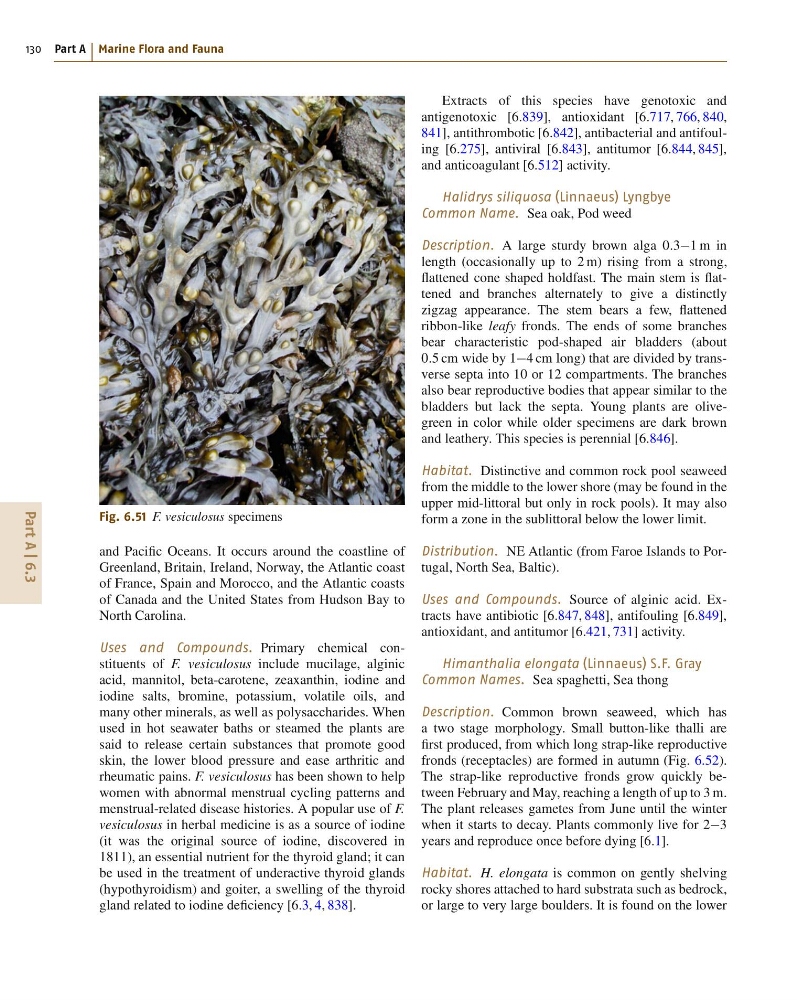
Fig. 6.51 F. vesiculosus specimens
and Pacific Oceans. It occurs around the coastline of
Greenland, Britain, Ireland, Norway, the Atlantic coast
of France, Spain and Morocco, and the Atlantic coasts
of Canada and the United States from Hudson Bay to
North Carolina.
Uses and Compounds. Primary chemical constituents of F. vesiculosus include mucilage, alginic
acid, mannitol, beta-carotene, zeaxanthin, iodine and
iodine salts, bromine, potassium, volatile oils, and
many other minerals, as well as polysaccharides. When
used in hot seawater baths or steamed the plants are
said to release certain substances that promote good
skin, the lower blood pressure and ease arthritic and
rheumatic pains. F. vesiculosus has been shown to help
women with abnormal menstrual cycling patterns and
menstrual-related disease histories. A popular use of F.
vesiculosus in herbal medicine is as a source of iodine
(it was the original source of iodine, discovered in
1811), an essential nutrient for the thyroid gland; it can
be used in the treatment of underactive thyroid glands
(hypothyroidism) and goiter, a swelling of the thyroid
gland related to iodine deficiency [6.3, 4, 838].
Extracts of this species have genotoxic and
antigenotoxic [6.839], antioxidant [6.717, 766, 840,
841], antithrombotic [6.842], antibacterial and antifouling [6.275], antiviral [6.843], antitumor [6.844, 845],
and anticoagulant [6.512] activity.
Halidrys siliquosa (Linnaeus) Lyngbye
Common Name. Sea oak, Pod weed
Description. A large sturdy brown alga 0:31 m in
length (occasionally up to 2 m) rising from a strong,
flattened cone shaped holdfast. The main stem is flattened and branches alternately to give a distinctly
zigzag appearance. The stem bears a few, flattened
ribbon-like leafy fronds. The ends of some branches
bear characteristic pod-shaped air bladders (about
0:5 cm wide by 14 cm long) that are divided by transverse septa into 10 or 12 compartments. The branches
also bear reproductive bodies that appear similar to the
bladders but lack the septa. Young plants are olivegreen in color while older specimens are dark brown
and leathery. This species is perennial [6.846].
Habitat. Distinctive and common rock pool seaweed
from the middle to the lower shore (may be found in the
upper mid-littoral but only in rock pools). It may also
form a zone in the sublittoral below the lower limit.
Distribution. NE Atlantic (from Faroe Islands to Portugal, North Sea, Baltic).
Uses and Compounds. Source of alginic acid. Extracts have antibiotic [6.847, 848], antifouling [6.849],
antioxidant, and antitumor [6.421, 731] activity.
Himanthalia elongata (Linnaeus) S.F. Gray
Common Names. Sea spaghetti, Sea thong
Description. Common brown seaweed, which has
a two stage morphology. Small button-like thalli are
first produced, from which long strap-like reproductive
fronds (receptacles) are formed in autumn (Fig. 6.52).
The strap-like reproductive fronds grow quickly between February and May, reaching a length of up to 3 m.
The plant releases gametes from June until the winter
when it starts to decay. Plants commonly live for 23
years and reproduce once before dying [6.1].
Habitat. H. elongata is common on gently shelving
rocky shores attached to hard substrata such as bedrock,
or large to very large boulders. It is found on the lower
130 Part A Marine Flora and Fauna
Fig. 6.51 F. vesiculosus specimens
and Pacific Oceans. It occurs around the coastline of
Greenland, Britain, Ireland, Norway, the Atlantic coast
of France, Spain and Morocco, and the Atlantic coasts
of Canada and the United States from Hudson Bay to
North Carolina.
Uses and Compounds. Primary chemical constituents of F. vesiculosus include mucilage, alginic
acid, mannitol, beta-carotene, zeaxanthin, iodine and
iodine salts, bromine, potassium, volatile oils, and
many other minerals, as well as polysaccharides. When
used in hot seawater baths or steamed the plants are
said to release certain substances that promote good
skin, the lower blood pressure and ease arthritic and
rheumatic pains. F. vesiculosus has been shown to help
women with abnormal menstrual cycling patterns and
menstrual-related disease histories. A popular use of F.
vesiculosus in herbal medicine is as a source of iodine
(it was the original source of iodine, discovered in
1811), an essential nutrient for the thyroid gland; it can
be used in the treatment of underactive thyroid glands
(hypothyroidism) and goiter, a swelling of the thyroid
gland related to iodine deficiency [6.3, 4, 838].
Extracts of this species have genotoxic and
antigenotoxic [6.839], antioxidant [6.717, 766, 840,
841], antithrombotic [6.842], antibacterial and antifouling [6.275], antiviral [6.843], antitumor [6.844, 845],
and anticoagulant [6.512] activity.
Halidrys siliquosa (Linnaeus) Lyngbye
Common Name. Sea oak, Pod weed
Description. A large sturdy brown alga 0:31 m in
length (occasionally up to 2 m) rising from a strong,
flattened cone shaped holdfast. The main stem is flattened and branches alternately to give a distinctly
zigzag appearance. The stem bears a few, flattened
ribbon-like leafy fronds. The ends of some branches
bear characteristic pod-shaped air bladders (about
0:5 cm wide by 14 cm long) that are divided by transverse septa into 10 or 12 compartments. The branches
also bear reproductive bodies that appear similar to the
bladders but lack the septa. Young plants are olivegreen in color while older specimens are dark brown
and leathery. This species is perennial [6.846].
Habitat. Distinctive and common rock pool seaweed
from the middle to the lower shore (may be found in the
upper mid-littoral but only in rock pools). It may also
form a zone in the sublittoral below the lower limit.
Distribution. NE Atlantic (from Faroe Islands to Portugal, North Sea, Baltic).
Uses and Compounds. Source of alginic acid. Extracts have antibiotic [6.847, 848], antifouling [6.849],
antioxidant, and antitumor [6.421, 731] activity.
Himanthalia elongata (Linnaeus) S.F. Gray
Common Names. Sea spaghetti, Sea thong
Description. Common brown seaweed, which has
a two stage morphology. Small button-like thalli are
first produced, from which long strap-like reproductive
fronds (receptacles) are formed in autumn (Fig. 6.52).
The strap-like reproductive fronds grow quickly between February and May, reaching a length of up to 3 m.
The plant releases gametes from June until the winter
when it starts to decay. Plants commonly live for 23
years and reproduce once before dying [6.1].
Habitat. H. elongata is common on gently shelving
rocky shores attached to hard substrata such as bedrock,
or large to very large boulders. It is found on the lower