

Part A | 6.3
120 Part A Marine Flora and Fauna
antithrombotic [6.732, 734], and antioxidant [6.546]
activity.
Colpomenia peregrina Sauvageau
Common Name. Oyster thief.
Description. Sometimes regularly spherical (C. peregrina) or more or less irregular outline (C. sinuosa),
yellowish-brown color, fixed to the substrate by filamentous rhizoids. Internally, the thallus is characterized
by an outer cortex composed of small colored cells and
inner pith composed of large pigmented cells [6.1].
Habitat. On moderately wave-exposed rocks and
(mostly) on other algae in the lower intertidal.
Distribution. NE Atlantic (Norway to Canary Islands); W Mediterranean; NW Pacific (Japan); NE
Pacific (Alaska to California); Australia, New Zealand.
Uses and Compounds. Extracts have cytotoxic and
antibacterial activity [6.735].
Colpomenia sinuosa (Mertens ex Roth)
Derbès & Solier
Description. Thallus bladder-like, smooth, slick, hollow, crisp, spherical to sac-like, irregularly expanded
or somewhat lobed, to 30 cm diameter, 10 cm high,
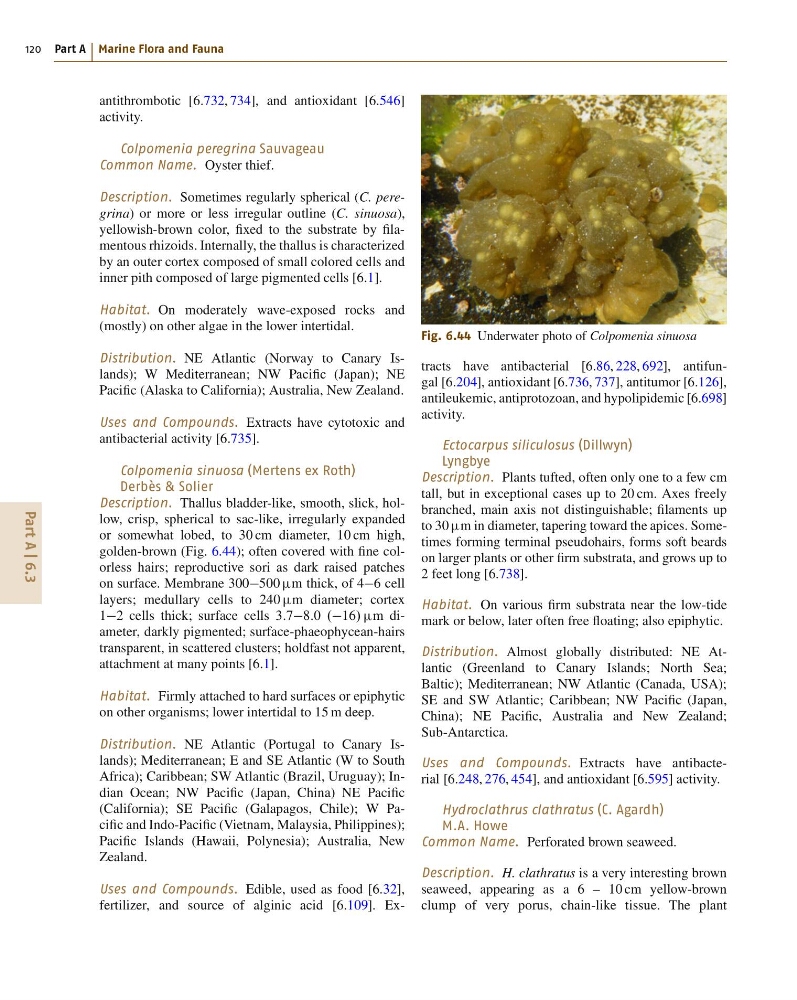
golden-brown (Fig. 6.44); often covered with fine colorless hairs; reproductive sori as dark raised patches
on surface. Membrane 300500 m thick, of 46 cell
layers; medullary cells to 240 m diameter; cortex
12 cells thick; surface cells 3:78:0 .16/ m diameter, darkly pigmented; surface-phaeophycean-hairs
transparent, in scattered clusters; holdfast not apparent,
attachment at many points [6.1].
Habitat. Firmly attached to hard surfaces or epiphytic
on other organisms; lower intertidal to 15 m deep.
Distribution. NE Atlantic (Portugal to Canary Islands); Mediterranean; E and SE Atlantic (W to South
Africa); Caribbean; SW Atlantic (Brazil, Uruguay); Indian Ocean; NW Pacific (Japan, China) NE Pacific
(California); SE Pacific (Galapagos, Chile); W Pacific and Indo-Pacific (Vietnam, Malaysia, Philippines);
Pacific Islands (Hawaii, Polynesia); Australia, New
Zealand.
Uses and Compounds. Edible, used as food [6.32],
fertilizer, and source of alginic acid [6.109]. ExFig. 6.44 Underwater photo of Colpomenia sinuosa
tracts have antibacterial [6.86, 228, 692], antifungal [6.204], antioxidant [6.736, 737], antitumor [6.126],
antileukemic, antiprotozoan, and hypolipidemic [6.698]
activity.
Ectocarpus siliculosus (Dillwyn)
Lyngbye
Description. Plants tufted, often only one to a few cm
tall, but in exceptional cases up to 20 cm. Axes freely
branched, main axis not distinguishable; filaments up
to 30 m in diameter, tapering toward the apices. Sometimes forming terminal pseudohairs, forms soft beards
on larger plants or other firm substrata, and grows up to
2 feet long [6.738].
Habitat. On various firm substrata near the low-tide
mark or below, later often free floating; also epiphytic.
Distribution. Almost globally distributed: NE Atlantic (Greenland to Canary Islands; North Sea;
Baltic); Mediterranean; NW Atlantic (Canada, USA);
SE and SW Atlantic; Caribbean; NW Pacific (Japan,
China); NE Pacific, Australia and New Zealand;
Sub-Antarctica.
Uses and Compounds. Extracts have antibacterial [6.248, 276, 454], and antioxidant [6.595] activity.
Hydroclathrus clathratus (C. Agardh)
M.A. Howe
Common Name. Perforated brown seaweed.
Description. H. clathratus is a very interesting brown
seaweed, appearing as a 6 – 10 cm yellow-brown
clump of very porus, chain-like tissue. The plant
120 Part A Marine Flora and Fauna
antithrombotic [6.732, 734], and antioxidant [6.546]
activity.
Colpomenia peregrina Sauvageau
Common Name. Oyster thief.
Description. Sometimes regularly spherical (C. peregrina) or more or less irregular outline (C. sinuosa),
yellowish-brown color, fixed to the substrate by filamentous rhizoids. Internally, the thallus is characterized
by an outer cortex composed of small colored cells and
inner pith composed of large pigmented cells [6.1].
Habitat. On moderately wave-exposed rocks and
(mostly) on other algae in the lower intertidal.
Distribution. NE Atlantic (Norway to Canary Islands); W Mediterranean; NW Pacific (Japan); NE
Pacific (Alaska to California); Australia, New Zealand.
Uses and Compounds. Extracts have cytotoxic and
antibacterial activity [6.735].
Colpomenia sinuosa (Mertens ex Roth)
Derbès & Solier
Description. Thallus bladder-like, smooth, slick, hollow, crisp, spherical to sac-like, irregularly expanded
or somewhat lobed, to 30 cm diameter, 10 cm high,
golden-brown (Fig. 6.44); often covered with fine colorless hairs; reproductive sori as dark raised patches
on surface. Membrane 300500 m thick, of 46 cell
layers; medullary cells to 240 m diameter; cortex
12 cells thick; surface cells 3:78:0 .16/ m diameter, darkly pigmented; surface-phaeophycean-hairs
transparent, in scattered clusters; holdfast not apparent,
attachment at many points [6.1].
Habitat. Firmly attached to hard surfaces or epiphytic
on other organisms; lower intertidal to 15 m deep.
Distribution. NE Atlantic (Portugal to Canary Islands); Mediterranean; E and SE Atlantic (W to South
Africa); Caribbean; SW Atlantic (Brazil, Uruguay); Indian Ocean; NW Pacific (Japan, China) NE Pacific
(California); SE Pacific (Galapagos, Chile); W Pacific and Indo-Pacific (Vietnam, Malaysia, Philippines);
Pacific Islands (Hawaii, Polynesia); Australia, New
Zealand.
Uses and Compounds. Edible, used as food [6.32],
fertilizer, and source of alginic acid [6.109]. ExFig. 6.44 Underwater photo of Colpomenia sinuosa
tracts have antibacterial [6.86, 228, 692], antifungal [6.204], antioxidant [6.736, 737], antitumor [6.126],
antileukemic, antiprotozoan, and hypolipidemic [6.698]
activity.
Ectocarpus siliculosus (Dillwyn)
Lyngbye
Description. Plants tufted, often only one to a few cm
tall, but in exceptional cases up to 20 cm. Axes freely
branched, main axis not distinguishable; filaments up
to 30 m in diameter, tapering toward the apices. Sometimes forming terminal pseudohairs, forms soft beards
on larger plants or other firm substrata, and grows up to
2 feet long [6.738].
Habitat. On various firm substrata near the low-tide
mark or below, later often free floating; also epiphytic.
Distribution. Almost globally distributed: NE Atlantic (Greenland to Canary Islands; North Sea;
Baltic); Mediterranean; NW Atlantic (Canada, USA);
SE and SW Atlantic; Caribbean; NW Pacific (Japan,
China); NE Pacific, Australia and New Zealand;
Sub-Antarctica.
Uses and Compounds. Extracts have antibacterial [6.248, 276, 454], and antioxidant [6.595] activity.
Hydroclathrus clathratus (C. Agardh)
M.A. Howe
Common Name. Perforated brown seaweed.
Description. H. clathratus is a very interesting brown
seaweed, appearing as a 6 – 10 cm yellow-brown
clump of very porus, chain-like tissue. The plant