

Seaweed Flora of the European North Atlantic and Mediterranean 6.3 Seaweeds Biodiversity and Potential 119
Part A | 6.3
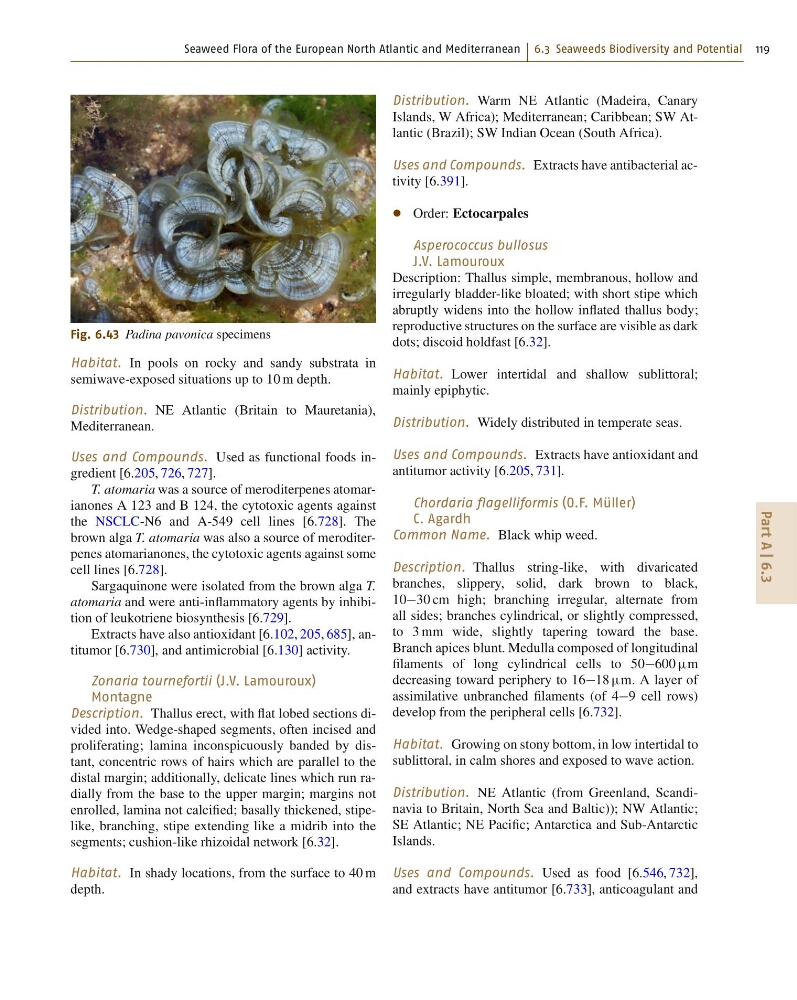
Fig. 6.43 Padina pavonica specimens
Habitat. In pools on rocky and sandy substrata in
semiwave-exposed situations up to 10 m depth.
Distribution. NE Atlantic (Britain to Mauretania),
Mediterranean.
Uses and Compounds. Used as functional foods ingredient [6.205, 726, 727].
T. atomaria was a source of meroditerpenes atomarianones A 123 and B 124, the cytotoxic agents against
the NSCLC-N6 and A-549 cell lines [6.728]. The
brown alga T. atomaria was also a source of meroditerpenes atomarianones, the cytotoxic agents against some
cell lines [6.728].
Sargaquinone were isolated from the brown alga T.
atomaria and were anti-inflammatory agents by inhibition of leukotriene biosynthesis [6.729].
Extracts have also antioxidant [6.102, 205, 685], antitumor [6.730], and antimicrobial [6.130] activity.
Zonaria tournefortii (J.V. Lamouroux)
Montagne
Description. Thallus erect, with flat lobed sections divided into. Wedge-shaped segments, often incised and
proliferating; lamina inconspicuously banded by distant, concentric rows of hairs which are parallel to the
distal margin; additionally, delicate lines which run radially from the base to the upper margin; margins not
enrolled, lamina not calcified; basally thickened, stipelike, branching, stipe extending like a midrib into the
segments; cushion-like rhizoidal network [6.32].
Habitat. In shady locations, from the surface to 40 m
depth.
Distribution. Warm NE Atlantic (Madeira, Canary
Islands, W Africa); Mediterranean; Caribbean; SW Atlantic (Brazil); SW Indian Ocean (South Africa).
Uses and Compounds. Extracts have antibacterial activity [6.391].
Order: Ectocarpales
Asperococcus bullosus
J.V. Lamouroux
Description: Thallus simple, membranous, hollow and
irregularly bladder-like bloated; with short stipe which
abruptly widens into the hollow inflated thallus body;
reproductive structures on the surface are visible as dark
dots; discoid holdfast [6.32].
Habitat. Lower intertidal and shallow sublittoral;
mainly epiphytic.
Distribution. Widely distributed in temperate seas.
Uses and Compounds. Extracts have antioxidant and
antitumor activity [6.205, 731].
Chordaria flagelliformis (O.F. Müller)
C. Agardh
Common Name. Black whip weed.
Description. Thallus string-like, with divaricated
branches, slippery, solid, dark brown to black,
1030 cm high; branching irregular, alternate from
all sides; branches cylindrical, or slightly compressed,
to 3 mm wide, slightly tapering toward the base.
Branch apices blunt. Medulla composed of longitudinal
filaments of long cylindrical cells to 50600 m
decreasing toward periphery to 1618 m. A layer of
assimilative unbranched filaments (of 49 cell rows)
develop from the peripheral cells [6.732].
Habitat. Growing on stony bottom, in low intertidal to
sublittoral, in calm shores and exposed to wave action.
Distribution. NE Atlantic (from Greenland, Scandinavia to Britain, North Sea and Baltic)); NW Atlantic;
SE Atlantic; NE Pacific; Antarctica and Sub-Antarctic
Islands.
Uses and Compounds. Used as food [6.546, 732],
and extracts have antitumor [6.733], anticoagulant and
Part A | 6.3
Fig. 6.43 Padina pavonica specimens
Habitat. In pools on rocky and sandy substrata in
semiwave-exposed situations up to 10 m depth.
Distribution. NE Atlantic (Britain to Mauretania),
Mediterranean.
Uses and Compounds. Used as functional foods ingredient [6.205, 726, 727].
T. atomaria was a source of meroditerpenes atomarianones A 123 and B 124, the cytotoxic agents against
the NSCLC-N6 and A-549 cell lines [6.728]. The
brown alga T. atomaria was also a source of meroditerpenes atomarianones, the cytotoxic agents against some
cell lines [6.728].
Sargaquinone were isolated from the brown alga T.
atomaria and were anti-inflammatory agents by inhibition of leukotriene biosynthesis [6.729].
Extracts have also antioxidant [6.102, 205, 685], antitumor [6.730], and antimicrobial [6.130] activity.
Zonaria tournefortii (J.V. Lamouroux)
Montagne
Description. Thallus erect, with flat lobed sections divided into. Wedge-shaped segments, often incised and
proliferating; lamina inconspicuously banded by distant, concentric rows of hairs which are parallel to the
distal margin; additionally, delicate lines which run radially from the base to the upper margin; margins not
enrolled, lamina not calcified; basally thickened, stipelike, branching, stipe extending like a midrib into the
segments; cushion-like rhizoidal network [6.32].
Habitat. In shady locations, from the surface to 40 m
depth.
Distribution. Warm NE Atlantic (Madeira, Canary
Islands, W Africa); Mediterranean; Caribbean; SW Atlantic (Brazil); SW Indian Ocean (South Africa).
Uses and Compounds. Extracts have antibacterial activity [6.391].
Order: Ectocarpales
Asperococcus bullosus
J.V. Lamouroux
Description: Thallus simple, membranous, hollow and
irregularly bladder-like bloated; with short stipe which
abruptly widens into the hollow inflated thallus body;
reproductive structures on the surface are visible as dark
dots; discoid holdfast [6.32].
Habitat. Lower intertidal and shallow sublittoral;
mainly epiphytic.
Distribution. Widely distributed in temperate seas.
Uses and Compounds. Extracts have antioxidant and
antitumor activity [6.205, 731].
Chordaria flagelliformis (O.F. Müller)
C. Agardh
Common Name. Black whip weed.
Description. Thallus string-like, with divaricated
branches, slippery, solid, dark brown to black,
1030 cm high; branching irregular, alternate from
all sides; branches cylindrical, or slightly compressed,
to 3 mm wide, slightly tapering toward the base.
Branch apices blunt. Medulla composed of longitudinal
filaments of long cylindrical cells to 50600 m
decreasing toward periphery to 1618 m. A layer of
assimilative unbranched filaments (of 49 cell rows)
develop from the peripheral cells [6.732].
Habitat. Growing on stony bottom, in low intertidal to
sublittoral, in calm shores and exposed to wave action.
Distribution. NE Atlantic (from Greenland, Scandinavia to Britain, North Sea and Baltic)); NW Atlantic;
SE Atlantic; NE Pacific; Antarctica and Sub-Antarctic
Islands.
Uses and Compounds. Used as food [6.546, 732],
and extracts have antitumor [6.733], anticoagulant and