

Seaweed Flora of the European North Atlantic and Mediterranean 6.3 Seaweeds Biodiversity and Potential 121
Part A | 6.3
has a very open, sponge-like structure with a complex series of holes perforating narrow, fleshy strips.
Its name, clathratus, means latticed, an apt description. H. clathratus is found worldwide in warm
seas but is an uncommon species on hard reefs. H.
clathratus is more often found on in calm, shallow areas where it is anchored in bare sand [6.32,
739].
Habitat. In mid-littoral, often on wave-exposed rocks,
more rarely in depths of apertures 13 cm, of the
bridges 13 mm.
Distribution. The worldwide distribution of H.
clathratus includes Europe, both coasts of Africa,
the Pacific Islands, Asia, Australia, North and South
America from California through Chile and the Gulf of
Mexico.
Uses and Compounds. H. clathratus has been used
for centuries in traditional cuisine and medicine of island cultures, such as Hawaii. Hydroclathrus clathratus
is known to possess anticancer, anti-herpetic, anti-inflammatory, and anticoagulant properties and is now
used as a mineral supplement in cosmetics and as
a soil-additive (fertilizer) for its high concentration of
micronutrients [6.32, 739].
Extracts have antiviral [6.740, 741], antitumor [6.742–747], cytotoxic and antiviral [6.72], and
antimicrobial [6.72, 230, 248, 692, 715] activity.
Leathesia marina (Lyngbye)
Decaisne
Synonym. Leathesia difformis
Common Names. Sea cauliflower, Sea balls.
Description. Thallus round in young stages, light
brown, firm-fleshy and slimy-smooth, later hollow, and
with an irregularly convoluted surface [6.32].
Habitat. Mostly epiphytically on larger algae or sessile on rocks.
Distribution. Nearly worldwide; NE Atlantic (Iceland to Canary Islands); Mediterranean; NW Atlantic; SE Atlantic (Namibia, South Africa); Indian Ocean (South Africa); NW Pacific (Japan,
China); NE Pacific (Alaska to California); SW Pacific
(Philippines); Australia; New Zealand, Antarctica and
Sub-Antarctica.
Uses and Compounds. Extracts have agricultural
bio-control and bio-stimulating [6.748], antifouling [6.749], antiviral [6.750], antioxidant [6.111], and
antitumor [6.751] activity.
Petalonia fascia (O.F. Müller) Kuntze
Description. Thallus consists of erect, light to dark
brown, dorsoventrally flattened lamina, arising from
a holdfast singly or in clusters; linear or broadly lanceolate to almost elliptical, abruptly or gradually narrowing
toward the base and merging into a elliptical, abruptly
or gradually narrowing toward the base and merging
into a short stipe, only slightly narrowing at the tip,
rounded and often frayed; thallus undivided, membranous and thin when young, later leathery-tough with
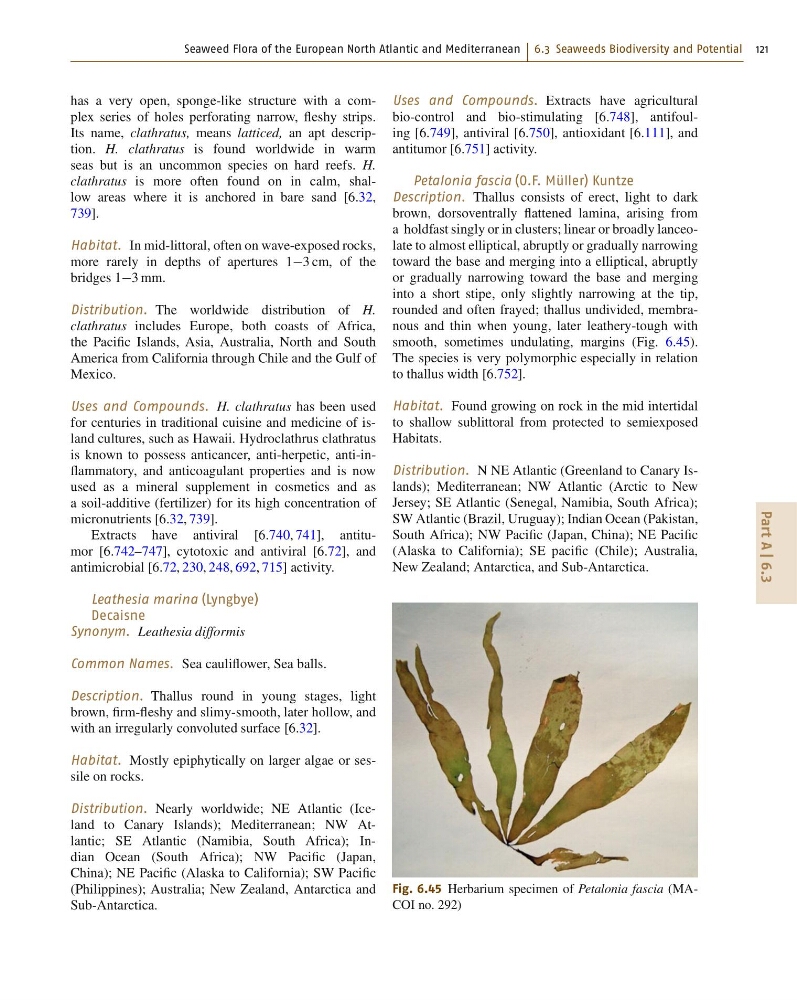
smooth, sometimes undulating, margins (Fig. 6.45).
The species is very polymorphic especially in relation
to thallus width [6.752].
Habitat. Found growing on rock in the mid intertidal
to shallow sublittoral from protected to semiexposed
Habitats.
Distribution. N NE Atlantic (Greenland to Canary Islands); Mediterranean; NW Atlantic (Arctic to New
Jersey; SE Atlantic (Senegal, Namibia, South Africa);
SW Atlantic (Brazil, Uruguay); Indian Ocean (Pakistan,
South Africa); NW Pacific (Japan, China); NE Pacific
(Alaska to California); SE pacific (Chile); Australia,
New Zealand; Antarctica, and Sub-Antarctica.
Fig. 6.45 Herbarium specimen of Petalonia fascia (MACOI no. 292)
Part A | 6.3
has a very open, sponge-like structure with a complex series of holes perforating narrow, fleshy strips.
Its name, clathratus, means latticed, an apt description. H. clathratus is found worldwide in warm
seas but is an uncommon species on hard reefs. H.
clathratus is more often found on in calm, shallow areas where it is anchored in bare sand [6.32,
739].
Habitat. In mid-littoral, often on wave-exposed rocks,
more rarely in depths of apertures 13 cm, of the
bridges 13 mm.
Distribution. The worldwide distribution of H.
clathratus includes Europe, both coasts of Africa,
the Pacific Islands, Asia, Australia, North and South
America from California through Chile and the Gulf of
Mexico.
Uses and Compounds. H. clathratus has been used
for centuries in traditional cuisine and medicine of island cultures, such as Hawaii. Hydroclathrus clathratus
is known to possess anticancer, anti-herpetic, anti-inflammatory, and anticoagulant properties and is now
used as a mineral supplement in cosmetics and as
a soil-additive (fertilizer) for its high concentration of
micronutrients [6.32, 739].
Extracts have antiviral [6.740, 741], antitumor [6.742–747], cytotoxic and antiviral [6.72], and
antimicrobial [6.72, 230, 248, 692, 715] activity.
Leathesia marina (Lyngbye)
Decaisne
Synonym. Leathesia difformis
Common Names. Sea cauliflower, Sea balls.
Description. Thallus round in young stages, light
brown, firm-fleshy and slimy-smooth, later hollow, and
with an irregularly convoluted surface [6.32].
Habitat. Mostly epiphytically on larger algae or sessile on rocks.
Distribution. Nearly worldwide; NE Atlantic (Iceland to Canary Islands); Mediterranean; NW Atlantic; SE Atlantic (Namibia, South Africa); Indian Ocean (South Africa); NW Pacific (Japan,
China); NE Pacific (Alaska to California); SW Pacific
(Philippines); Australia; New Zealand, Antarctica and
Sub-Antarctica.
Uses and Compounds. Extracts have agricultural
bio-control and bio-stimulating [6.748], antifouling [6.749], antiviral [6.750], antioxidant [6.111], and
antitumor [6.751] activity.
Petalonia fascia (O.F. Müller) Kuntze
Description. Thallus consists of erect, light to dark
brown, dorsoventrally flattened lamina, arising from
a holdfast singly or in clusters; linear or broadly lanceolate to almost elliptical, abruptly or gradually narrowing
toward the base and merging into a elliptical, abruptly
or gradually narrowing toward the base and merging
into a short stipe, only slightly narrowing at the tip,
rounded and often frayed; thallus undivided, membranous and thin when young, later leathery-tough with
smooth, sometimes undulating, margins (Fig. 6.45).
The species is very polymorphic especially in relation
to thallus width [6.752].
Habitat. Found growing on rock in the mid intertidal
to shallow sublittoral from protected to semiexposed
Habitats.
Distribution. N NE Atlantic (Greenland to Canary Islands); Mediterranean; NW Atlantic (Arctic to New
Jersey; SE Atlantic (Senegal, Namibia, South Africa);
SW Atlantic (Brazil, Uruguay); Indian Ocean (Pakistan,
South Africa); NW Pacific (Japan, China); NE Pacific
(Alaska to California); SE pacific (Chile); Australia,
New Zealand; Antarctica, and Sub-Antarctica.
Fig. 6.45 Herbarium specimen of Petalonia fascia (MACOI no. 292)