

Seaweed Flora of the European North Atlantic and Mediterranean 6.3 Seaweeds Biodiversity and Potential 111
Part A | 6.3
Order: Neamatomales
Schizymenia dubyi (Chauvin ex Duby)
J. Agardh
Description. Erect leaf-like flat fronds, brow-red
(liver-colored), translucent, gradually widening from
the base, simple or irregularly split or lobed, then at
a narrow angle, overlapping; often noticeably sickleshaped, with smooth margin, not proliferating texture
soft-slippery; cystocarps very small and sunken; very
short stunted stipe, small discoid holdfast [6.32].
Habitat. Pools and on rock mid lower intertidal zone.
Distribution. NE Atlantic (Iceland to Morocco);
Mediterranean; NW Pacific (Japan, China, Korea);
Australia.
Uses and Compounds. Extracts have antioxidant
[6.350], antitumor [6.638], antiviral, and anticoagulant [6.205, 546, 639, 640] activity.
Order: Palmariales
Palmaria palmata (Linnaeus) Weber & Mohr
Common Name. Dulse, Grannogh, Dillisk, Handed
focus.
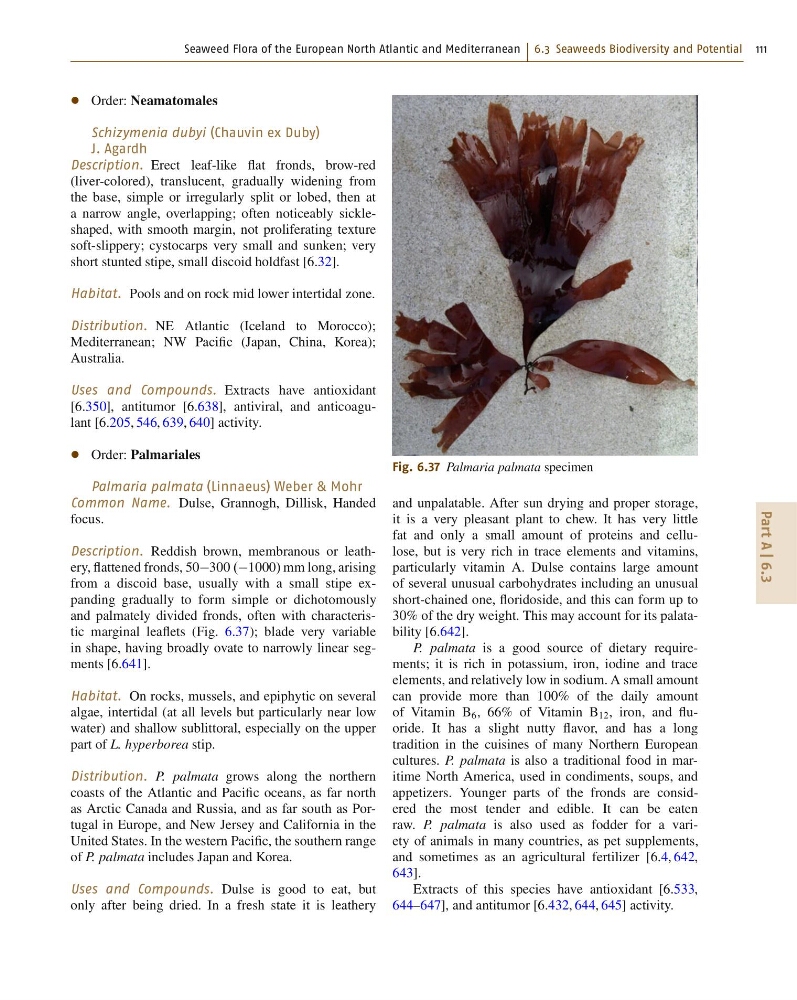
Description. Reddish brown, membranous or leathery, flattened fronds, 50300 .1000/ mm long, arising
from a discoid base, usually with a small stipe expanding gradually to form simple or dichotomously
and palmately divided fronds, often with characteristic marginal leaflets (Fig. 6.37); blade very variable
in shape, having broadly ovate to narrowly linear segments [6.641].
Habitat. On rocks, mussels, and epiphytic on several
algae, intertidal (at all levels but particularly near low
water) and shallow sublittoral, especially on the upper
part of L. hyperborea stip.
Distribution. P. palmata grows along the northern
coasts of the Atlantic and Pacific oceans, as far north
as Arctic Canada and Russia, and as far south as Portugal in Europe, and New Jersey and California in the
United States. In the western Pacific, the southern range
of P. palmata includes Japan and Korea.
Uses and Compounds. Dulse is good to eat, but
only after being dried. In a fresh state it is leathery
Fig. 6.37 Palmaria palmata specimen
and unpalatable. After sun drying and proper storage,
it is a very pleasant plant to chew. It has very little
fat and only a small amount of proteins and cellulose, but is very rich in trace elements and vitamins,
particularly vitamin A. Dulse contains large amount
of several unusual carbohydrates including an unusual
short-chained one, floridoside, and this can form up to
30% of the dry weight. This may account for its palatability [6.642].
P. palmata is a good source of dietary requirements; it is rich in potassium, iron, iodine and trace
elements, and relatively low in sodium. A small amount
can provide more than 100% of the daily amount
of Vitamin B 6 , 66% of Vitamin B 12 , iron, and fluoride. It has a slight nutty flavor, and has a long
tradition in the cuisines of many Northern European
cultures. P. palmata is also a traditional food in maritime North America, used in condiments, soups, and
appetizers. Younger parts of the fronds are considered the most tender and edible. It can be eaten
raw. P. palmata is also used as fodder for a variety of animals in many countries, as pet supplements,
and sometimes as an agricultural fertilizer [6.4, 642,
643].
Extracts of this species have antioxidant [6.533,
644–647], and antitumor [6.432, 644, 645] activity.
Part A | 6.3
Order: Neamatomales
Schizymenia dubyi (Chauvin ex Duby)
J. Agardh
Description. Erect leaf-like flat fronds, brow-red
(liver-colored), translucent, gradually widening from
the base, simple or irregularly split or lobed, then at
a narrow angle, overlapping; often noticeably sickleshaped, with smooth margin, not proliferating texture
soft-slippery; cystocarps very small and sunken; very
short stunted stipe, small discoid holdfast [6.32].
Habitat. Pools and on rock mid lower intertidal zone.
Distribution. NE Atlantic (Iceland to Morocco);
Mediterranean; NW Pacific (Japan, China, Korea);
Australia.
Uses and Compounds. Extracts have antioxidant
[6.350], antitumor [6.638], antiviral, and anticoagulant [6.205, 546, 639, 640] activity.
Order: Palmariales
Palmaria palmata (Linnaeus) Weber & Mohr
Common Name. Dulse, Grannogh, Dillisk, Handed
focus.
Description. Reddish brown, membranous or leathery, flattened fronds, 50300 .1000/ mm long, arising
from a discoid base, usually with a small stipe expanding gradually to form simple or dichotomously
and palmately divided fronds, often with characteristic marginal leaflets (Fig. 6.37); blade very variable
in shape, having broadly ovate to narrowly linear segments [6.641].
Habitat. On rocks, mussels, and epiphytic on several
algae, intertidal (at all levels but particularly near low
water) and shallow sublittoral, especially on the upper
part of L. hyperborea stip.
Distribution. P. palmata grows along the northern
coasts of the Atlantic and Pacific oceans, as far north
as Arctic Canada and Russia, and as far south as Portugal in Europe, and New Jersey and California in the
United States. In the western Pacific, the southern range
of P. palmata includes Japan and Korea.
Uses and Compounds. Dulse is good to eat, but
only after being dried. In a fresh state it is leathery
Fig. 6.37 Palmaria palmata specimen
and unpalatable. After sun drying and proper storage,
it is a very pleasant plant to chew. It has very little
fat and only a small amount of proteins and cellulose, but is very rich in trace elements and vitamins,
particularly vitamin A. Dulse contains large amount
of several unusual carbohydrates including an unusual
short-chained one, floridoside, and this can form up to
30% of the dry weight. This may account for its palatability [6.642].
P. palmata is a good source of dietary requirements; it is rich in potassium, iron, iodine and trace
elements, and relatively low in sodium. A small amount
can provide more than 100% of the daily amount
of Vitamin B 6 , 66% of Vitamin B 12 , iron, and fluoride. It has a slight nutty flavor, and has a long
tradition in the cuisines of many Northern European
cultures. P. palmata is also a traditional food in maritime North America, used in condiments, soups, and
appetizers. Younger parts of the fronds are considered the most tender and edible. It can be eaten
raw. P. palmata is also used as fodder for a variety of animals in many countries, as pet supplements,
and sometimes as an agricultural fertilizer [6.4, 642,
643].
Extracts of this species have antioxidant [6.533,
644–647], and antitumor [6.432, 644, 645] activity.