

Part A | 6.3
110 Part A Marine Flora and Fauna
Distribution. NE Atlantic (from France, Spain): Atlantic Islands; Mediterranean; NW Atlantic; Caribbean;
SW and SE Atlantic; Indo-Pacific Oceans; Australia.
Uses and Compounds. Extracts have anticoagulant [6.206], and antioxidant [6.65] activity.
Liagora viscida (Forsskål) C. Agardh
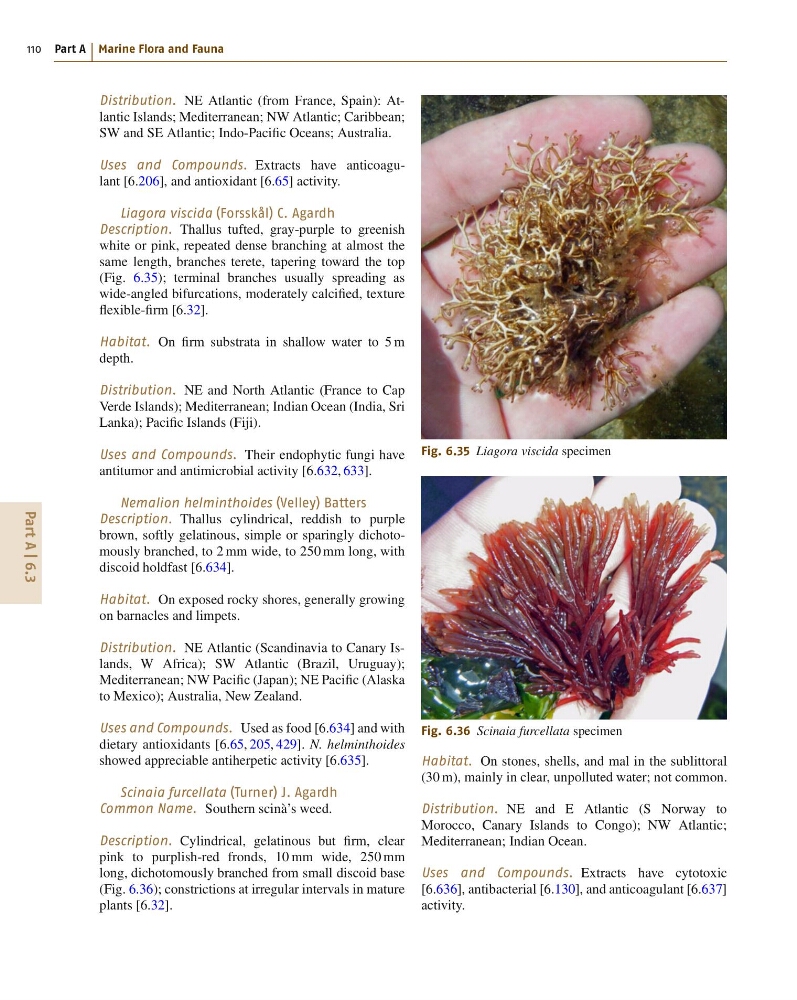
Description. Thallus tufted, gray-purple to greenish
white or pink, repeated dense branching at almost the
same length, branches terete, tapering toward the top
(Fig. 6.35); terminal branches usually spreading as
wide-angled bifurcations, moderately calcified, texture
flexible-firm [6.32].
Habitat. On firm substrata in shallow water to 5 m
depth.
Distribution. NE and North Atlantic (France to Cap
Verde Islands); Mediterranean; Indian Ocean (India, Sri
Lanka); Pacific Islands (Fiji).
Uses and Compounds. Their endophytic fungi have
antitumor and antimicrobial activity [6.632, 633].
Nemalion helminthoides (Velley) Batters
Description. Thallus cylindrical, reddish to purple
brown, softly gelatinous, simple or sparingly dichotomously branched, to 2 mm wide, to 250 mm long, with
discoid holdfast [6.634].
Habitat. On exposed rocky shores, generally growing
on barnacles and limpets.
Distribution. NE Atlantic (Scandinavia to Canary Islands, W Africa); SW Atlantic (Brazil, Uruguay);
Mediterranean; NW Pacific (Japan); NE Pacific (Alaska
to Mexico); Australia, New Zealand.
Uses and Compounds. Used as food [6.634] and with
dietary antioxidants [6.65, 205, 429]. N. helminthoides
showed appreciable antiherpetic activity [6.635].
Scinaia furcellata (Turner) J. Agardh
Common Name. Southern scinà’s weed.
Description. Cylindrical, gelatinous but firm, clear
pink to purplish-red fronds, 10 mm wide, 250 mm
long, dichotomously branched from small discoid base
(Fig. 6.36); constrictions at irregular intervals in mature
plants [6.32].
Fig. 6.35 Liagora viscida specimen
Fig. 6.36 Scinaia furcellata specimen
Habitat. On stones, shells, and mal in the sublittoral
(30 m), mainly in clear, unpolluted water; not common.
Distribution. NE and E Atlantic (S Norway to
Morocco, Canary Islands to Congo); NW Atlantic;
Mediterranean; Indian Ocean.
Uses and Compounds. Extracts have cytotoxic
[6.636], antibacterial [6.130], and anticoagulant [6.637]
activity.
110 Part A Marine Flora and Fauna
Distribution. NE Atlantic (from France, Spain): Atlantic Islands; Mediterranean; NW Atlantic; Caribbean;
SW and SE Atlantic; Indo-Pacific Oceans; Australia.
Uses and Compounds. Extracts have anticoagulant [6.206], and antioxidant [6.65] activity.
Liagora viscida (Forsskål) C. Agardh
Description. Thallus tufted, gray-purple to greenish
white or pink, repeated dense branching at almost the
same length, branches terete, tapering toward the top
(Fig. 6.35); terminal branches usually spreading as
wide-angled bifurcations, moderately calcified, texture
flexible-firm [6.32].
Habitat. On firm substrata in shallow water to 5 m
depth.
Distribution. NE and North Atlantic (France to Cap
Verde Islands); Mediterranean; Indian Ocean (India, Sri
Lanka); Pacific Islands (Fiji).
Uses and Compounds. Their endophytic fungi have
antitumor and antimicrobial activity [6.632, 633].
Nemalion helminthoides (Velley) Batters
Description. Thallus cylindrical, reddish to purple
brown, softly gelatinous, simple or sparingly dichotomously branched, to 2 mm wide, to 250 mm long, with
discoid holdfast [6.634].
Habitat. On exposed rocky shores, generally growing
on barnacles and limpets.
Distribution. NE Atlantic (Scandinavia to Canary Islands, W Africa); SW Atlantic (Brazil, Uruguay);
Mediterranean; NW Pacific (Japan); NE Pacific (Alaska
to Mexico); Australia, New Zealand.
Uses and Compounds. Used as food [6.634] and with
dietary antioxidants [6.65, 205, 429]. N. helminthoides
showed appreciable antiherpetic activity [6.635].
Scinaia furcellata (Turner) J. Agardh
Common Name. Southern scinà’s weed.
Description. Cylindrical, gelatinous but firm, clear
pink to purplish-red fronds, 10 mm wide, 250 mm
long, dichotomously branched from small discoid base
(Fig. 6.36); constrictions at irregular intervals in mature
plants [6.32].
Fig. 6.35 Liagora viscida specimen
Fig. 6.36 Scinaia furcellata specimen
Habitat. On stones, shells, and mal in the sublittoral
(30 m), mainly in clear, unpolluted water; not common.
Distribution. NE and E Atlantic (S Norway to
Morocco, Canary Islands to Congo); NW Atlantic;
Mediterranean; Indian Ocean.
Uses and Compounds. Extracts have cytotoxic
[6.636], antibacterial [6.130], and anticoagulant [6.637]
activity.