

Part A | 6.3
112 Part A Marine Flora and Fauna
Rhodothamniella floridula (Dillwyn)
Feldmann
Description. R. floridula is perennial brownish-red
seaweed found on the lower shore. It usually covers
large areas of rock in sandy habitats. At the base of the
seaweed, filaments bind with sand to form a spongy,
carpet like mass. The filaments are well-spaced and
branch out up to 3 cm in length. Upright filaments of
the seaweed uncovered by the ebbing tide appear as
tufts of hair; when plants dry out they have a purplish
tinge [6.648].
Habitat. Turf-forming on sand-covered rocks, midand lower intertidal, often under Fucus serratus; widely
distributed, very common.
Distribution. NE Atlantic (Ireland and Britain to Portugal); SE Atlantic (Namibia, South Africa); SW Atlantic (Argentina).
Uses and Compounds. Used for the production of
pharmaceuticals and functional foods [6.205]. Extracts
have antioxidant activity [6.205].
Order: Plocamiales
Plocamium cartilagineum (Linnaeus)
P.S. Dixon
Common Names. Cock’s comb, Kammtang,
Kamwier, Red comb weed.
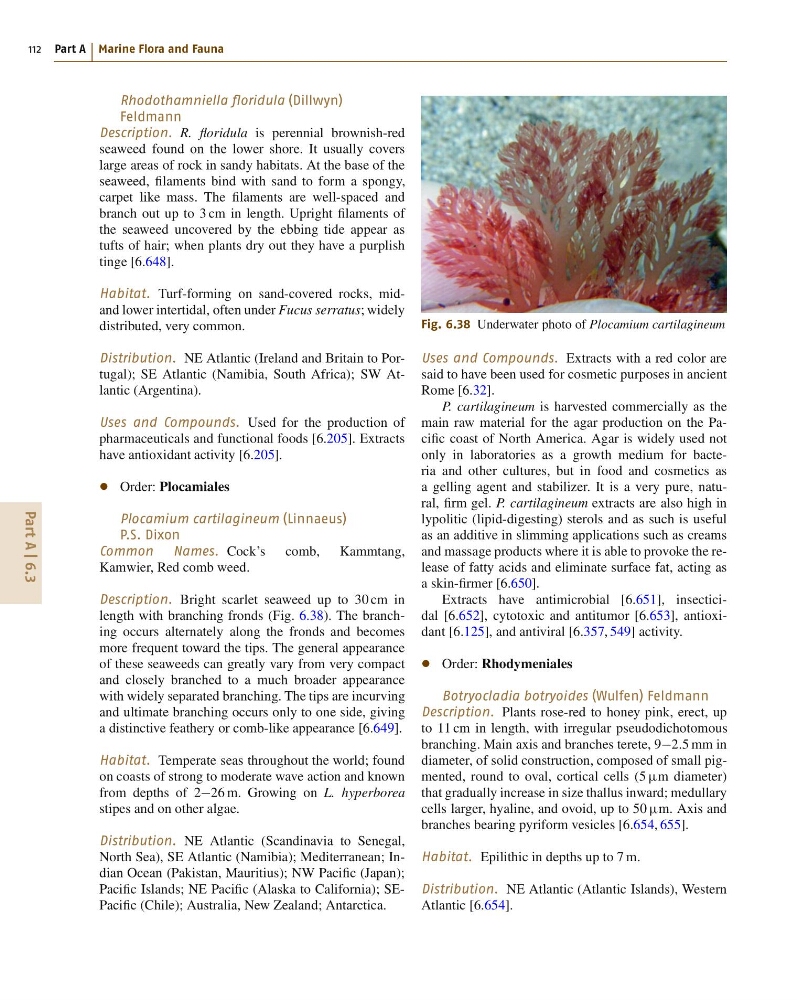
Description. Bright scarlet seaweed up to 30 cm in
length with branching fronds (Fig. 6.38). The branching occurs alternately along the fronds and becomes
more frequent toward the tips. The general appearance
of these seaweeds can greatly vary from very compact
and closely branched to a much broader appearance
with widely separated branching. The tips are incurving
and ultimate branching occurs only to one side, giving
a distinctive feathery or comb-like appearance [6.649].
Habitat. Temperate seas throughout the world; found
on coasts of strong to moderate wave action and known
from depths of 226 m. Growing on L. hyperborea
stipes and on other algae.
Distribution. NE Atlantic (Scandinavia to Senegal,
North Sea), SE Atlantic (Namibia); Mediterranean; Indian Ocean (Pakistan, Mauritius); NW Pacific (Japan);
Pacific Islands; NE Pacific (Alaska to California); SEPacific (Chile); Australia, New Zealand; Antarctica.
Fig. 6.38 Underwater photo of Plocamium cartilagineum
Uses and Compounds. Extracts with a red color are
said to have been used for cosmetic purposes in ancient
Rome [6.32].
P. cartilagineum is harvested commercially as the
main raw material for the agar production on the Pacific coast of North America. Agar is widely used not
only in laboratories as a growth medium for bacteria and other cultures, but in food and cosmetics as
a gelling agent and stabilizer. It is a very pure, natural, firm gel. P. cartilagineum extracts are also high in
lypolitic (lipid-digesting) sterols and as such is useful
as an additive in slimming applications such as creams
and massage products where it is able to provoke the release of fatty acids and eliminate surface fat, acting as
a skin-firmer [6.650].
Extracts have antimicrobial [6.651], insecticidal [6.652], cytotoxic and antitumor [6.653], antioxidant [6.125], and antiviral [6.357, 549] activity.
Order: Rhodymeniales
Botryocladia botryoides (Wulfen) Feldmann
Description. Plants rose-red to honey pink, erect, up
to 11 cm in length, with irregular pseudodichotomous
branching. Main axis and branches terete, 92:5 mm in
diameter, of solid construction, composed of small pigmented, round to oval, cortical cells (5 m diameter)
that gradually increase in size thallus inward; medullary
cells larger, hyaline, and ovoid, up to 50 m. Axis and
branches bearing pyriform vesicles [6.654, 655].
Habitat. Epilithic in depths up to 7 m.
Distribution. NE Atlantic (Atlantic Islands), Western
Atlantic [6.654].
112 Part A Marine Flora and Fauna
Rhodothamniella floridula (Dillwyn)
Feldmann
Description. R. floridula is perennial brownish-red
seaweed found on the lower shore. It usually covers
large areas of rock in sandy habitats. At the base of the
seaweed, filaments bind with sand to form a spongy,
carpet like mass. The filaments are well-spaced and
branch out up to 3 cm in length. Upright filaments of
the seaweed uncovered by the ebbing tide appear as
tufts of hair; when plants dry out they have a purplish
tinge [6.648].
Habitat. Turf-forming on sand-covered rocks, midand lower intertidal, often under Fucus serratus; widely
distributed, very common.
Distribution. NE Atlantic (Ireland and Britain to Portugal); SE Atlantic (Namibia, South Africa); SW Atlantic (Argentina).
Uses and Compounds. Used for the production of
pharmaceuticals and functional foods [6.205]. Extracts
have antioxidant activity [6.205].
Order: Plocamiales
Plocamium cartilagineum (Linnaeus)
P.S. Dixon
Common Names. Cock’s comb, Kammtang,
Kamwier, Red comb weed.
Description. Bright scarlet seaweed up to 30 cm in
length with branching fronds (Fig. 6.38). The branching occurs alternately along the fronds and becomes
more frequent toward the tips. The general appearance
of these seaweeds can greatly vary from very compact
and closely branched to a much broader appearance
with widely separated branching. The tips are incurving
and ultimate branching occurs only to one side, giving
a distinctive feathery or comb-like appearance [6.649].
Habitat. Temperate seas throughout the world; found
on coasts of strong to moderate wave action and known
from depths of 226 m. Growing on L. hyperborea
stipes and on other algae.
Distribution. NE Atlantic (Scandinavia to Senegal,
North Sea), SE Atlantic (Namibia); Mediterranean; Indian Ocean (Pakistan, Mauritius); NW Pacific (Japan);
Pacific Islands; NE Pacific (Alaska to California); SEPacific (Chile); Australia, New Zealand; Antarctica.
Fig. 6.38 Underwater photo of Plocamium cartilagineum
Uses and Compounds. Extracts with a red color are
said to have been used for cosmetic purposes in ancient
Rome [6.32].
P. cartilagineum is harvested commercially as the
main raw material for the agar production on the Pacific coast of North America. Agar is widely used not
only in laboratories as a growth medium for bacteria and other cultures, but in food and cosmetics as
a gelling agent and stabilizer. It is a very pure, natural, firm gel. P. cartilagineum extracts are also high in
lypolitic (lipid-digesting) sterols and as such is useful
as an additive in slimming applications such as creams
and massage products where it is able to provoke the release of fatty acids and eliminate surface fat, acting as
a skin-firmer [6.650].
Extracts have antimicrobial [6.651], insecticidal [6.652], cytotoxic and antitumor [6.653], antioxidant [6.125], and antiviral [6.357, 549] activity.
Order: Rhodymeniales
Botryocladia botryoides (Wulfen) Feldmann
Description. Plants rose-red to honey pink, erect, up
to 11 cm in length, with irregular pseudodichotomous
branching. Main axis and branches terete, 92:5 mm in
diameter, of solid construction, composed of small pigmented, round to oval, cortical cells (5 m diameter)
that gradually increase in size thallus inward; medullary
cells larger, hyaline, and ovoid, up to 50 m. Axis and
branches bearing pyriform vesicles [6.654, 655].
Habitat. Epilithic in depths up to 7 m.
Distribution. NE Atlantic (Atlantic Islands), Western
Atlantic [6.654].