

Part A | 6.3
104 Part A Marine Flora and Fauna
Distribution. NE and E Atlantic (Ireland to W
Africa); Mediterranean; NW to SW Atlantic (North
and South Carolina, Brazil, Uruguay); Caribbean;
Australia.
Uses and Compounds. Produces sulfated galactans –
carrageenans [6.554] with antioxidant [6.205], and antiviral [6.555–557] activity.
Hypnea cornuta (Kützing) J. Agardh
Description. Plants caespitose or loosely intricatecaespitose, up to 30 cm in length, soft in texture and
reddish brown in color; axes subterete, up to 1 mm
in diameter at the base, pointed at the apex, spirally
branched up to the fourth order; branching angle less
than 908; axes and branches loosely clothed with stellate processes; branches up to 550 m in diameter,
and spinous ultimate branchlets, 6070 m in diameter, slightly constricted at their base; extensive basal
system of prostrate axes attached by secondary discoid holdfasts produced by the cortical cells at any axis
level [6.558].
Habitat. In mid-littoral rock pools exhibit the habit of
free-floating plants, while in the open sea it throve attached on rocks within 50 cm.
Distribution. W Atlantic (USA to Brazil); Mediterranean; Caribbean (Cuba); Indian Ocean; NW Pacific
(Japan); Indonesia; Australia.
Uses and Compounds. Produces carrageenan
[6.559].
Hypnea musciformis (Wulfen) J.V. Lamouroux
Common Names. Hook weed, Hooked seaweed,
Hypnea.
Description. H. musciformis is a red alga with loosely
intertwined cylindrical branches that form clumps or
masses up to 20 cm tall, though plants are often broken
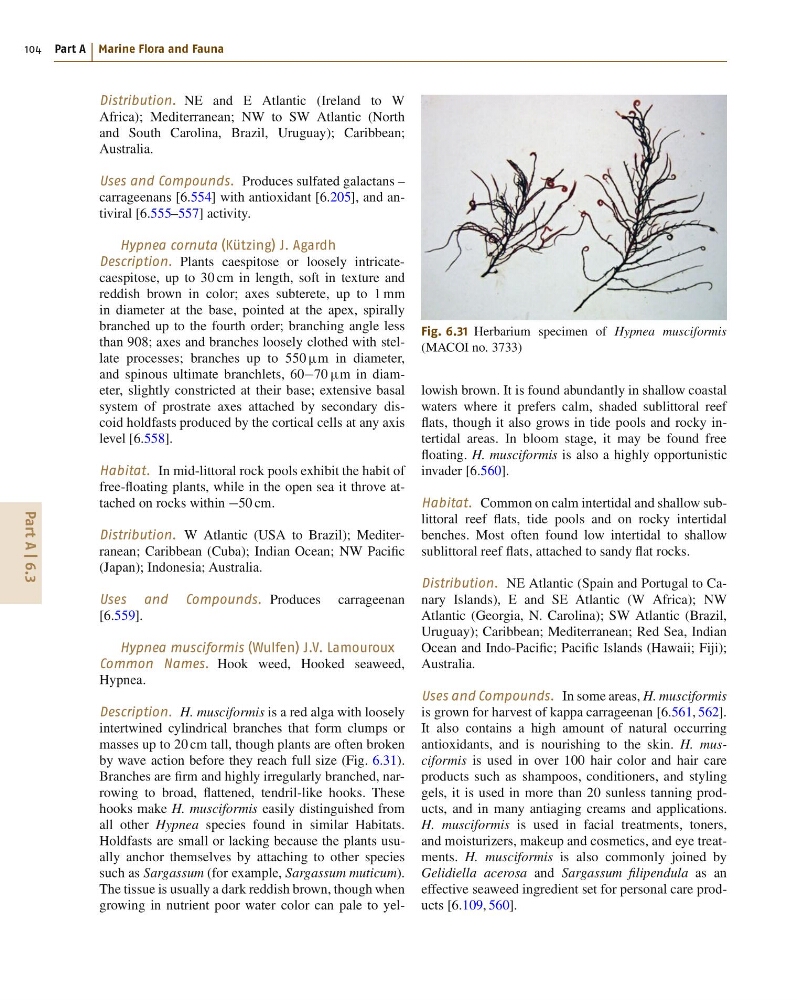
by wave action before they reach full size (Fig. 6.31).
Branches are firm and highly irregularly branched, narrowing to broad, flattened, tendril-like hooks. These
hooks make H. musciformis easily distinguished from
all other Hypnea species found in similar Habitats.
Holdfasts are small or lacking because the plants usually anchor themselves by attaching to other species
such as Sargassum (for example, Sargassum muticum).
The tissue is usually a dark reddish brown, though when
growing in nutrient poor water color can pale to yelFig. 6.31 Herbarium specimen of Hypnea musciformis
(MACOI no. 3733)
lowish brown. It is found abundantly in shallow coastal
waters where it prefers calm, shaded sublittoral reef
flats, though it also grows in tide pools and rocky intertidal areas. In bloom stage, it may be found free
floating. H. musciformis is also a highly opportunistic
invader [6.560].
Habitat. Common on calm intertidal and shallow sublittoral reef flats, tide pools and on rocky intertidal
benches. Most often found low intertidal to shallow
sublittoral reef flats, attached to sandy flat rocks.
Distribution. NE Atlantic (Spain and Portugal to Canary Islands), E and SE Atlantic (W Africa); NW
Atlantic (Georgia, N. Carolina); SW Atlantic (Brazil,
Uruguay); Caribbean; Mediterranean; Red Sea, Indian
Ocean and Indo-Pacific; Pacific Islands (Hawaii; Fiji);
Australia.
Uses and Compounds. In some areas, H. musciformis
is grown for harvest of kappa carrageenan [6.561, 562].
It also contains a high amount of natural occurring
antioxidants, and is nourishing to the skin. H. musciformis is used in over 100 hair color and hair care
products such as shampoos, conditioners, and styling
gels, it is used in more than 20 sunless tanning products, and in many antiaging creams and applications.
H. musciformis is used in facial treatments, toners,
and moisturizers, makeup and cosmetics, and eye treatments. H. musciformis is also commonly joined by
Gelidiella acerosa and Sargassum filipendula as an
effective seaweed ingredient set for personal care products [6.109, 560].
104 Part A Marine Flora and Fauna
Distribution. NE and E Atlantic (Ireland to W
Africa); Mediterranean; NW to SW Atlantic (North
and South Carolina, Brazil, Uruguay); Caribbean;
Australia.
Uses and Compounds. Produces sulfated galactans –
carrageenans [6.554] with antioxidant [6.205], and antiviral [6.555–557] activity.
Hypnea cornuta (Kützing) J. Agardh
Description. Plants caespitose or loosely intricatecaespitose, up to 30 cm in length, soft in texture and
reddish brown in color; axes subterete, up to 1 mm
in diameter at the base, pointed at the apex, spirally
branched up to the fourth order; branching angle less
than 908; axes and branches loosely clothed with stellate processes; branches up to 550 m in diameter,
and spinous ultimate branchlets, 6070 m in diameter, slightly constricted at their base; extensive basal
system of prostrate axes attached by secondary discoid holdfasts produced by the cortical cells at any axis
level [6.558].
Habitat. In mid-littoral rock pools exhibit the habit of
free-floating plants, while in the open sea it throve attached on rocks within 50 cm.
Distribution. W Atlantic (USA to Brazil); Mediterranean; Caribbean (Cuba); Indian Ocean; NW Pacific
(Japan); Indonesia; Australia.
Uses and Compounds. Produces carrageenan
[6.559].
Hypnea musciformis (Wulfen) J.V. Lamouroux
Common Names. Hook weed, Hooked seaweed,
Hypnea.
Description. H. musciformis is a red alga with loosely
intertwined cylindrical branches that form clumps or
masses up to 20 cm tall, though plants are often broken
by wave action before they reach full size (Fig. 6.31).
Branches are firm and highly irregularly branched, narrowing to broad, flattened, tendril-like hooks. These
hooks make H. musciformis easily distinguished from
all other Hypnea species found in similar Habitats.
Holdfasts are small or lacking because the plants usually anchor themselves by attaching to other species
such as Sargassum (for example, Sargassum muticum).
The tissue is usually a dark reddish brown, though when
growing in nutrient poor water color can pale to yelFig. 6.31 Herbarium specimen of Hypnea musciformis
(MACOI no. 3733)
lowish brown. It is found abundantly in shallow coastal
waters where it prefers calm, shaded sublittoral reef
flats, though it also grows in tide pools and rocky intertidal areas. In bloom stage, it may be found free
floating. H. musciformis is also a highly opportunistic
invader [6.560].
Habitat. Common on calm intertidal and shallow sublittoral reef flats, tide pools and on rocky intertidal
benches. Most often found low intertidal to shallow
sublittoral reef flats, attached to sandy flat rocks.
Distribution. NE Atlantic (Spain and Portugal to Canary Islands), E and SE Atlantic (W Africa); NW
Atlantic (Georgia, N. Carolina); SW Atlantic (Brazil,
Uruguay); Caribbean; Mediterranean; Red Sea, Indian
Ocean and Indo-Pacific; Pacific Islands (Hawaii; Fiji);
Australia.
Uses and Compounds. In some areas, H. musciformis
is grown for harvest of kappa carrageenan [6.561, 562].
It also contains a high amount of natural occurring
antioxidants, and is nourishing to the skin. H. musciformis is used in over 100 hair color and hair care
products such as shampoos, conditioners, and styling
gels, it is used in more than 20 sunless tanning products, and in many antiaging creams and applications.
H. musciformis is used in facial treatments, toners,
and moisturizers, makeup and cosmetics, and eye treatments. H. musciformis is also commonly joined by
Gelidiella acerosa and Sargassum filipendula as an
effective seaweed ingredient set for personal care products [6.109, 560].