

Seaweed Flora of the European North Atlantic and Mediterranean 6.3 Seaweeds Biodiversity and Potential 103
Part A | 6.3
fastigiate, to 2 mm diameter and 300 mm long, with
acute apices; attached by much-branched rhizoids.
Multiaxial, medulla of cylindrical cells interspersed
with rhizoids, cortex of irregular filaments, inner
cells elliptical, outer cells narrow, elongated, in radial
rows [6.544].
Habitat. On rocks, lower intertidal and shallow sublittoral, in pools and runnels, in open situations, often on
sandy and muddy shores, tolerating lowered salinities.
Distribution. North Atlantic (Nova Scotia, Greenaland); NE Atlantic (Faroe Islands, Ireland and Britain to
Spain), North Sea (Scandinavia, Hegoland), Baltic; W
Mediterranean (Spain, Sardinia, Sicily); Indian Ocean
(India, Pakistan).
Uses and Compounds. Source of hybrid carrageenan
(Furcellaran) [6.32, 545]. The sulfated polysaccharides of this species have immunostimulation activity [6.546].
Gigartina pistillata (S.G. Gmelin) Stackhouse
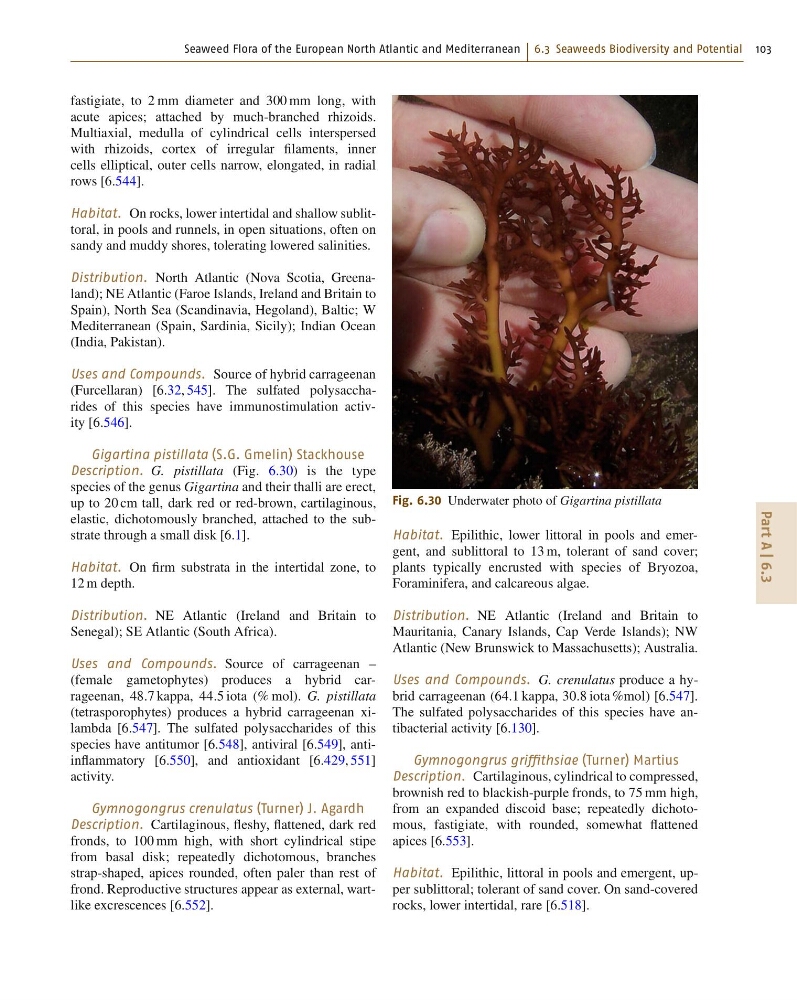
Description. G. pistillata (Fig. 6.30) is the type
species of the genus Gigartina and their thalli are erect,
up to 20 cm tall, dark red or red-brown, cartilaginous,
elastic, dichotomously branched, attached to the substrate through a small disk [6.1].
Habitat. On firm substrata in the intertidal zone, to
12 m depth.
Distribution. NE Atlantic (Ireland and Britain to
Senegal); SE Atlantic (South Africa).
Uses and Compounds. Source of carrageenan –
(female gametophytes) produces a hybrid carrageenan, 48:7 kappa, 44:5 iota (% mol). G. pistillata
(tetrasporophytes) produces a hybrid carrageenan xilambda [6.547]. The sulfated polysaccharides of this
species have antitumor [6.548], antiviral [6.549], antiinflammatory [6.550], and antioxidant [6.429, 551]
activity.
Gymnogongrus crenulatus (Turner) J. Agardh
Description. Cartilaginous, fleshy, flattened, dark red
fronds, to 100 mm high, with short cylindrical stipe
from basal disk; repeatedly dichotomous, branches
strap-shaped, apices rounded, often paler than rest of
frond. Reproductive structures appear as external, wartlike excrescences [6.552].
Fig. 6.30 Underwater photo of Gigartina pistillata
Habitat. Epilithic, lower littoral in pools and emergent, and sublittoral to 13 m, tolerant of sand cover;
plants typically encrusted with species of Bryozoa,
Foraminifera, and calcareous algae.
Distribution. NE Atlantic (Ireland and Britain to
Mauritania, Canary Islands, Cap Verde Islands); NW
Atlantic (New Brunswick to Massachusetts); Australia.
Uses and Compounds. G. crenulatus produce a hybrid carrageenan (64:1 kappa, 30:8 iota %mol) [6.547].
The sulfated polysaccharides of this species have antibacterial activity [6.130].
Gymnogongrus griffithsiae (Turner) Martius
Description. Cartilaginous, cylindrical to compressed,
brownish red to blackish-purple fronds, to 75 mm high,
from an expanded discoid base; repeatedly dichotomous, fastigiate, with rounded, somewhat flattened
apices [6.553].
Habitat. Epilithic, littoral in pools and emergent, upper sublittoral; tolerant of sand cover. On sand-covered
rocks, lower intertidal, rare [6.518].
Part A | 6.3
fastigiate, to 2 mm diameter and 300 mm long, with
acute apices; attached by much-branched rhizoids.
Multiaxial, medulla of cylindrical cells interspersed
with rhizoids, cortex of irregular filaments, inner
cells elliptical, outer cells narrow, elongated, in radial
rows [6.544].
Habitat. On rocks, lower intertidal and shallow sublittoral, in pools and runnels, in open situations, often on
sandy and muddy shores, tolerating lowered salinities.
Distribution. North Atlantic (Nova Scotia, Greenaland); NE Atlantic (Faroe Islands, Ireland and Britain to
Spain), North Sea (Scandinavia, Hegoland), Baltic; W
Mediterranean (Spain, Sardinia, Sicily); Indian Ocean
(India, Pakistan).
Uses and Compounds. Source of hybrid carrageenan
(Furcellaran) [6.32, 545]. The sulfated polysaccharides of this species have immunostimulation activity [6.546].
Gigartina pistillata (S.G. Gmelin) Stackhouse
Description. G. pistillata (Fig. 6.30) is the type
species of the genus Gigartina and their thalli are erect,
up to 20 cm tall, dark red or red-brown, cartilaginous,
elastic, dichotomously branched, attached to the substrate through a small disk [6.1].
Habitat. On firm substrata in the intertidal zone, to
12 m depth.
Distribution. NE Atlantic (Ireland and Britain to
Senegal); SE Atlantic (South Africa).
Uses and Compounds. Source of carrageenan –
(female gametophytes) produces a hybrid carrageenan, 48:7 kappa, 44:5 iota (% mol). G. pistillata
(tetrasporophytes) produces a hybrid carrageenan xilambda [6.547]. The sulfated polysaccharides of this
species have antitumor [6.548], antiviral [6.549], antiinflammatory [6.550], and antioxidant [6.429, 551]
activity.
Gymnogongrus crenulatus (Turner) J. Agardh
Description. Cartilaginous, fleshy, flattened, dark red
fronds, to 100 mm high, with short cylindrical stipe
from basal disk; repeatedly dichotomous, branches
strap-shaped, apices rounded, often paler than rest of
frond. Reproductive structures appear as external, wartlike excrescences [6.552].
Fig. 6.30 Underwater photo of Gigartina pistillata
Habitat. Epilithic, lower littoral in pools and emergent, and sublittoral to 13 m, tolerant of sand cover;
plants typically encrusted with species of Bryozoa,
Foraminifera, and calcareous algae.
Distribution. NE Atlantic (Ireland and Britain to
Mauritania, Canary Islands, Cap Verde Islands); NW
Atlantic (New Brunswick to Massachusetts); Australia.
Uses and Compounds. G. crenulatus produce a hybrid carrageenan (64:1 kappa, 30:8 iota %mol) [6.547].
The sulfated polysaccharides of this species have antibacterial activity [6.130].
Gymnogongrus griffithsiae (Turner) Martius
Description. Cartilaginous, cylindrical to compressed,
brownish red to blackish-purple fronds, to 75 mm high,
from an expanded discoid base; repeatedly dichotomous, fastigiate, with rounded, somewhat flattened
apices [6.553].
Habitat. Epilithic, littoral in pools and emergent, upper sublittoral; tolerant of sand cover. On sand-covered
rocks, lower intertidal, rare [6.518].