

Part A | 6.3
102 Part A Marine Flora and Fauna
pharmaceutical industries. Examples of applications
include making ice cream and air fresheners, beer clarification, and treatment for coughs and diarrhea [6.109,
530, 531].
Extracts have antifouling and antibacterial [6.61,
532], antioxidant, and antimicrobial [6.205, 373, 533].
Cystoclonium purpureum (Hudson) Batters
Description. Rather soft, cylindrical, dull-purplish
pink fronds, 3 mm wide, to 600 mm long. Branches
numerous, alternate, branchlets tapered at both ends;
branches sometimes drawn out into long twisting tendrils; multiaxial, medulla a cordlike strand of loosely
interwoven, narrow filaments, surrounded by large,
rounded cells, with outer layer of small, angular, assimilatory cells; said to have an onion-like smell shortly
after collection [6.534].
Habitat. On rocks and stones in mid-littoral and in
shallow sublittoral, generally distributed, abundant.
Distribution. North Atlantic (Arctic Canada to
Spain); North Sea (Helgoland); Baltic, Mediterranean (Greece), Indian Ocean (Pakistan), Australia
(Queensland).
Uses and Compounds. Source of carrageenan [6.32,
521, 535]. Extracts have nematicide [6.536], antibacterial [6.86, 358, 537], and anticoagulant [6.375]
activity.
Dilsea carnosa (Schmidel) Kuntze
Common Name. Red rags.
Description. One of the larger red seaweeds, D.
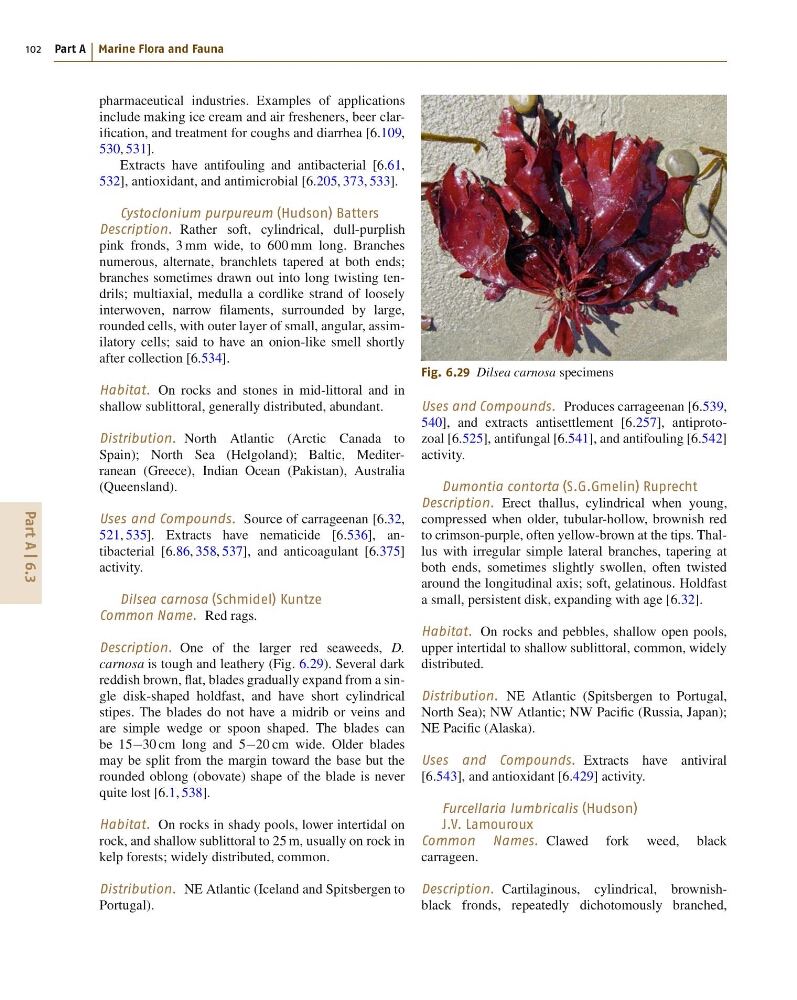
carnosa is tough and leathery (Fig. 6.29). Several dark
reddish brown, flat, blades gradually expand from a single disk-shaped holdfast, and have short cylindrical
stipes. The blades do not have a midrib or veins and
are simple wedge or spoon shaped. The blades can
be 1530 cm long and 520 cm wide. Older blades
may be split from the margin toward the base but the
rounded oblong (obovate) shape of the blade is never
quite lost [6.1, 538].
Habitat. On rocks in shady pools, lower intertidal on
rock, and shallow sublittoral to 25 m, usually on rock in
kelp forests; widely distributed, common.
Distribution. NE Atlantic (Iceland and Spitsbergen to
Portugal).
Fig. 6.29 Dilsea carnosa specimens
Uses and Compounds. Produces carrageenan [6.539,
540], and extracts antisettlement [6.257], antiprotozoal [6.525], antifungal [6.541], and antifouling [6.542]
activity.
Dumontia contorta (S.G.Gmelin) Ruprecht
Description. Erect thallus, cylindrical when young,
compressed when older, tubular-hollow, brownish red
to crimson-purple, often yellow-brown at the tips. Thallus with irregular simple lateral branches, tapering at
both ends, sometimes slightly swollen, often twisted
around the longitudinal axis; soft, gelatinous. Holdfast
a small, persistent disk, expanding with age [6.32].
Habitat. On rocks and pebbles, shallow open pools,
upper intertidal to shallow sublittoral, common, widely
distributed.
Distribution. NE Atlantic (Spitsbergen to Portugal,
North Sea); NW Atlantic; NW Pacific (Russia, Japan);
NE Pacific (Alaska).
Uses and Compounds. Extracts have antiviral
[6.543], and antioxidant [6.429] activity.
Furcellaria lumbricalis (Hudson)
J.V. Lamouroux
Common Names. Clawed fork weed, black
carrageen.
Description. Cartilaginous, cylindrical, brownishblack fronds, repeatedly dichotomously branched,
102 Part A Marine Flora and Fauna
pharmaceutical industries. Examples of applications
include making ice cream and air fresheners, beer clarification, and treatment for coughs and diarrhea [6.109,
530, 531].
Extracts have antifouling and antibacterial [6.61,
532], antioxidant, and antimicrobial [6.205, 373, 533].
Cystoclonium purpureum (Hudson) Batters
Description. Rather soft, cylindrical, dull-purplish
pink fronds, 3 mm wide, to 600 mm long. Branches
numerous, alternate, branchlets tapered at both ends;
branches sometimes drawn out into long twisting tendrils; multiaxial, medulla a cordlike strand of loosely
interwoven, narrow filaments, surrounded by large,
rounded cells, with outer layer of small, angular, assimilatory cells; said to have an onion-like smell shortly
after collection [6.534].
Habitat. On rocks and stones in mid-littoral and in
shallow sublittoral, generally distributed, abundant.
Distribution. North Atlantic (Arctic Canada to
Spain); North Sea (Helgoland); Baltic, Mediterranean (Greece), Indian Ocean (Pakistan), Australia
(Queensland).
Uses and Compounds. Source of carrageenan [6.32,
521, 535]. Extracts have nematicide [6.536], antibacterial [6.86, 358, 537], and anticoagulant [6.375]
activity.
Dilsea carnosa (Schmidel) Kuntze
Common Name. Red rags.
Description. One of the larger red seaweeds, D.
carnosa is tough and leathery (Fig. 6.29). Several dark
reddish brown, flat, blades gradually expand from a single disk-shaped holdfast, and have short cylindrical
stipes. The blades do not have a midrib or veins and
are simple wedge or spoon shaped. The blades can
be 1530 cm long and 520 cm wide. Older blades
may be split from the margin toward the base but the
rounded oblong (obovate) shape of the blade is never
quite lost [6.1, 538].
Habitat. On rocks in shady pools, lower intertidal on
rock, and shallow sublittoral to 25 m, usually on rock in
kelp forests; widely distributed, common.
Distribution. NE Atlantic (Iceland and Spitsbergen to
Portugal).
Fig. 6.29 Dilsea carnosa specimens
Uses and Compounds. Produces carrageenan [6.539,
540], and extracts antisettlement [6.257], antiprotozoal [6.525], antifungal [6.541], and antifouling [6.542]
activity.
Dumontia contorta (S.G.Gmelin) Ruprecht
Description. Erect thallus, cylindrical when young,
compressed when older, tubular-hollow, brownish red
to crimson-purple, often yellow-brown at the tips. Thallus with irregular simple lateral branches, tapering at
both ends, sometimes slightly swollen, often twisted
around the longitudinal axis; soft, gelatinous. Holdfast
a small, persistent disk, expanding with age [6.32].
Habitat. On rocks and pebbles, shallow open pools,
upper intertidal to shallow sublittoral, common, widely
distributed.
Distribution. NE Atlantic (Spitsbergen to Portugal,
North Sea); NW Atlantic; NW Pacific (Russia, Japan);
NE Pacific (Alaska).
Uses and Compounds. Extracts have antiviral
[6.543], and antioxidant [6.429] activity.
Furcellaria lumbricalis (Hudson)
J.V. Lamouroux
Common Names. Clawed fork weed, black
carrageen.
Description. Cartilaginous, cylindrical, brownishblack fronds, repeatedly dichotomously branched,