

Seaweed Flora of the European North Atlantic and Mediterranean 6.3 Seaweeds Biodiversity and Potential 105
Part A | 6.3
Extracts have antiviral [6.238], antifungal [6.563,
564], antitumoral [6.421, 565], antihelminthic [6.566],
psychotropic and anxiolytic [6.567], antibacterial [6.38,
70, 242, 421, 568, 569], cytotoxic, antioxidant, larvicidal, and antifeed [6.242, 570, 571] activity.
Hypnea spinella (C. Agardh) Kützing
Description. Fragile, upright, or in tangled mats, to
15 cm high, light brown-red, rose-red or bleached;
branching in all directions; branches 0:41:0 mm
diameter, cylindrical. Branchlets spine-, spur-, or
tendril-like, numerous, spirally arranged, to 2:5 mm
long, occasionally longer; apices tapering, pointed,
slightly up-curved. Cortex 12 cells thick; cells
rounded to irregular, 7:525:0 m diameter, densely
pigmented; medullary cells thick-walled, irregular
to ovoid, 100320 m diameter, surrounding obvious thick-walled central filament (7080 m diameter); holdfast initially disk-like. Tetrasporangia ovoid,
1023 m diameter, 2549 m long, zonately divided,
in swollen sori (nemathecia) girdling middle part of
lateral branchlet; cystocarps spherical, 100900 m
diameter, solitary or clustered at base to middle of
branchlet [6.572].
Habitat. Attached to small shells or rubble, often
entangled in seagrass beds; lower intertidal to 7 m (reported to 27 m) deep.
Distribution. Warm E Atlantic (Atlantic Islands, W
coast of Africa); Mediterranean; Caribbean; NW Pacific
(Japan, China); Pacific Islands (Hawaii); Indo-Pacific
(Philippines, Vietnam); E Pacific (Mexico, Ecuador);
Australia.
Uses and Compounds. This is an edible species, being commonly eaten (boiled in coconut milk) in other
parts of the Pacific and Asia [6.573]. Extracts have
antifungal [6.204], and immunomodulatory [6.394]
activity.
Mastocarpus stellatus (Stackhouse) Guiry
Common Name. False Irish moss.
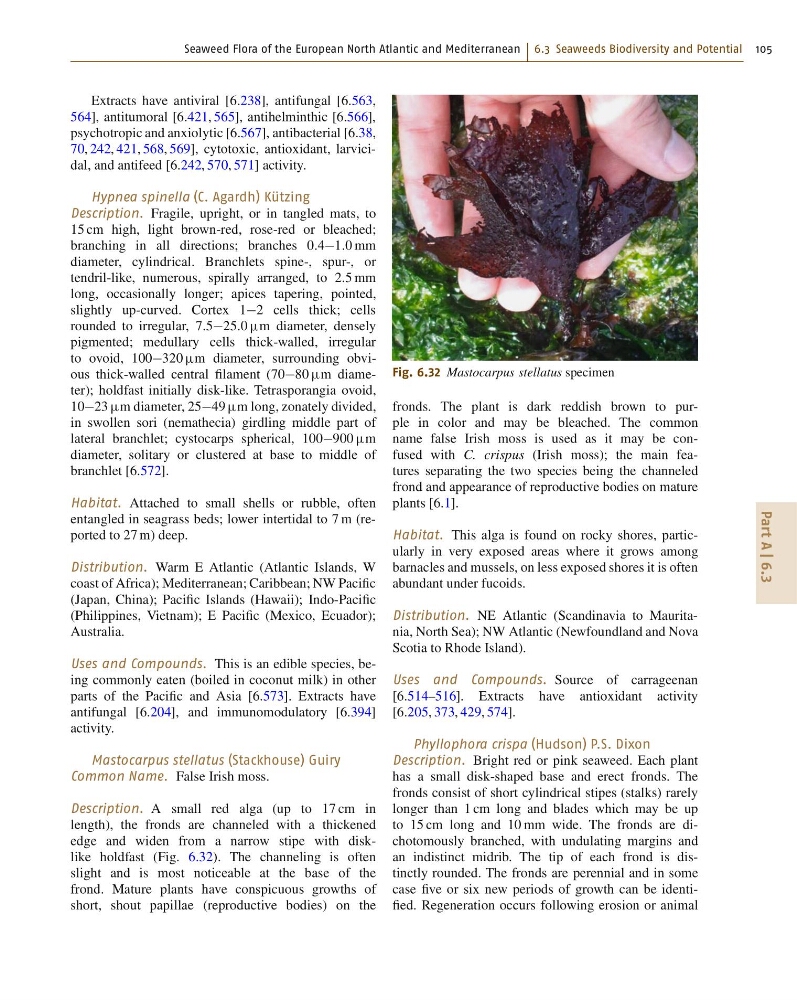
Description. A small red alga (up to 17 cm in
length), the fronds are channeled with a thickened
edge and widen from a narrow stipe with disklike holdfast (Fig. 6.32). The channeling is often
slight and is most noticeable at the base of the
frond. Mature plants have conspicuous growths of
short, shout papillae (reproductive bodies) on the
Fig. 6.32 Mastocarpus stellatus specimen
fronds. The plant is dark reddish brown to purple in color and may be bleached. The common
name false Irish moss is used as it may be confused with C. crispus (Irish moss); the main features separating the two species being the channeled
frond and appearance of reproductive bodies on mature
plants [6.1].
Habitat. This alga is found on rocky shores, particularly in very exposed areas where it grows among
barnacles and mussels, on less exposed shores it is often
abundant under fucoids.
Distribution. NE Atlantic (Scandinavia to Mauritania, North Sea); NW Atlantic (Newfoundland and Nova
Scotia to Rhode Island).
Uses and Compounds. Source of carrageenan
[6.514–516]. Extracts have antioxidant activity
[6.205, 373, 429, 574].
Phyllophora crispa (Hudson) P.S. Dixon
Description. Bright red or pink seaweed. Each plant
has a small disk-shaped base and erect fronds. The
fronds consist of short cylindrical stipes (stalks) rarely
longer than 1 cm long and blades which may be up
to 15 cm long and 10 mm wide. The fronds are dichotomously branched, with undulating margins and
an indistinct midrib. The tip of each frond is distinctly rounded. The fronds are perennial and in some
case five or six new periods of growth can be identified. Regeneration occurs following erosion or animal
Part A | 6.3
Extracts have antiviral [6.238], antifungal [6.563,
564], antitumoral [6.421, 565], antihelminthic [6.566],
psychotropic and anxiolytic [6.567], antibacterial [6.38,
70, 242, 421, 568, 569], cytotoxic, antioxidant, larvicidal, and antifeed [6.242, 570, 571] activity.
Hypnea spinella (C. Agardh) Kützing
Description. Fragile, upright, or in tangled mats, to
15 cm high, light brown-red, rose-red or bleached;
branching in all directions; branches 0:41:0 mm
diameter, cylindrical. Branchlets spine-, spur-, or
tendril-like, numerous, spirally arranged, to 2:5 mm
long, occasionally longer; apices tapering, pointed,
slightly up-curved. Cortex 12 cells thick; cells
rounded to irregular, 7:525:0 m diameter, densely
pigmented; medullary cells thick-walled, irregular
to ovoid, 100320 m diameter, surrounding obvious thick-walled central filament (7080 m diameter); holdfast initially disk-like. Tetrasporangia ovoid,
1023 m diameter, 2549 m long, zonately divided,
in swollen sori (nemathecia) girdling middle part of
lateral branchlet; cystocarps spherical, 100900 m
diameter, solitary or clustered at base to middle of
branchlet [6.572].
Habitat. Attached to small shells or rubble, often
entangled in seagrass beds; lower intertidal to 7 m (reported to 27 m) deep.
Distribution. Warm E Atlantic (Atlantic Islands, W
coast of Africa); Mediterranean; Caribbean; NW Pacific
(Japan, China); Pacific Islands (Hawaii); Indo-Pacific
(Philippines, Vietnam); E Pacific (Mexico, Ecuador);
Australia.
Uses and Compounds. This is an edible species, being commonly eaten (boiled in coconut milk) in other
parts of the Pacific and Asia [6.573]. Extracts have
antifungal [6.204], and immunomodulatory [6.394]
activity.
Mastocarpus stellatus (Stackhouse) Guiry
Common Name. False Irish moss.
Description. A small red alga (up to 17 cm in
length), the fronds are channeled with a thickened
edge and widen from a narrow stipe with disklike holdfast (Fig. 6.32). The channeling is often
slight and is most noticeable at the base of the
frond. Mature plants have conspicuous growths of
short, shout papillae (reproductive bodies) on the
Fig. 6.32 Mastocarpus stellatus specimen
fronds. The plant is dark reddish brown to purple in color and may be bleached. The common
name false Irish moss is used as it may be confused with C. crispus (Irish moss); the main features separating the two species being the channeled
frond and appearance of reproductive bodies on mature
plants [6.1].
Habitat. This alga is found on rocky shores, particularly in very exposed areas where it grows among
barnacles and mussels, on less exposed shores it is often
abundant under fucoids.
Distribution. NE Atlantic (Scandinavia to Mauritania, North Sea); NW Atlantic (Newfoundland and Nova
Scotia to Rhode Island).
Uses and Compounds. Source of carrageenan
[6.514–516]. Extracts have antioxidant activity
[6.205, 373, 429, 574].
Phyllophora crispa (Hudson) P.S. Dixon
Description. Bright red or pink seaweed. Each plant
has a small disk-shaped base and erect fronds. The
fronds consist of short cylindrical stipes (stalks) rarely
longer than 1 cm long and blades which may be up
to 15 cm long and 10 mm wide. The fronds are dichotomously branched, with undulating margins and
an indistinct midrib. The tip of each frond is distinctly rounded. The fronds are perennial and in some
case five or six new periods of growth can be identified. Regeneration occurs following erosion or animal