

Seaweed Flora of the European North Atlantic and Mediterranean 6.3 Seaweeds Biodiversity and Potential 91
Part A | 6.3
cave, with ephemerally colorless dichotomous hairs
surrounding apical cell [6.425].
Habitat. On stones and shells, sometimes epiphytic,
upper intertidal, widely distributed, locally common.
Distribution. NE Atlantic (Britain to Morocco); SW
Atlantic (Brazil).
Uses and Compounds. Perform antibacterial activity [6.340, 391].
Osmundea pinnatifida (Hudson)
Stackhouse
Common Name. Pepper dulse.
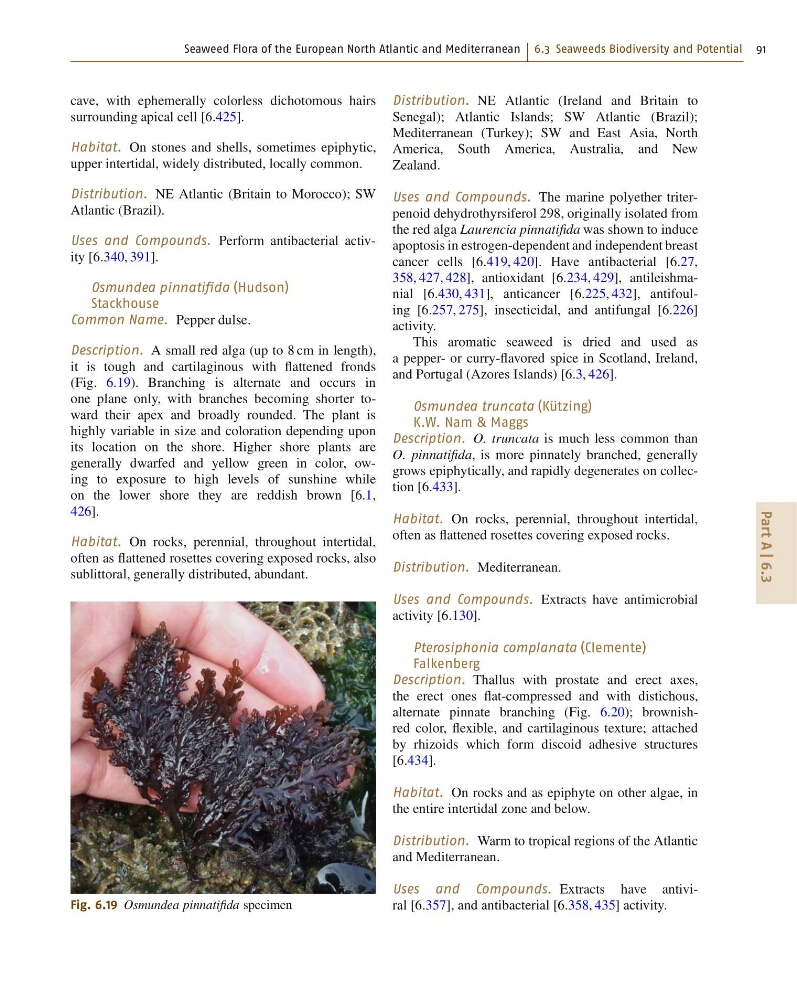
Description. A small red alga (up to 8 cm in length),
it is tough and cartilaginous with flattened fronds
(Fig. 6.19). Branching is alternate and occurs in
one plane only, with branches becoming shorter toward their apex and broadly rounded. The plant is
highly variable in size and coloration depending upon
its location on the shore. Higher shore plants are
generally dwarfed and yellow green in color, owing to exposure to high levels of sunshine while
on the lower shore they are reddish brown [6.1,
426].
Habitat. On rocks, perennial, throughout intertidal,
often as flattened rosettes covering exposed rocks, also
sublittoral, generally distributed, abundant.
Fig. 6.19 Osmundea pinnatifida specimen
Distribution. NE Atlantic (Ireland and Britain to
Senegal); Atlantic Islands; SW Atlantic (Brazil);
Mediterranean (Turkey); SW and East Asia, North
America, South America, Australia, and New
Zealand.
Uses and Compounds. The marine polyether triterpenoid dehydrothyrsiferol 298, originally isolated from
the red alga Laurencia pinnatifida was shown to induce
apoptosis in estrogen-dependent and independent breast
cancer cells [6.419, 420]. Have antibacterial [6.27,
358, 427, 428], antioxidant [6.234, 429], antileishmanial [6.430, 431], anticancer [6.225, 432], antifouling [6.257, 275], insecticidal, and antifungal [6.226]
activity.
This aromatic seaweed is dried and used as
a pepper- or curry-flavored spice in Scotland, Ireland,
and Portugal (Azores Islands) [6.3, 426].
Osmundea truncata (Kützing)
K.W. Nam & Maggs
Description. O. truncata is much less common than
O. pinnatifida, is more pinnately branched, generally
grows epiphytically, and rapidly degenerates on collection [6.433].
Habitat. On rocks, perennial, throughout intertidal,
often as flattened rosettes covering exposed rocks.
Distribution. Mediterranean.
Uses and Compounds. Extracts have antimicrobial
activity [6.130].
Pterosiphonia complanata (Clemente)
Falkenberg
Description. Thallus with prostate and erect axes,
the erect ones flat-compressed and with distichous,
alternate pinnate branching (Fig. 6.20); brownishred color, flexible, and cartilaginous texture; attached
by rhizoids which form discoid adhesive structures
[6.434].
Habitat. On rocks and as epiphyte on other algae, in
the entire intertidal zone and below.
Distribution. Warm to tropical regions of the Atlantic
and Mediterranean.
Uses and Compounds. Extracts have antiviral [6.357], and antibacterial [6.358, 435] activity.
Part A | 6.3
cave, with ephemerally colorless dichotomous hairs
surrounding apical cell [6.425].
Habitat. On stones and shells, sometimes epiphytic,
upper intertidal, widely distributed, locally common.
Distribution. NE Atlantic (Britain to Morocco); SW
Atlantic (Brazil).
Uses and Compounds. Perform antibacterial activity [6.340, 391].
Osmundea pinnatifida (Hudson)
Stackhouse
Common Name. Pepper dulse.
Description. A small red alga (up to 8 cm in length),
it is tough and cartilaginous with flattened fronds
(Fig. 6.19). Branching is alternate and occurs in
one plane only, with branches becoming shorter toward their apex and broadly rounded. The plant is
highly variable in size and coloration depending upon
its location on the shore. Higher shore plants are
generally dwarfed and yellow green in color, owing to exposure to high levels of sunshine while
on the lower shore they are reddish brown [6.1,
426].
Habitat. On rocks, perennial, throughout intertidal,
often as flattened rosettes covering exposed rocks, also
sublittoral, generally distributed, abundant.
Fig. 6.19 Osmundea pinnatifida specimen
Distribution. NE Atlantic (Ireland and Britain to
Senegal); Atlantic Islands; SW Atlantic (Brazil);
Mediterranean (Turkey); SW and East Asia, North
America, South America, Australia, and New
Zealand.
Uses and Compounds. The marine polyether triterpenoid dehydrothyrsiferol 298, originally isolated from
the red alga Laurencia pinnatifida was shown to induce
apoptosis in estrogen-dependent and independent breast
cancer cells [6.419, 420]. Have antibacterial [6.27,
358, 427, 428], antioxidant [6.234, 429], antileishmanial [6.430, 431], anticancer [6.225, 432], antifouling [6.257, 275], insecticidal, and antifungal [6.226]
activity.
This aromatic seaweed is dried and used as
a pepper- or curry-flavored spice in Scotland, Ireland,
and Portugal (Azores Islands) [6.3, 426].
Osmundea truncata (Kützing)
K.W. Nam & Maggs
Description. O. truncata is much less common than
O. pinnatifida, is more pinnately branched, generally
grows epiphytically, and rapidly degenerates on collection [6.433].
Habitat. On rocks, perennial, throughout intertidal,
often as flattened rosettes covering exposed rocks.
Distribution. Mediterranean.
Uses and Compounds. Extracts have antimicrobial
activity [6.130].
Pterosiphonia complanata (Clemente)
Falkenberg
Description. Thallus with prostate and erect axes,
the erect ones flat-compressed and with distichous,
alternate pinnate branching (Fig. 6.20); brownishred color, flexible, and cartilaginous texture; attached
by rhizoids which form discoid adhesive structures
[6.434].
Habitat. On rocks and as epiphyte on other algae, in
the entire intertidal zone and below.
Distribution. Warm to tropical regions of the Atlantic
and Mediterranean.
Uses and Compounds. Extracts have antiviral [6.357], and antibacterial [6.358, 435] activity.