

Seaweed Flora of the European North Atlantic and Mediterranean 6.3 Seaweeds Biodiversity and Potential 87
Part A | 6.3
Habitat. C. coerulescens is a sublittoral species,
growing on pebbles in mud from extreme low water to
4 m depth.
Distribution. NE Atlantic (Ireland and Britain to
Senegal); Mediterranean.
Uses and Compounds. Produces hemagglutinins [6.375].
Chondria dasyphylla (Woodward) C. Agardh
Description. The thallus is 1021 cm high, reddish
brown in color, with the primary erect axis initially arising from a discoid holdfast to 4 mm diameter, subsequently further erect axes arising from the
same holdfast giving a clumped appearance. Short
creeping branchlets are produced from the lowermost
parts of erect axes, and become attached to the substrate by small rhizoidal haptera about 0:5 mm diameter. The thallus branching is irregularly radial,
erect-patent with 3–4 orders of branching, ultimate
branches arising every two to six (eight) axial cells.
Ultimate branchlets are 250500 m diameter, the
variation being a reflection of the robustness of the
plant [6.376].
Habitat. Usually found in mid-littoral pools.
Distribution. NE Atlantic (Ireland to W Africa);
Mediterranean, Caribbean, Indian Ocean.
Uses and Compounds. According to the results
of Khanavi et al. study [6.377], hexane fraction of
Chondria dasyphylla could contain phytosterols (fucosterol) with cytotoxicity against breast and colon
cancer cell line. Extracts of this seaweed have larvicidal [6.378], antibacterial, antifungal, antiprotozoal, antiviral, antifertility, and hypoglycemic [6.218]
activity.
Cryptopleura ramosa (Hudson) L. Newton
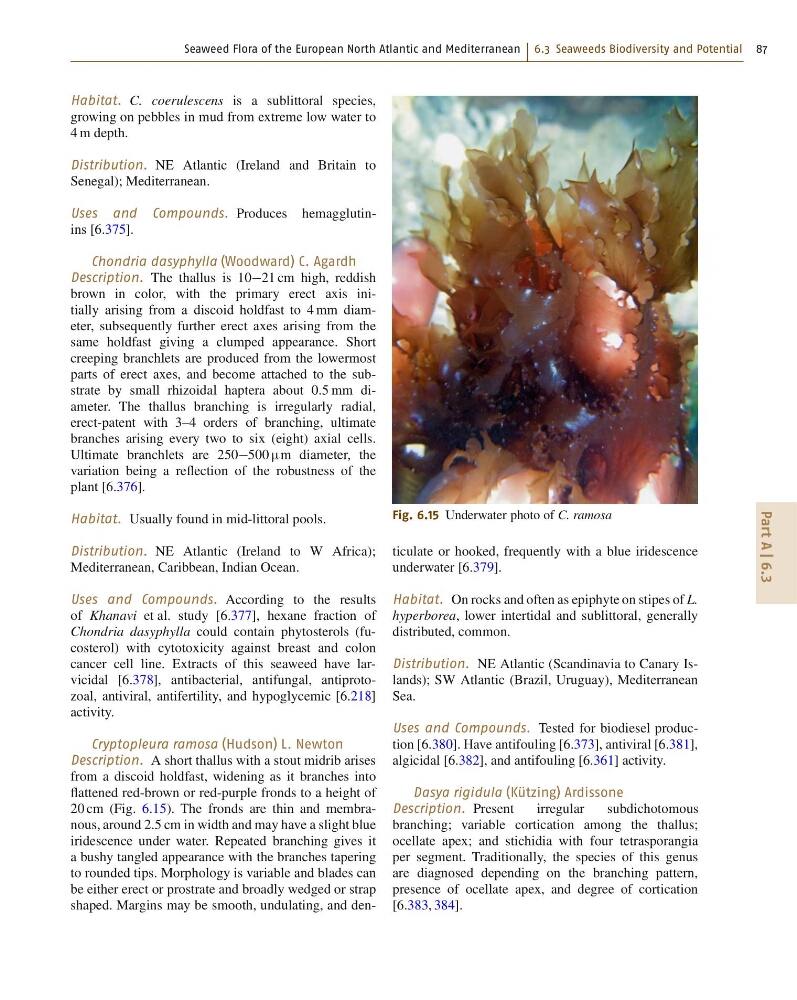
Description. A short thallus with a stout midrib arises
from a discoid holdfast, widening as it branches into
flattened red-brown or red-purple fronds to a height of
20 cm (Fig. 6.15). The fronds are thin and membranous, around 2:5 cm in width and may have a slight blue
iridescence under water. Repeated branching gives it
a bushy tangled appearance with the branches tapering
to rounded tips. Morphology is variable and blades can
be either erect or prostrate and broadly wedged or strap
shaped. Margins may be smooth, undulating, and denFig. 6.15 Underwater photo of C. ramosa
ticulate or hooked, frequently with a blue iridescence
underwater [6.379].
Habitat. On rocks and often as epiphyte on stipes of L.
hyperborea, lower intertidal and sublittoral, generally
distributed, common.
Distribution. NE Atlantic (Scandinavia to Canary Islands); SW Atlantic (Brazil, Uruguay), Mediterranean
Sea.
Uses and Compounds. Tested for biodiesel production [6.380]. Have antifouling [6.373], antiviral [6.381],
algicidal [6.382], and antifouling [6.361] activity.
Dasya rigidula (Kützing) Ardissone
Description. Present
irregular
subdichotomous
branching; variable cortication among the thallus;
ocellate apex; and stichidia with four tetrasporangia
per segment. Traditionally, the species of this genus
are diagnosed depending on the branching pattern,
presence of ocellate apex, and degree of cortication
[6.383, 384].
Part A | 6.3
Habitat. C. coerulescens is a sublittoral species,
growing on pebbles in mud from extreme low water to
4 m depth.
Distribution. NE Atlantic (Ireland and Britain to
Senegal); Mediterranean.
Uses and Compounds. Produces hemagglutinins [6.375].
Chondria dasyphylla (Woodward) C. Agardh
Description. The thallus is 1021 cm high, reddish
brown in color, with the primary erect axis initially arising from a discoid holdfast to 4 mm diameter, subsequently further erect axes arising from the
same holdfast giving a clumped appearance. Short
creeping branchlets are produced from the lowermost
parts of erect axes, and become attached to the substrate by small rhizoidal haptera about 0:5 mm diameter. The thallus branching is irregularly radial,
erect-patent with 3–4 orders of branching, ultimate
branches arising every two to six (eight) axial cells.
Ultimate branchlets are 250500 m diameter, the
variation being a reflection of the robustness of the
plant [6.376].
Habitat. Usually found in mid-littoral pools.
Distribution. NE Atlantic (Ireland to W Africa);
Mediterranean, Caribbean, Indian Ocean.
Uses and Compounds. According to the results
of Khanavi et al. study [6.377], hexane fraction of
Chondria dasyphylla could contain phytosterols (fucosterol) with cytotoxicity against breast and colon
cancer cell line. Extracts of this seaweed have larvicidal [6.378], antibacterial, antifungal, antiprotozoal, antiviral, antifertility, and hypoglycemic [6.218]
activity.
Cryptopleura ramosa (Hudson) L. Newton
Description. A short thallus with a stout midrib arises
from a discoid holdfast, widening as it branches into
flattened red-brown or red-purple fronds to a height of
20 cm (Fig. 6.15). The fronds are thin and membranous, around 2:5 cm in width and may have a slight blue
iridescence under water. Repeated branching gives it
a bushy tangled appearance with the branches tapering
to rounded tips. Morphology is variable and blades can
be either erect or prostrate and broadly wedged or strap
shaped. Margins may be smooth, undulating, and denFig. 6.15 Underwater photo of C. ramosa
ticulate or hooked, frequently with a blue iridescence
underwater [6.379].
Habitat. On rocks and often as epiphyte on stipes of L.
hyperborea, lower intertidal and sublittoral, generally
distributed, common.
Distribution. NE Atlantic (Scandinavia to Canary Islands); SW Atlantic (Brazil, Uruguay), Mediterranean
Sea.
Uses and Compounds. Tested for biodiesel production [6.380]. Have antifouling [6.373], antiviral [6.381],
algicidal [6.382], and antifouling [6.361] activity.
Dasya rigidula (Kützing) Ardissone
Description. Present
irregular
subdichotomous
branching; variable cortication among the thallus;
ocellate apex; and stichidia with four tetrasporangia
per segment. Traditionally, the species of this genus
are diagnosed depending on the branching pattern,
presence of ocellate apex, and degree of cortication
[6.383, 384].