

Part A | 6.3
88 Part A Marine Flora and Fauna
Habitat. From the mid-littoral to deep waters.
Distribution. NE and E Atlantic (From France to
Senegal); Atlantic Islands; West Atlantic; Caribbean;
SW Atlantic (Brazil); Mediterranean.
Uses and Compounds. Have antibacterial activity [6.60].
Delesseria sanguinea (Hudson)
J.V. Lamouroux
Common Name. Sea beech
Description. Membranous, bright crimson fronds,
with cartilaginous, cylindrical, branched stipe, from
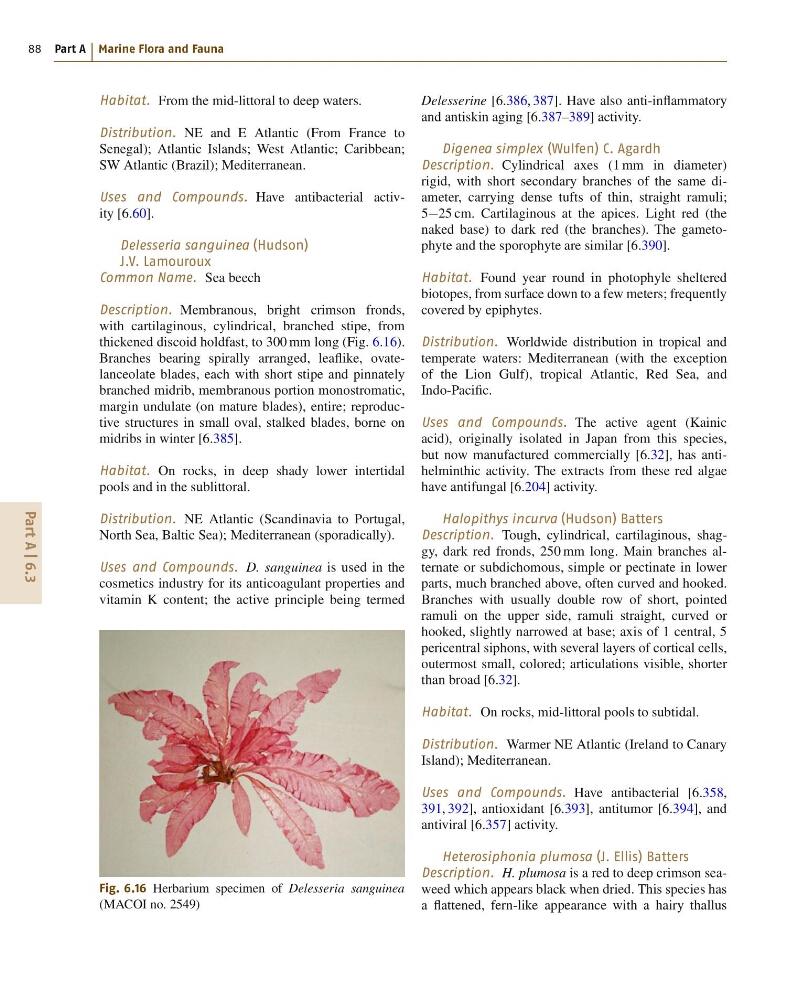
thickened discoid holdfast, to 300 mm long (Fig. 6.16).
Branches bearing spirally arranged, leaflike, ovatelanceolate blades, each with short stipe and pinnately
branched midrib, membranous portion monostromatic,
margin undulate (on mature blades), entire; reproductive structures in small oval, stalked blades, borne on
midribs in winter [6.385].
Habitat. On rocks, in deep shady lower intertidal
pools and in the sublittoral.
Distribution. NE Atlantic (Scandinavia to Portugal,
North Sea, Baltic Sea); Mediterranean (sporadically).
Uses and Compounds. D. sanguinea is used in the
cosmetics industry for its anticoagulant properties and
vitamin K content; the active principle being termed
Fig. 6.16 Herbarium specimen of Delesseria sanguinea
(MACOI no. 2549)
Delesserine [6.386, 387]. Have also anti-inflammatory
and antiskin aging [6.387–389] activity.
Digenea simplex (Wulfen) C. Agardh
Description. Cylindrical axes (1 mm in diameter)
rigid, with short secondary branches of the same diameter, carrying dense tufts of thin, straight ramuli;
525 cm. Cartilaginous at the apices. Light red (the
naked base) to dark red (the branches). The gametophyte and the sporophyte are similar [6.390].
Habitat. Found year round in photophyle sheltered
biotopes, from surface down to a few meters; frequently
covered by epiphytes.
Distribution. Worldwide distribution in tropical and
temperate waters: Mediterranean (with the exception
of the Lion Gulf), tropical Atlantic, Red Sea, and
Indo-Pacific.
Uses and Compounds. The active agent (Kainic
acid), originally isolated in Japan from this species,
but now manufactured commercially [6.32], has antihelminthic activity. The extracts from these red algae
have antifungal [6.204] activity.
Halopithys incurva (Hudson) Batters
Description. Tough, cylindrical, cartilaginous, shaggy, dark red fronds, 250 mm long. Main branches alternate or subdichomous, simple or pectinate in lower
parts, much branched above, often curved and hooked.
Branches with usually double row of short, pointed
ramuli on the upper side, ramuli straight, curved or
hooked, slightly narrowed at base; axis of 1 central, 5
pericentral siphons, with several layers of cortical cells,
outermost small, colored; articulations visible, shorter
than broad [6.32].
Habitat. On rocks, mid-littoral pools to subtidal.
Distribution. Warmer NE Atlantic (Ireland to Canary
Island); Mediterranean.
Uses and Compounds. Have antibacterial [6.358,
391, 392], antioxidant [6.393], antitumor [6.394], and
antiviral [6.357] activity.
Heterosiphonia plumosa (J. Ellis) Batters
Description. H. plumosa is a red to deep crimson seaweed which appears black when dried. This species has
a flattened, fern-like appearance with a hairy thallus
88 Part A Marine Flora and Fauna
Habitat. From the mid-littoral to deep waters.
Distribution. NE and E Atlantic (From France to
Senegal); Atlantic Islands; West Atlantic; Caribbean;
SW Atlantic (Brazil); Mediterranean.
Uses and Compounds. Have antibacterial activity [6.60].
Delesseria sanguinea (Hudson)
J.V. Lamouroux
Common Name. Sea beech
Description. Membranous, bright crimson fronds,
with cartilaginous, cylindrical, branched stipe, from
thickened discoid holdfast, to 300 mm long (Fig. 6.16).
Branches bearing spirally arranged, leaflike, ovatelanceolate blades, each with short stipe and pinnately
branched midrib, membranous portion monostromatic,
margin undulate (on mature blades), entire; reproductive structures in small oval, stalked blades, borne on
midribs in winter [6.385].
Habitat. On rocks, in deep shady lower intertidal
pools and in the sublittoral.
Distribution. NE Atlantic (Scandinavia to Portugal,
North Sea, Baltic Sea); Mediterranean (sporadically).
Uses and Compounds. D. sanguinea is used in the
cosmetics industry for its anticoagulant properties and
vitamin K content; the active principle being termed
Fig. 6.16 Herbarium specimen of Delesseria sanguinea
(MACOI no. 2549)
Delesserine [6.386, 387]. Have also anti-inflammatory
and antiskin aging [6.387–389] activity.
Digenea simplex (Wulfen) C. Agardh
Description. Cylindrical axes (1 mm in diameter)
rigid, with short secondary branches of the same diameter, carrying dense tufts of thin, straight ramuli;
525 cm. Cartilaginous at the apices. Light red (the
naked base) to dark red (the branches). The gametophyte and the sporophyte are similar [6.390].
Habitat. Found year round in photophyle sheltered
biotopes, from surface down to a few meters; frequently
covered by epiphytes.
Distribution. Worldwide distribution in tropical and
temperate waters: Mediterranean (with the exception
of the Lion Gulf), tropical Atlantic, Red Sea, and
Indo-Pacific.
Uses and Compounds. The active agent (Kainic
acid), originally isolated in Japan from this species,
but now manufactured commercially [6.32], has antihelminthic activity. The extracts from these red algae
have antifungal [6.204] activity.
Halopithys incurva (Hudson) Batters
Description. Tough, cylindrical, cartilaginous, shaggy, dark red fronds, 250 mm long. Main branches alternate or subdichomous, simple or pectinate in lower
parts, much branched above, often curved and hooked.
Branches with usually double row of short, pointed
ramuli on the upper side, ramuli straight, curved or
hooked, slightly narrowed at base; axis of 1 central, 5
pericentral siphons, with several layers of cortical cells,
outermost small, colored; articulations visible, shorter
than broad [6.32].
Habitat. On rocks, mid-littoral pools to subtidal.
Distribution. Warmer NE Atlantic (Ireland to Canary
Island); Mediterranean.
Uses and Compounds. Have antibacterial [6.358,
391, 392], antioxidant [6.393], antitumor [6.394], and
antiviral [6.357] activity.
Heterosiphonia plumosa (J. Ellis) Batters
Description. H. plumosa is a red to deep crimson seaweed which appears black when dried. This species has
a flattened, fern-like appearance with a hairy thallus