

Seaweed Flora of the European North Atlantic and Mediterranean 6.3 Seaweeds Biodiversity and Potential 75
Part A | 6.3
Chaetomorpha capillaris (Kützing) Børgesen
Description. Thallus medium green, loose-lying in
shade on tidal flats, forming loose, woolly, entangled
masses with few if any attachment cells. Filaments unbranched, of similar diameter throughout. Cells (70)
85100 .105/ m in diameter and L/B 12, not collapsing on drying; walls 812 m thick; chloroplasts
densely reticulate with numerous pyrenoids [6.158].
Habitat. In shade on mangrove pneumatophores or
under Samphires on tidal flats.
Distribution. Mediterranean and North Atlantic;
Southern Australia and New Zealand.
Uses and Compounds. Have antifungal activity [6.62].
Chaetomorpha linum (O.F. Müller) Kützing
Common Name. Spaghetti algae.
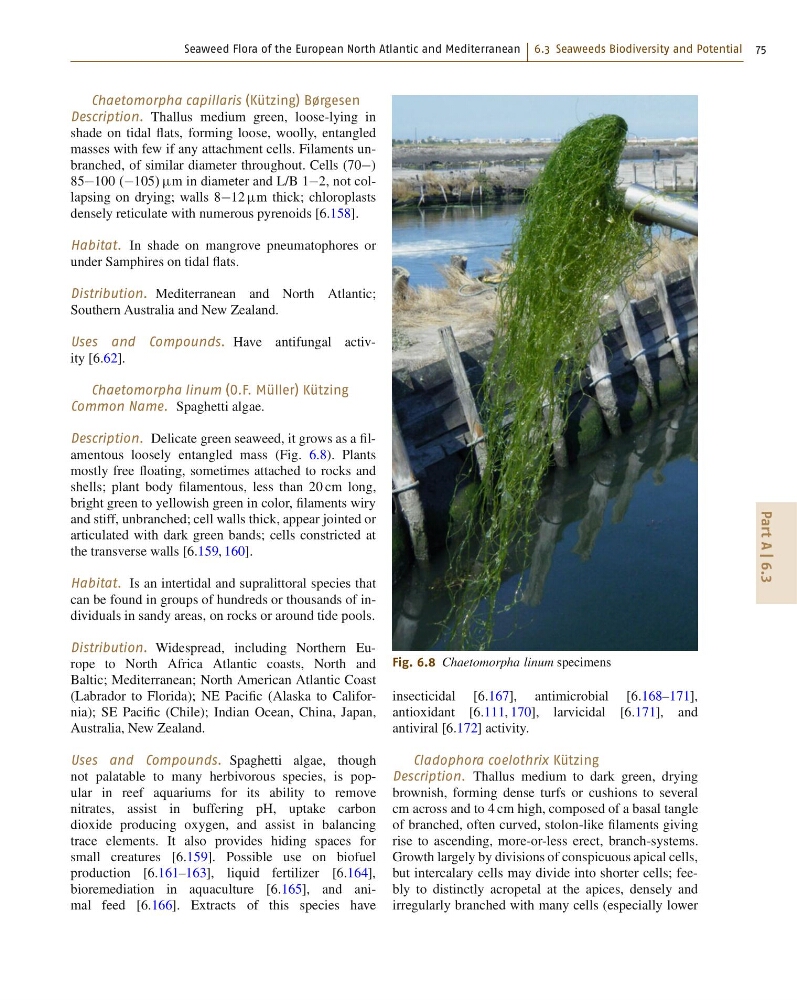
Description. Delicate green seaweed, it grows as a filamentous loosely entangled mass (Fig. 6.8). Plants
mostly free floating, sometimes attached to rocks and
shells; plant body filamentous, less than 20 cm long,
bright green to yellowish green in color, filaments wiry
and stiff, unbranched; cell walls thick, appear jointed or
articulated with dark green bands; cells constricted at
the transverse walls [6.159, 160].
Habitat. Is an intertidal and supralittoral species that
can be found in groups of hundreds or thousands of individuals in sandy areas, on rocks or around tide pools.
Distribution. Widespread, including Northern Europe to North Africa Atlantic coasts, North and
Baltic; Mediterranean; North American Atlantic Coast
(Labrador to Florida); NE Pacific (Alaska to California); SE Pacific (Chile); Indian Ocean, China, Japan,
Australia, New Zealand.
Uses and Compounds. Spaghetti algae, though
not palatable to many herbivorous species, is popular in reef aquariums for its ability to remove
nitrates, assist in buffering pH, uptake carbon
dioxide producing oxygen, and assist in balancing
trace elements. It also provides hiding spaces for
small creatures [6.159]. Possible use on biofuel
production [6.161–163], liquid fertilizer [6.164],
bioremediation in aquaculture [6.165], and animal feed [6.166]. Extracts of this species have
Fig. 6.8 Chaetomorpha linum specimens
insecticidal [6.167], antimicrobial [6.168–171],
antioxidant [6.111, 170], larvicidal [6.171], and
antiviral [6.172] activity.
Cladophora coelothrix Kützing
Description. Thallus medium to dark green, drying
brownish, forming dense turfs or cushions to several
cm across and to 4 cm high, composed of a basal tangle
of branched, often curved, stolon-like filaments giving
rise to ascending, more-or-less erect, branch-systems.
Growth largely by divisions of conspicuous apical cells,
but intercalary cells may divide into shorter cells; feebly to distinctly acropetal at the apices, densely and
irregularly branched with many cells (especially lower
Part A | 6.3
Chaetomorpha capillaris (Kützing) Børgesen
Description. Thallus medium green, loose-lying in
shade on tidal flats, forming loose, woolly, entangled
masses with few if any attachment cells. Filaments unbranched, of similar diameter throughout. Cells (70)
85100 .105/ m in diameter and L/B 12, not collapsing on drying; walls 812 m thick; chloroplasts
densely reticulate with numerous pyrenoids [6.158].
Habitat. In shade on mangrove pneumatophores or
under Samphires on tidal flats.
Distribution. Mediterranean and North Atlantic;
Southern Australia and New Zealand.
Uses and Compounds. Have antifungal activity [6.62].
Chaetomorpha linum (O.F. Müller) Kützing
Common Name. Spaghetti algae.
Description. Delicate green seaweed, it grows as a filamentous loosely entangled mass (Fig. 6.8). Plants
mostly free floating, sometimes attached to rocks and
shells; plant body filamentous, less than 20 cm long,
bright green to yellowish green in color, filaments wiry
and stiff, unbranched; cell walls thick, appear jointed or
articulated with dark green bands; cells constricted at
the transverse walls [6.159, 160].
Habitat. Is an intertidal and supralittoral species that
can be found in groups of hundreds or thousands of individuals in sandy areas, on rocks or around tide pools.
Distribution. Widespread, including Northern Europe to North Africa Atlantic coasts, North and
Baltic; Mediterranean; North American Atlantic Coast
(Labrador to Florida); NE Pacific (Alaska to California); SE Pacific (Chile); Indian Ocean, China, Japan,
Australia, New Zealand.
Uses and Compounds. Spaghetti algae, though
not palatable to many herbivorous species, is popular in reef aquariums for its ability to remove
nitrates, assist in buffering pH, uptake carbon
dioxide producing oxygen, and assist in balancing
trace elements. It also provides hiding spaces for
small creatures [6.159]. Possible use on biofuel
production [6.161–163], liquid fertilizer [6.164],
bioremediation in aquaculture [6.165], and animal feed [6.166]. Extracts of this species have
Fig. 6.8 Chaetomorpha linum specimens
insecticidal [6.167], antimicrobial [6.168–171],
antioxidant [6.111, 170], larvicidal [6.171], and
antiviral [6.172] activity.
Cladophora coelothrix Kützing
Description. Thallus medium to dark green, drying
brownish, forming dense turfs or cushions to several
cm across and to 4 cm high, composed of a basal tangle
of branched, often curved, stolon-like filaments giving
rise to ascending, more-or-less erect, branch-systems.
Growth largely by divisions of conspicuous apical cells,
but intercalary cells may divide into shorter cells; feebly to distinctly acropetal at the apices, densely and
irregularly branched with many cells (especially lower