

Part A | 6.3
74 Part A Marine Flora and Fauna
Uses and Compounds. For a time, important
researches object in cell biology (cell differentiation, interaction of nucleus and cytoplasm)
[6.32].
Class: Siphonocladophyceae
Order: Siphonocladales
Valonia utricularis (Roth) C. Agardh
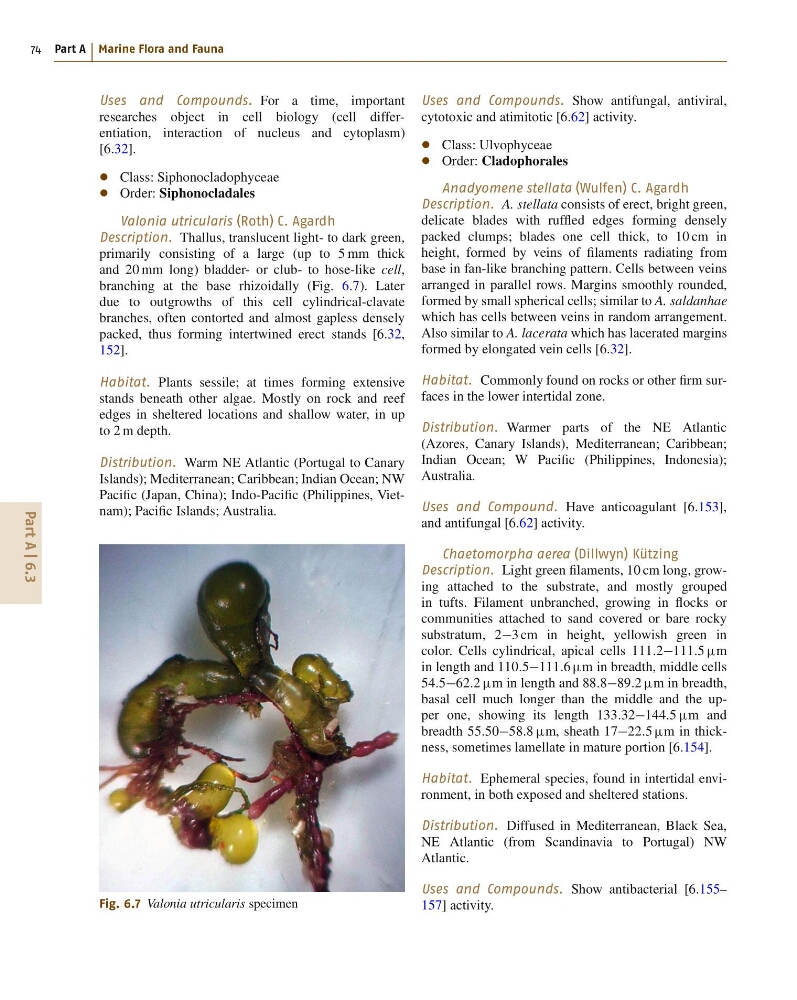
Description. Thallus, translucent light- to dark green,
primarily consisting of a large (up to 5 mm thick
and 20 mm long) bladder- or club- to hose-like cell,
branching at the base rhizoidally (Fig. 6.7). Later
due to outgrowths of this cell cylindrical-clavate
branches, often contorted and almost gapless densely
packed, thus forming intertwined erect stands [6.32,
152].
Habitat. Plants sessile; at times forming extensive
stands beneath other algae. Mostly on rock and reef
edges in sheltered locations and shallow water, in up
to 2 m depth.
Distribution. Warm NE Atlantic (Portugal to Canary
Islands); Mediterranean; Caribbean; Indian Ocean; NW
Pacific (Japan, China); Indo-Pacific (Philippines, Vietnam); Pacific Islands; Australia.
Fig. 6.7 Valonia utricularis specimen
Uses and Compounds. Show antifungal, antiviral,
cytotoxic and atimitotic [6.62] activity.
Class: Ulvophyceae
Order: Cladophorales
Anadyomene stellata (Wulfen) C. Agardh
Description. A. stellata consists of erect, bright green,
delicate blades with ruffled edges forming densely
packed clumps; blades one cell thick, to 10 cm in
height, formed by veins of filaments radiating from
base in fan-like branching pattern. Cells between veins
arranged in parallel rows. Margins smoothly rounded,
formed by small spherical cells; similar to A. saldanhae
which has cells between veins in random arrangement.
Also similar to A. lacerata which has lacerated margins
formed by elongated vein cells [6.32].
Habitat. Commonly found on rocks or other firm surfaces in the lower intertidal zone.
Distribution. Warmer parts of the NE Atlantic
(Azores, Canary Islands), Mediterranean; Caribbean;
Indian Ocean; W Pacific (Philippines, Indonesia);
Australia.
Uses and Compound. Have anticoagulant [6.153],
and antifungal [6.62] activity.
Chaetomorpha aerea (Dillwyn) Kützing
Description. Light green filaments, 10 cm long, growing attached to the substrate, and mostly grouped
in tufts. Filament unbranched, growing in flocks or
communities attached to sand covered or bare rocky
substratum, 23 cm in height, yellowish green in
color. Cells cylindrical, apical cells 111:2111:5 m
in length and 110:5111:6 m in breadth, middle cells
54:562:2 m in length and 88:889:2 m in breadth,
basal cell much longer than the middle and the upper one, showing its length 133:32144:5 m and
breadth 55:5058:8 m, sheath 1722:5 m in thickness, sometimes lamellate in mature portion [6.154].
Habitat. Ephemeral species, found in intertidal environment, in both exposed and sheltered stations.
Distribution. Diffused in Mediterranean, Black Sea,
NE Atlantic (from Scandinavia to Portugal) NW
Atlantic.
Uses and Compounds. Show antibacterial [6.155–
157] activity.
74 Part A Marine Flora and Fauna
Uses and Compounds. For a time, important
researches object in cell biology (cell differentiation, interaction of nucleus and cytoplasm)
[6.32].
Class: Siphonocladophyceae
Order: Siphonocladales
Valonia utricularis (Roth) C. Agardh
Description. Thallus, translucent light- to dark green,
primarily consisting of a large (up to 5 mm thick
and 20 mm long) bladder- or club- to hose-like cell,
branching at the base rhizoidally (Fig. 6.7). Later
due to outgrowths of this cell cylindrical-clavate
branches, often contorted and almost gapless densely
packed, thus forming intertwined erect stands [6.32,
152].
Habitat. Plants sessile; at times forming extensive
stands beneath other algae. Mostly on rock and reef
edges in sheltered locations and shallow water, in up
to 2 m depth.
Distribution. Warm NE Atlantic (Portugal to Canary
Islands); Mediterranean; Caribbean; Indian Ocean; NW
Pacific (Japan, China); Indo-Pacific (Philippines, Vietnam); Pacific Islands; Australia.
Fig. 6.7 Valonia utricularis specimen
Uses and Compounds. Show antifungal, antiviral,
cytotoxic and atimitotic [6.62] activity.
Class: Ulvophyceae
Order: Cladophorales
Anadyomene stellata (Wulfen) C. Agardh
Description. A. stellata consists of erect, bright green,
delicate blades with ruffled edges forming densely
packed clumps; blades one cell thick, to 10 cm in
height, formed by veins of filaments radiating from
base in fan-like branching pattern. Cells between veins
arranged in parallel rows. Margins smoothly rounded,
formed by small spherical cells; similar to A. saldanhae
which has cells between veins in random arrangement.
Also similar to A. lacerata which has lacerated margins
formed by elongated vein cells [6.32].
Habitat. Commonly found on rocks or other firm surfaces in the lower intertidal zone.
Distribution. Warmer parts of the NE Atlantic
(Azores, Canary Islands), Mediterranean; Caribbean;
Indian Ocean; W Pacific (Philippines, Indonesia);
Australia.
Uses and Compound. Have anticoagulant [6.153],
and antifungal [6.62] activity.
Chaetomorpha aerea (Dillwyn) Kützing
Description. Light green filaments, 10 cm long, growing attached to the substrate, and mostly grouped
in tufts. Filament unbranched, growing in flocks or
communities attached to sand covered or bare rocky
substratum, 23 cm in height, yellowish green in
color. Cells cylindrical, apical cells 111:2111:5 m
in length and 110:5111:6 m in breadth, middle cells
54:562:2 m in length and 88:889:2 m in breadth,
basal cell much longer than the middle and the upper one, showing its length 133:32144:5 m and
breadth 55:5058:8 m, sheath 1722:5 m in thickness, sometimes lamellate in mature portion [6.154].
Habitat. Ephemeral species, found in intertidal environment, in both exposed and sheltered stations.
Distribution. Diffused in Mediterranean, Black Sea,
NE Atlantic (from Scandinavia to Portugal) NW
Atlantic.
Uses and Compounds. Show antibacterial [6.155–
157] activity.