

Seaweed Flora of the European North Atlantic and Mediterranean 6.3 Seaweeds Biodiversity and Potential 73
Part A | 6.3
creams, day creams, night creams, eye creams, antiaging creams, masks, scrubs, lip balms, and lotions.
C. tomentosum is a popular food in some parts of
Asia [6.120, 122].
This species have antihelminthic and antiprotozoal
[6.32, 122, 123], antioxidant [6.124, 125], antigenotoxic [6.124], antitumor [6.126], anticoagulant [6.127–
129], antibacterial [6.96, 102, 130, 131] activity.
Halimeda opuntia (Linnaeus) J.V. Lamouroux
Description. Thick, profusely branched clumps of
rounded three-lobed or ribbed leaf-like segments, between 10 and 25 cm in height. The branches are numerous and are in different planes, rather than nearly
in a single plane as some other species are. This alga
can cover larger areas with a dense mat so that individual plants are indistinguishable [6.32, 132].
Habitat. Grow in shallow depressions, cracks and
crevices, between hard corals and other somewhat protected areas of the reef, down to 55 m.
Distribution. Mediterranean; Caribbean; SW Pacific
and Pacific Islands; Japan; Indian Ocean.
Uses and Compounds. H. opuntia show hairgrowth-stimulating [6.133], antimicrobial and cytotoxic [6.134–138], antioxidant and hepatoprotective [6.139–141], larvicidal [6.142], antileishmanial [6.143], and antiviral [6.144] activity.
Halimeda tuna (J. Ellis & Solander)
J.V. Lamouroux
Description. Thallus calcified, dark green, distinctly
segmented with initial branching in one plane; segments
disk-like to triangular, up to 2 cm wide. Internodal
siphons uncalcified, united in twos or threes, and terminating in pseudodichotomous laterals. Surface cells
oppressed to one another in a honeycomb pattern,
2575 m in diameter [6.32].
Habitat. Found on hard rocky substratum in shallow
water, less than 2 m depth.
Distribution. Globally in warmer seas: NE Atlantic
(Morocco, Azores, Canary Islands); Mediterranean;
Caribbean; NW Pacific (Japan); SE Pacific (Chile); SW
Pacific; Pacific Islands; Indian Ocean; Australia.
Uses and Compounds. This species have antibacterial [6.114, 145, 146], antioxidant [6.65, 147], anticoagulant [6.128], pesticide [6.136, 148], antifungal [6.62],
Antitrypanosomal [6.149], cytotoxic and antiproliferative [6.150] activity.
Class: Dasycladophyceae
Order: Dasycladales
Acetabularia acetabulum (Linnaeus) P.C. Silva
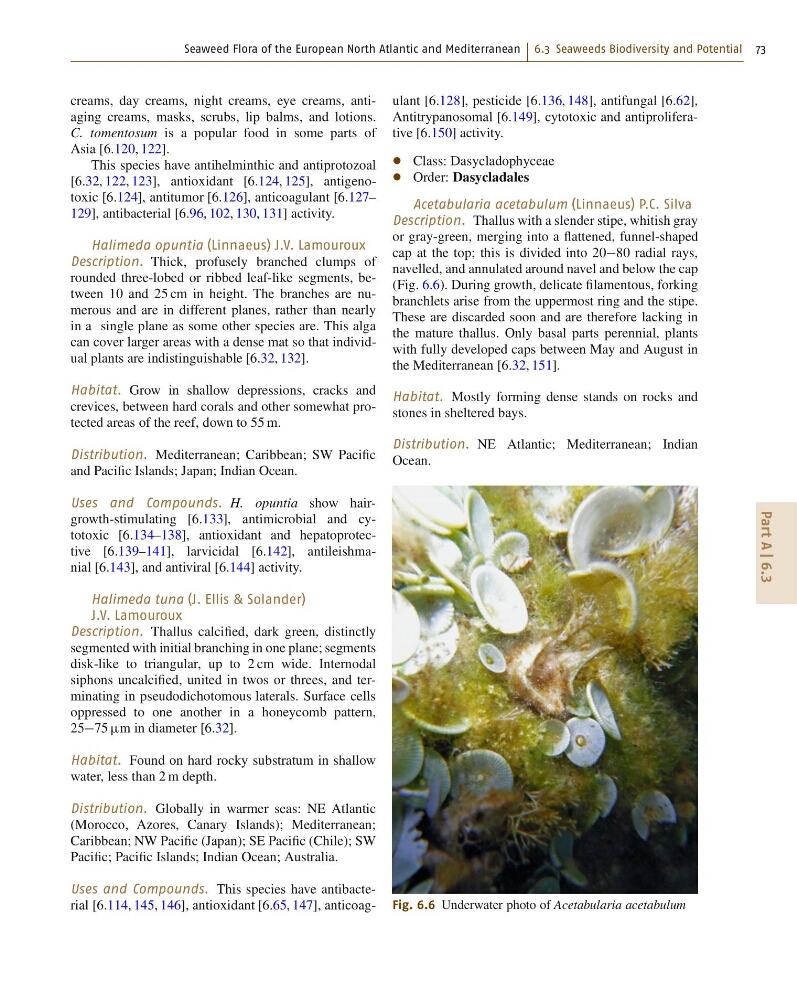
Description. Thallus with a slender stipe, whitish gray
or gray-green, merging into a flattened, funnel-shaped
cap at the top; this is divided into 2080 radial rays,
navelled, and annulated around navel and below the cap
(Fig. 6.6). During growth, delicate filamentous, forking
branchlets arise from the uppermost ring and the stipe.
These are discarded soon and are therefore lacking in
the mature thallus. Only basal parts perennial, plants
with fully developed caps between May and August in
the Mediterranean [6.32, 151].
Habitat. Mostly forming dense stands on rocks and
stones in sheltered bays.
Distribution. NE Atlantic; Mediterranean; Indian
Ocean.
Fig. 6.6 Underwater photo of Acetabularia acetabulum
Part A | 6.3
creams, day creams, night creams, eye creams, antiaging creams, masks, scrubs, lip balms, and lotions.
C. tomentosum is a popular food in some parts of
Asia [6.120, 122].
This species have antihelminthic and antiprotozoal
[6.32, 122, 123], antioxidant [6.124, 125], antigenotoxic [6.124], antitumor [6.126], anticoagulant [6.127–
129], antibacterial [6.96, 102, 130, 131] activity.
Halimeda opuntia (Linnaeus) J.V. Lamouroux
Description. Thick, profusely branched clumps of
rounded three-lobed or ribbed leaf-like segments, between 10 and 25 cm in height. The branches are numerous and are in different planes, rather than nearly
in a single plane as some other species are. This alga
can cover larger areas with a dense mat so that individual plants are indistinguishable [6.32, 132].
Habitat. Grow in shallow depressions, cracks and
crevices, between hard corals and other somewhat protected areas of the reef, down to 55 m.
Distribution. Mediterranean; Caribbean; SW Pacific
and Pacific Islands; Japan; Indian Ocean.
Uses and Compounds. H. opuntia show hairgrowth-stimulating [6.133], antimicrobial and cytotoxic [6.134–138], antioxidant and hepatoprotective [6.139–141], larvicidal [6.142], antileishmanial [6.143], and antiviral [6.144] activity.
Halimeda tuna (J. Ellis & Solander)
J.V. Lamouroux
Description. Thallus calcified, dark green, distinctly
segmented with initial branching in one plane; segments
disk-like to triangular, up to 2 cm wide. Internodal
siphons uncalcified, united in twos or threes, and terminating in pseudodichotomous laterals. Surface cells
oppressed to one another in a honeycomb pattern,
2575 m in diameter [6.32].
Habitat. Found on hard rocky substratum in shallow
water, less than 2 m depth.
Distribution. Globally in warmer seas: NE Atlantic
(Morocco, Azores, Canary Islands); Mediterranean;
Caribbean; NW Pacific (Japan); SE Pacific (Chile); SW
Pacific; Pacific Islands; Indian Ocean; Australia.
Uses and Compounds. This species have antibacterial [6.114, 145, 146], antioxidant [6.65, 147], anticoagulant [6.128], pesticide [6.136, 148], antifungal [6.62],
Antitrypanosomal [6.149], cytotoxic and antiproliferative [6.150] activity.
Class: Dasycladophyceae
Order: Dasycladales
Acetabularia acetabulum (Linnaeus) P.C. Silva
Description. Thallus with a slender stipe, whitish gray
or gray-green, merging into a flattened, funnel-shaped
cap at the top; this is divided into 2080 radial rays,
navelled, and annulated around navel and below the cap
(Fig. 6.6). During growth, delicate filamentous, forking
branchlets arise from the uppermost ring and the stipe.
These are discarded soon and are therefore lacking in
the mature thallus. Only basal parts perennial, plants
with fully developed caps between May and August in
the Mediterranean [6.32, 151].
Habitat. Mostly forming dense stands on rocks and
stones in sheltered bays.
Distribution. NE Atlantic; Mediterranean; Indian
Ocean.
Fig. 6.6 Underwater photo of Acetabularia acetabulum