

c.
c.
c.
c.
T.
s.
T.
a.66.i.1U6
de.b.iU6
c.W!.v.u, e..t:u.6
.6ocUa.U.6
gJr.a.vida.
c.0.6.ta.tum
65
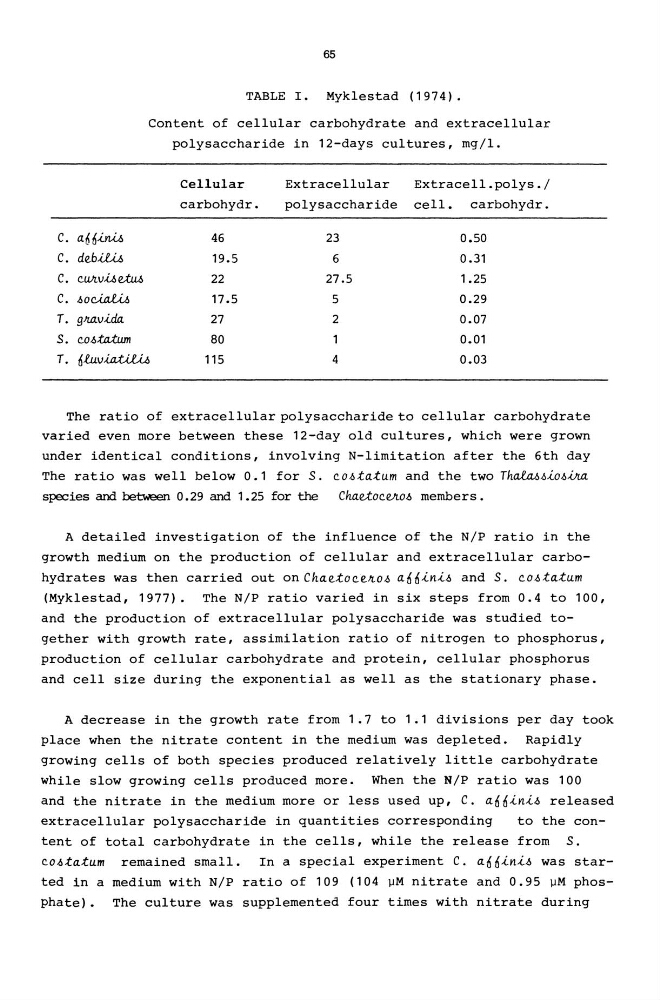
TABLE I. Myklestad (1974).
Content of cellular carbohydrate and extracellular
polysaccharide in 12-days cultures, mg/l.
Cellular
Extracellular
Extracell.polys.1
carbohydr.
polysaccharide cell. carbohydr.
46
23
0.50
19.5
6
0.31
22
27.5
1.25
17.5
5
0.29
27
2
0.07
80
1
0.01
6R..u.v~
115
4
0.03
The ratio of extracellular polysaccharide to cellular carbohydrate
varied even more between these 12-day old cultures, which were grown
under identical conditions, involving N-limitation after the 6th day
The ratio was well below 0.1 for S. c.o.6Za.Zum and the two T~.6io.6~
species and between 0.29 and 1.25 for the
Cha.ctoc.eJW.6 members.
A detailed investigation of the influence of the NIP ratio in the
growth medium on the production of cellular and extracellular carbohydrates was then carried out on Cha.e.zoc.e.JtO.6 a.66.irr..i.6 and S. c.O.6za.zum
(Myklestad, 1977). The NIP ratio varied in six steps from 0.4 to 100,
and the production of extracellular polysaccharide was studied together with growth rate, assimilation ratio of nitrogen to phosphorus,
production of cellular carbohydrate and protein, cellular phosphorus
and cell size during the exponential as well as the stationary phase.
A decrease in the growth rate from 1.7 to 1.1 divisions per day took
place when the nitrate content in the medium was depleted. Rapidly
growing cells of both species produced relatively little carbohydrate
while slow growing cells produced more. When the NIP ratio was 100
and the nitrate in the medium more or less used up, C. a.66.irr..i.6 released
extracellular polysaccharide in quantities corresponding
to the content of total carbohydrate in the cells, while the release from S.
c.o.6za.zum remained small. In a special experiment C. a.66.irr..i.6 was started in a medium with NIP ratio of 109 (104 ~M nitrate and 0.95 ~M phosphate). The culture was supplemented four times with nitrate during
c.
c.
c.
T.
s.
T.
a.66.i.1U6
de.b.iU6
c.W!.v.u, e..t:u.6
.6ocUa.U.6
gJr.a.vida.
c.0.6.ta.tum
65
TABLE I. Myklestad (1974).
Content of cellular carbohydrate and extracellular
polysaccharide in 12-days cultures, mg/l.
Cellular
Extracellular
Extracell.polys.1
carbohydr.
polysaccharide cell. carbohydr.
46
23
0.50
19.5
6
0.31
22
27.5
1.25
17.5
5
0.29
27
2
0.07
80
1
0.01
6R..u.v~
115
4
0.03
The ratio of extracellular polysaccharide to cellular carbohydrate
varied even more between these 12-day old cultures, which were grown
under identical conditions, involving N-limitation after the 6th day
The ratio was well below 0.1 for S. c.o.6Za.Zum and the two T~.6io.6~
species and between 0.29 and 1.25 for the
Cha.ctoc.eJW.6 members.
A detailed investigation of the influence of the NIP ratio in the
growth medium on the production of cellular and extracellular carbohydrates was then carried out on Cha.e.zoc.e.JtO.6 a.66.irr..i.6 and S. c.O.6za.zum
(Myklestad, 1977). The NIP ratio varied in six steps from 0.4 to 100,
and the production of extracellular polysaccharide was studied together with growth rate, assimilation ratio of nitrogen to phosphorus,
production of cellular carbohydrate and protein, cellular phosphorus
and cell size during the exponential as well as the stationary phase.
A decrease in the growth rate from 1.7 to 1.1 divisions per day took
place when the nitrate content in the medium was depleted. Rapidly
growing cells of both species produced relatively little carbohydrate
while slow growing cells produced more. When the NIP ratio was 100
and the nitrate in the medium more or less used up, C. a.66.irr..i.6 released
extracellular polysaccharide in quantities corresponding
to the content of total carbohydrate in the cells, while the release from S.
c.o.6za.zum remained small. In a special experiment C. a.66.irr..i.6 was started in a medium with NIP ratio of 109 (104 ~M nitrate and 0.95 ~M phosphate). The culture was supplemented four times with nitrate during