

66
22 days to keep the concentration at 100 ~M, while no more phosphate
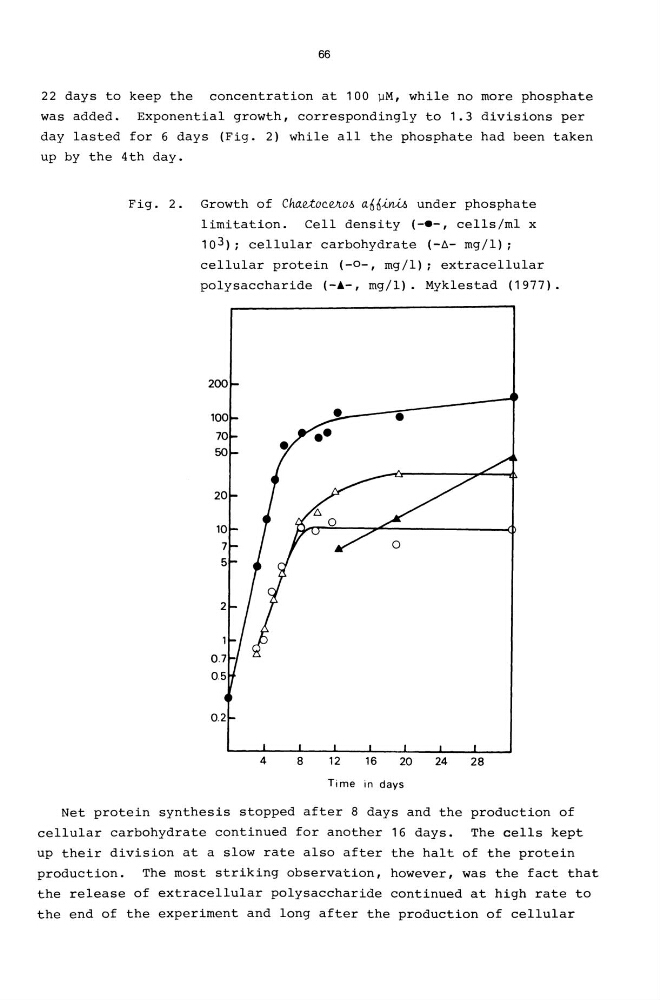
was added. Exponential growth, correspondingly to 1.3 divisions per
day lasted for 6 days (Fig. 2) while all the phosphate had been taken
up by the 4th day.
Fig. 2. Growth of Chae.tOC.eJLO-6 a.66.i.1U6 under phosphate
limitation. Cell density (-e-, cells/ml x
10 3 ); cellular carbohydrate (-~- mg/l);
cellular protein (-0-, mg/l); extracellular
polysaccharide (-a-, mg/l). Myklestad (1977).
200
et--._---l"
0.2
12
16
20
24
28
Time in days
Net protein synthesis stopped after 8 days and the production of
cellular carbohydrate continued for another 16 days. The cells kept
up their division at a slow rate also after the halt of the protein
production. The most striking observation, however, was the fact that
the release of extracellular polysaccharide continued at high rate to
the end of the experiment and long after the production of cellular
22 days to keep the concentration at 100 ~M, while no more phosphate
was added. Exponential growth, correspondingly to 1.3 divisions per
day lasted for 6 days (Fig. 2) while all the phosphate had been taken
up by the 4th day.
Fig. 2. Growth of Chae.tOC.eJLO-6 a.66.i.1U6 under phosphate
limitation. Cell density (-e-, cells/ml x
10 3 ); cellular carbohydrate (-~- mg/l);
cellular protein (-0-, mg/l); extracellular
polysaccharide (-a-, mg/l). Myklestad (1977).
200
et--._---l"
0.2
12
16
20
24
28
Time in days
Net protein synthesis stopped after 8 days and the production of
cellular carbohydrate continued for another 16 days. The cells kept
up their division at a slow rate also after the halt of the protein
production. The most striking observation, however, was the fact that
the release of extracellular polysaccharide continued at high rate to
the end of the experiment and long after the production of cellular