

133
amoun t 0 f ph ycoerythr in •
However, if the phycoerythrin level is
considered in relation to the chlorophyll emission,
there is
considerably more phycoerythrin fluorescence in the "blue" water
population than in the "green" water.
CHANGES IN FLUORESCENT SIGNATURES OF NATURAL POPULATIONS ASSOCIATED
WITH NUTRIENT ENRICHMENT
We have accumulated evidence that suggests that the major change
in fluorescent signatures is associated with the transition from
oligotrophic to eutrophic waters.
One of the best examples of these
changes can be found in the frontal regions which separates stratified from unstratified waters, namely in a region of tidal mixing.
Figures 3-5 show properties of water masses adjacent to and off
Georges Bank.
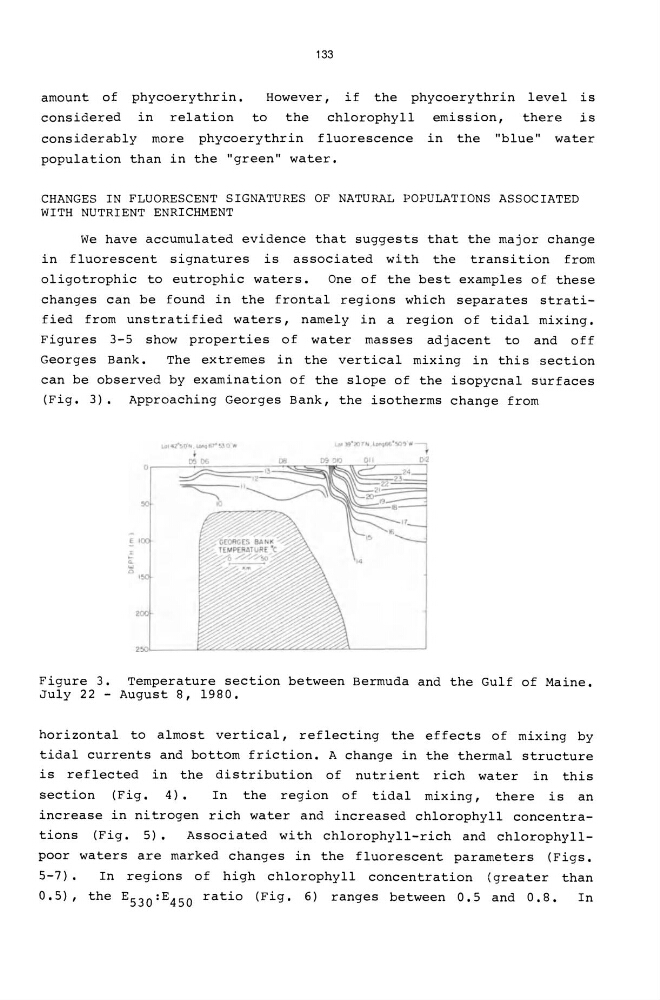
The extremes in the vertical mixing in this section
can be observed by examination of the slope of the isopycnal surfaces
(Fig. 3). Approaching Georges Bank, the isotherms change from
Figure 3. Temperature section between Bermuda and the Gulf of Maine.
July 22 - August 8, 1980.
horizontal to almost vertical, reflecting the effects of mixing by
tidal currents and bottom friction. A change in the thermal structure
is reflected in the distribution of nutrient rich water in this
section (Fig. 4).
In the region of tidal mixing, there is an
increase in nitrogen rich water and increased chlorophyll concentrations (Fig. 5).
Associated with chlorophyll-rich and chlorophyllpoor waters are marked changes in the fluorescent parameters (Figs.
5-7) •
In regions of high chlorophyll concentration (greater than
0.5), the E530:E450 ratio (Fig. 6) ranges between 0.5 and 0.8.
In
amoun t 0 f ph ycoerythr in •
However, if the phycoerythrin level is
considered in relation to the chlorophyll emission,
there is
considerably more phycoerythrin fluorescence in the "blue" water
population than in the "green" water.
CHANGES IN FLUORESCENT SIGNATURES OF NATURAL POPULATIONS ASSOCIATED
WITH NUTRIENT ENRICHMENT
We have accumulated evidence that suggests that the major change
in fluorescent signatures is associated with the transition from
oligotrophic to eutrophic waters.
One of the best examples of these
changes can be found in the frontal regions which separates stratified from unstratified waters, namely in a region of tidal mixing.
Figures 3-5 show properties of water masses adjacent to and off
Georges Bank.
The extremes in the vertical mixing in this section
can be observed by examination of the slope of the isopycnal surfaces
(Fig. 3). Approaching Georges Bank, the isotherms change from
Figure 3. Temperature section between Bermuda and the Gulf of Maine.
July 22 - August 8, 1980.
horizontal to almost vertical, reflecting the effects of mixing by
tidal currents and bottom friction. A change in the thermal structure
is reflected in the distribution of nutrient rich water in this
section (Fig. 4).
In the region of tidal mixing, there is an
increase in nitrogen rich water and increased chlorophyll concentrations (Fig. 5).
Associated with chlorophyll-rich and chlorophyllpoor waters are marked changes in the fluorescent parameters (Figs.
5-7) •
In regions of high chlorophyll concentration (greater than
0.5), the E530:E450 ratio (Fig. 6) ranges between 0.5 and 0.8.
In