

132
nm
).
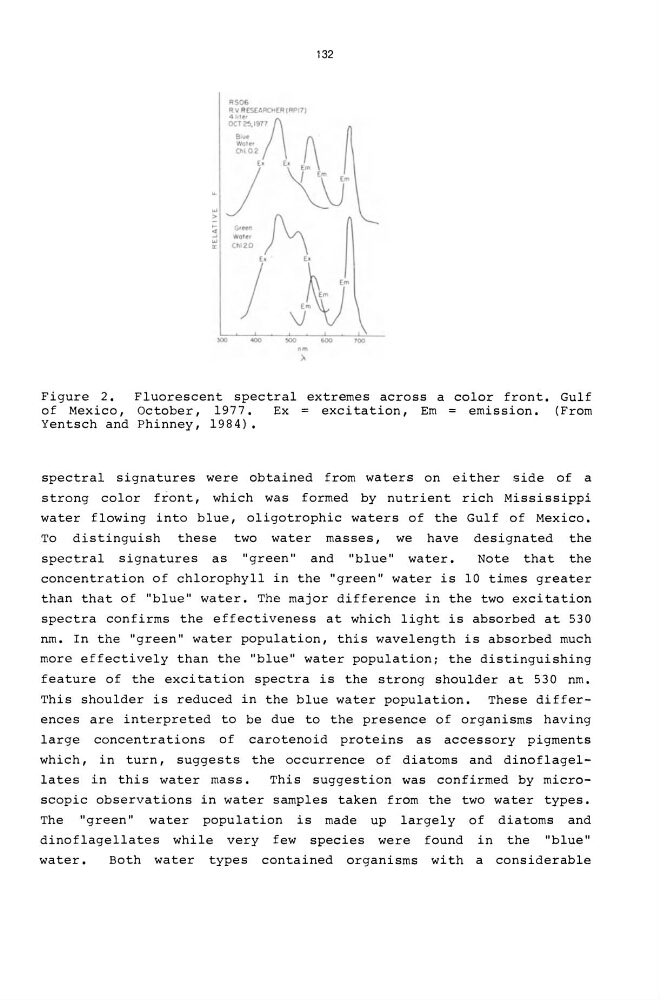
Figure 2.
Fluorescent spectral extremes across a color front. Gulf
of Mexico, October, 1977.
Ex = excitation, Em = emission . (From
Yentsch and Phinney, 1984).
spectral signatures were obtained from waters on either side of a
strong color front, which was formed by nutrient rich Mississippi
water flowing into blue, oligotrophic waters of the Gulf of Mexico.
To distinguish these two water masses, we have designated the
spectral signatures as "green" and "blue" water.
Note that the
concentration of chlorophyll in the "green" water is 10 times greater
than that of "blue" water. The major difference in the two excitation
spectra confirms the effectiveness at which light is absorbed at 530
nm. In the "green" water population, this wavelength is absorbed much
more effectively than the "blue" water population; the distinguishing
feature of the excitation spectra is the strong shoulder at 530 nm.
This shoulder is reduced in the blue water population. These differences are interpreted to be due to the presence of organisms having
large concentrations of carotenoid proteins as accessory pigments
which, in turn, suggests the occurrence of diatoms and dinoflagellates in this water mass.
This suggestion was confirmed by microscopic observations in water samples taken from the two water types.
The "green" water population is made up largely of diatoms and
dinoflagellates while very few species were found in the "blue"
water.
Both water types contained organisms with a considerable
nm
).
Figure 2.
Fluorescent spectral extremes across a color front. Gulf
of Mexico, October, 1977.
Ex = excitation, Em = emission . (From
Yentsch and Phinney, 1984).
spectral signatures were obtained from waters on either side of a
strong color front, which was formed by nutrient rich Mississippi
water flowing into blue, oligotrophic waters of the Gulf of Mexico.
To distinguish these two water masses, we have designated the
spectral signatures as "green" and "blue" water.
Note that the
concentration of chlorophyll in the "green" water is 10 times greater
than that of "blue" water. The major difference in the two excitation
spectra confirms the effectiveness at which light is absorbed at 530
nm. In the "green" water population, this wavelength is absorbed much
more effectively than the "blue" water population; the distinguishing
feature of the excitation spectra is the strong shoulder at 530 nm.
This shoulder is reduced in the blue water population. These differences are interpreted to be due to the presence of organisms having
large concentrations of carotenoid proteins as accessory pigments
which, in turn, suggests the occurrence of diatoms and dinoflagellates in this water mass.
This suggestion was confirmed by microscopic observations in water samples taken from the two water types.
The "green" water population is made up largely of diatoms and
dinoflagellates while very few species were found in the "blue"
water.
Both water types contained organisms with a considerable