

735
This led to high patchiness in plant species within the restoration cells, which is
apparent in the wider scatter of data points for these years on the nMDS graph
(Fig. 21.20a). The community trajectory since 2011 has moved towards the reference
condition. In 2013, the patches of S. alterniflora were in excellent condition with tall
and vibrant plants. In the spring of 2014, a large number of S. alterniflora seedlings
were observed throughout the restoration cells (Fig. 21.23). This sexual reproduction
along with continued rhizomal (asexual) spread lead to a near continuous coverage of
S. alterniflora in the restoration cells in 2015 (particularly in the NW cell; Fig. 21.22c).
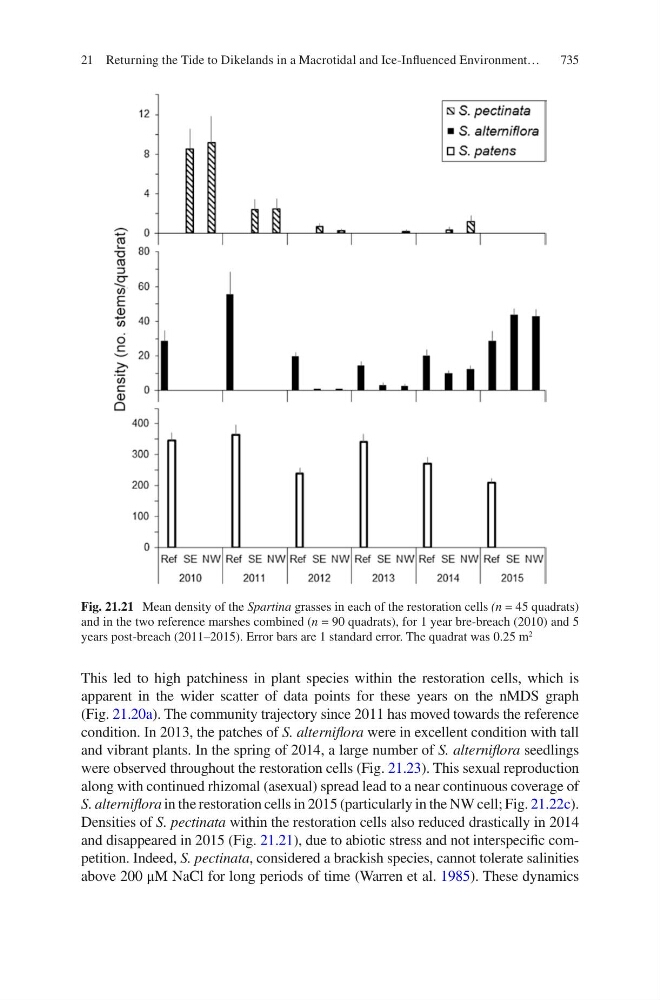
Densities of S. pectinata within the restoration cells also reduced drastically in 2014
and disappeared in 2015 (Fig. 21.21), due to abiotic stress and not interspecific competition. Indeed, S. pectinata, considered a brackish species, cannot tolerate salinities
above 200 μM NaCl for long periods of time (Warren et al. 1985). These dynamics
Fig. 21.21 Mean density of the Spartina grasses in each of the restoration cells (n = 45 quadrats)
and in the two reference marshes combined (n = 90 quadrats), for 1 year bre-breach (2010) and 5
years post-breach (2011–2015). Error bars are 1 standard error. The quadrat was 0.25 m
2
21 Returning the Tide to Dikelands in a Macrotidal and Ice-Influenced Environment…