

736
are apparent on the nMDS graph as the group of data points becomes tight again in
2015 due to the lowered variation (Fig. 21.20a). The spread of points on the nMDS
graph also changes between 2014 and 2015 due to the disappearance of the last “terrestrial” plant species (S. pectinata) within the restoration cells proper. Note that S.
pectinata now grows vibrantly along the mid to higher edges of the dike. The lack of
overlap between reference and restoration sites in 2015 is due to the continued
absence of S. patens within the restoration cells (Fig. 21.21). S. patens and the various
other plants found in the high marsh zone of a mature marsh (e.g., seaside plantain
Plantago maritima, sea lavender Limonium carolinianum, orach Atriplex spp., arrowgrass Triglochin maritima) currently occur on the seaward face of the new dike. These
species are expected to start spreading into the restoration cells proper once the marsh
surface has accreted sufficiently. The elevation of the surface of the restoration cells
is still about 1 m below the surface of the adjacent reference salt marshes.
The contrasting type of S. alterniflora spread between the early years (2012 and
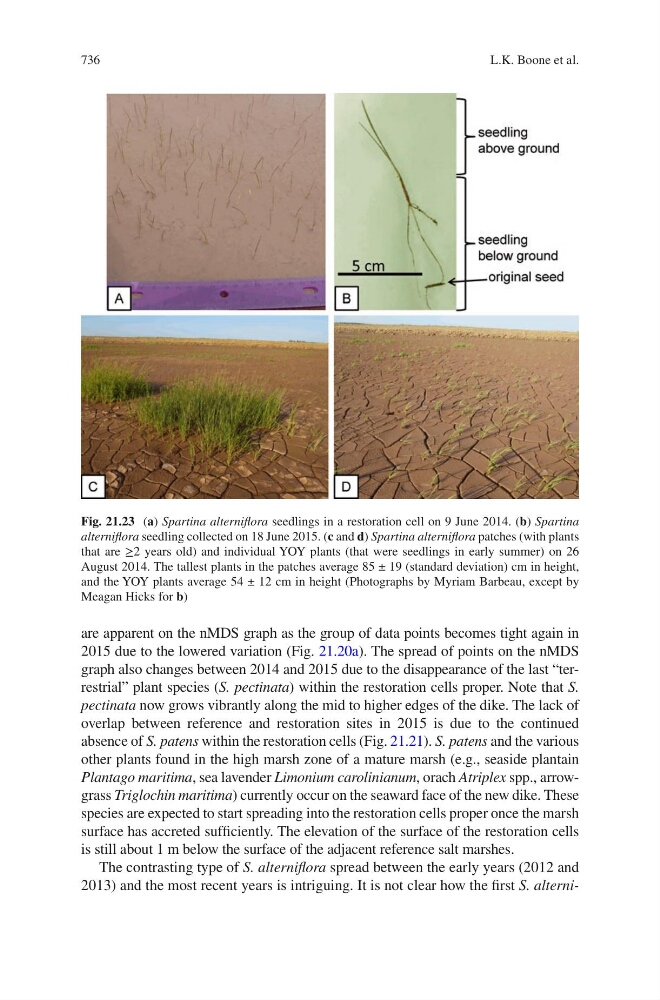
2013) and the most recent years is intriguing. It is not clear how the first S. alterniFig. 21.23 (a) Spartina alterniflora seedlings in a restoration cell on 9 June 2014. (b) Spartina
alterniflora seedling collected on 18 June 2015. (c and d) Spartina alterniflora patches (with plants
that are ≥2 years old) and individual YOY plants (that were seedlings in early summer) on 26
August 2014. The tallest plants in the patches average 85 ± 19 (standard deviation) cm in height,
and the YOY plants average 54 ± 12 cm in height (Photographs by Myriam Barbeau, except by
Meagan Hicks for b)
L.K. Boone et al.