

729
it was only going to be some matter of months to years before the effective width of
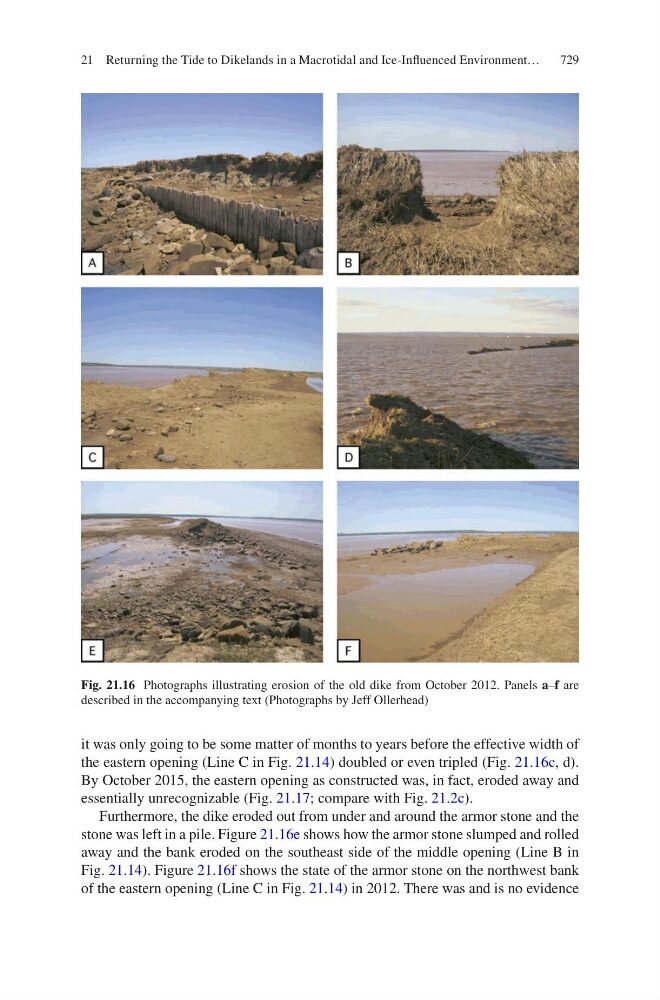
the eastern opening (Line C in Fig. 21.14) doubled or even tripled (Fig. 21.16c, d).
By October 2015, the eastern opening as constructed was, in fact, eroded away and
essentially unrecognizable (Fig. 21.17; compare with Fig. 21.2c).
Furthermore, the dike eroded out from under and around the armor stone and the
stone was left in a pile. Figure 21.16e shows how the armor stone slumped and rolled
away and the bank eroded on the southeast side of the middle opening (Line B in
Fig. 21.14). Figure 21.16f shows the state of the armor stone on the northwest bank
of the eastern opening (Line C in Fig. 21.14) in 2012. There was and is no evidence
Fig. 21.16 Photographs illustrating erosion of the old dike from October 2012. Panels a–f are
described in the accompanying text (Photographs by Jeff Ollerhead)
21 Returning the Tide to Dikelands in a Macrotidal and Ice-Influenced Environment…