

728
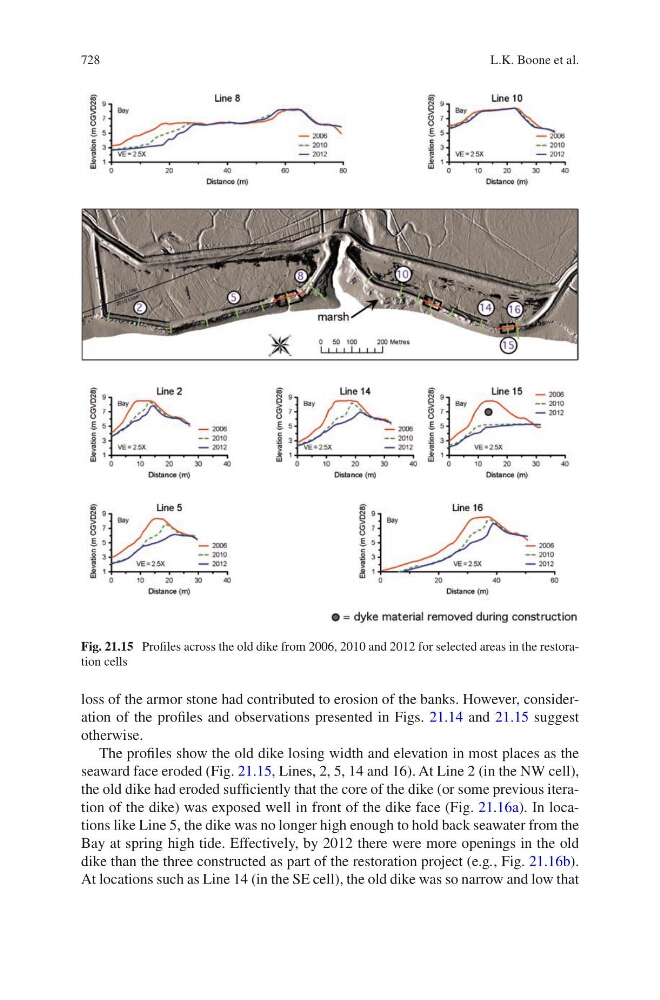
loss of the armor stone had contributed to erosion of the banks. However, consideration of the profiles and observations presented in Figs. 21.14 and 21.15 suggest
otherwise.
The profiles show the old dike losing width and elevation in most places as the
seaward face eroded (Fig. 21.15, Lines, 2, 5, 14 and 16). At Line 2 (in the NW cell),
the old dike had eroded sufficiently that the core of the dike (or some previous iteration of the dike) was exposed well in front of the dike face (Fig. 21.16a). In locations like Line 5, the dike was no longer high enough to hold back seawater from the
Bay at spring high tide. Effectively, by 2012 there were more openings in the old
dike than the three constructed as part of the restoration project (e.g., Fig. 21.16b).
At locations such as Line 14 (in the SE cell), the old dike was so narrow and low that
Fig. 21.15 Profiles across the old dike from 2006, 2010 and 2012 for selected areas in the restoration cells
L.K. Boone et al.