

717
may be significant. This has been observed in some salt marshes in eastern North
America (Argow et al. 2011; Ollerhead et al. 1999).
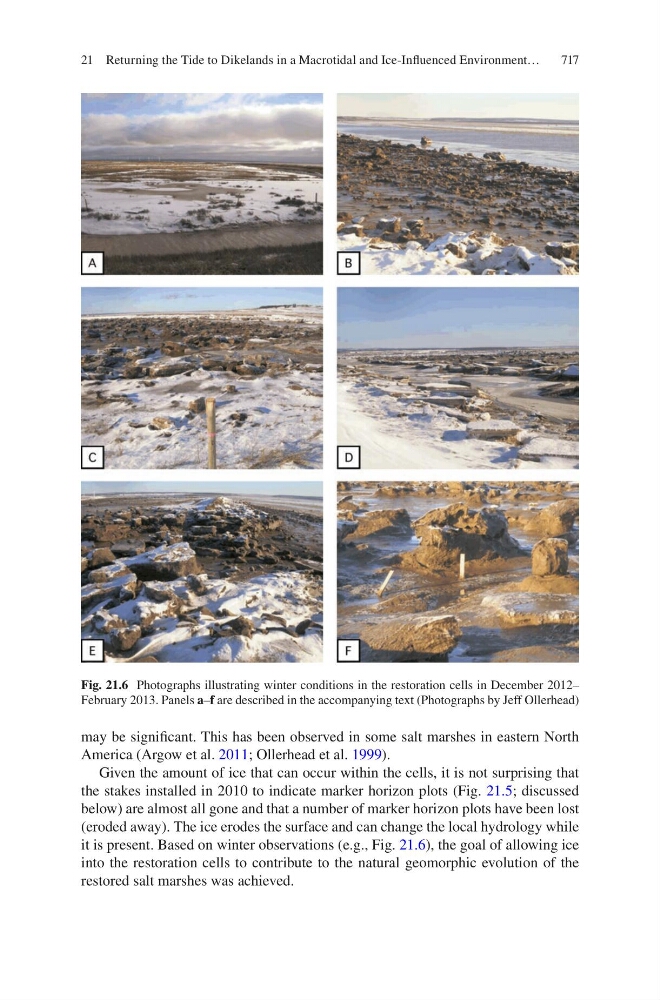
Given the amount of ice that can occur within the cells, it is not surprising that
the stakes installed in 2010 to indicate marker horizon plots (Fig. 21.5; discussed
below) are almost all gone and that a number of marker horizon plots have been lost
(eroded away). The ice erodes the surface and can change the local hydrology while
it is present. Based on winter observations (e.g., Fig. 21.6), the goal of allowing ice
into the restoration cells to contribute to the natural geomorphic evolution of the
restored salt marshes was achieved.
Fig. 21.6 Photographs illustrating winter conditions in the restoration cells in December 2012–
February 2013. Panels a–f are described in the accompanying text (Photographs by Jeff Ollerhead)
21 Returning the Tide to Dikelands in a Macrotidal and Ice-Influenced Environment…