

675
(Fig. 20.25e). Jacks are captured with multifilament gillnets and hand lines. During
the analyzed period (2014–2015) 73.16 tons (5%) of mullets were landed at the
Piaçabuçu (Table 20.3).
In 2015, there was an increase of 27.4 and 35.9% in the catch of sharks and rays,
respectively, compared to 2014 (Table 20.3). This increase can be related to a higher
fishing effort along the coast before the closed period of fishing in the river
(November to February), and fishers directing efforts towards resources as elasmobranches. Capture of sharks and rays in the river result from intrusion of saline
water in the estuarine environment, caused by changes in river flow. Sharks are
caught by artisanal longline (“groseira”), gillnets and hand lines. They are landed at
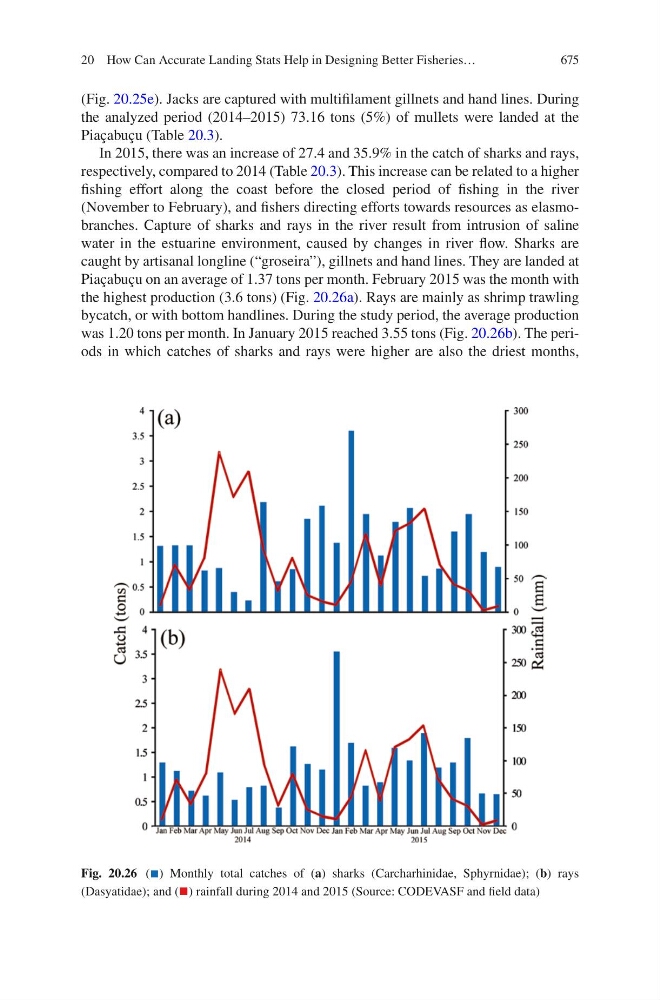
Piaçabuçu on an average of 1.37 tons per month. February 2015 was the month with
the highest production (3.6 tons) (Fig. 20.26a). Rays are mainly as shrimp trawling
bycatch, or with bottom handlines. During the study period, the average production
was 1.20 tons per month. In January 2015 reached 3.55 tons (Fig. 20.26b). The periods in which catches of sharks and rays were higher are also the driest months,
Fig. 20.26 (■) Monthly total catches of (a) sharks (Carcharhinidae, Sphyrnidae); (b) rays
(Dasyatidae); and (■) rainfall during 2014 and 2015 (Source: CODEVASF and field data)
20 How Can Accurate Landing Stats Help in Designing Better Fisheries…