

674
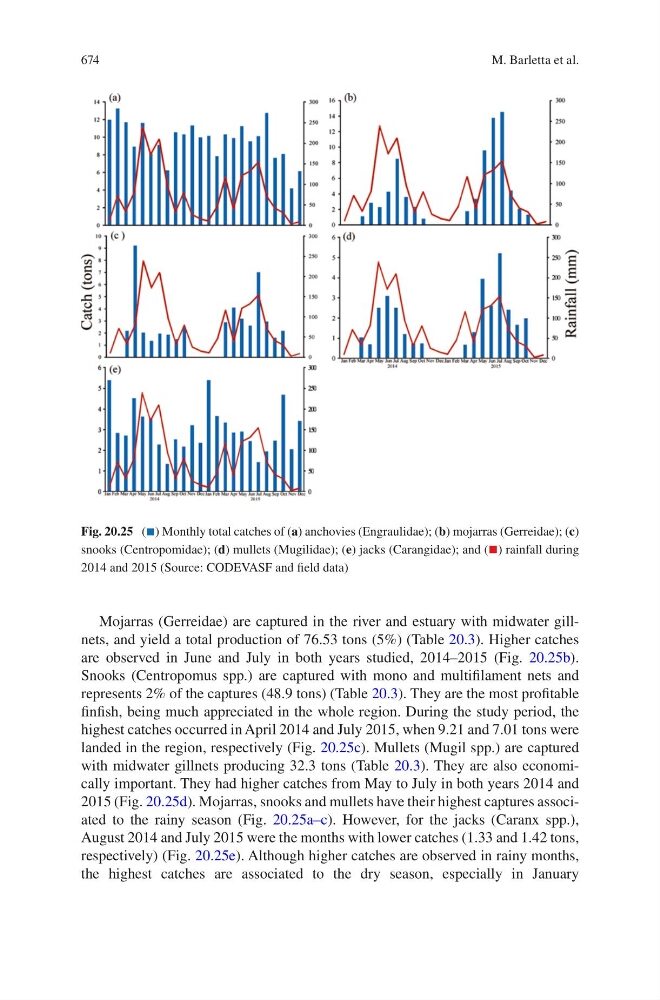
Mojarras (Gerreidae) are captured in the river and estuary with midwater gillnets, and yield a total production of 76.53 tons (5%) (Table 20.3). Higher catches
are observed in June and July in both years studied, 2014–2015 (Fig. 20.25b).
Snooks (Centropomus spp.) are captured with mono and multifilament nets and
represents 2% of the captures (48.9 tons) (Table 20.3). They are the most profitable
finfish, being much appreciated in the whole region. During the study period, the
highest catches occurred in April 2014 and July 2015, when 9.21 and 7.01 tons were
landed in the region, respectively (Fig. 20.25c). Mullets (Mugil spp.) are captured
with midwater gillnets producing 32.3 tons (Table 20.3). They are also economically important. They had higher catches from May to July in both years 2014 and
2015 (Fig. 20.25d). Mojarras, snooks and mullets have their highest captures associated to the rainy season (Fig. 20.25a–c). However, for the jacks (Caranx spp.),
August 2014 and July 2015 were the months with lower catches (1.33 and 1.42 tons,
respectively) (Fig. 20.25e). Although higher catches are observed in rainy months,
the highest catches are associated to the dry season, especially in January
Fig. 20.25 (■) Monthly total catches of (a) anchovies (Engraulidae); (b) mojarras (Gerreidae); (c)
snooks (Centropomidae); (d) mullets (Mugilidae); (e) jacks (Carangidae); and (■) rainfall during
2014 and 2015 (Source: CODEVASF and field data)
M. Barletta et al.