

673
creels. Increased catches (from 4.52 to 7.60 tons), especially in the period between
May and July 2014 and from August to October in 2015, were observed (Fig. 20.24c).
Captures are also associated to higher rainfall (Fig. 20.24c). Shrimp trawling
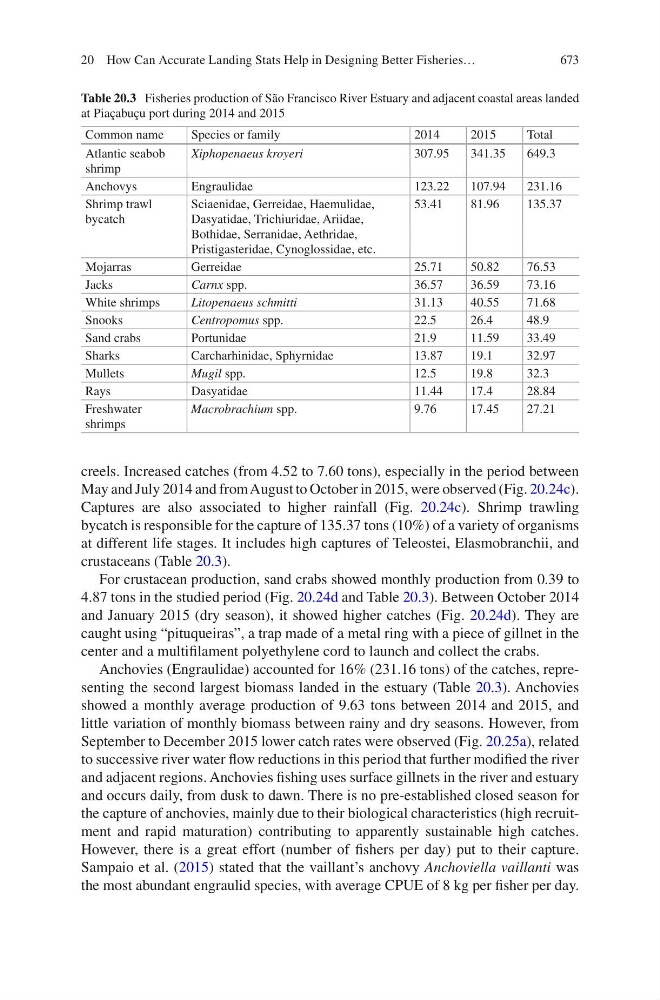
bycatch is responsible for the capture of 135.37 tons (10%) of a variety of organisms
at different life stages. It includes high captures of Teleostei, Elasmobranchii, and
crustaceans (Table 20.3).
For crustacean production, sand crabs showed monthly production from 0.39 to
4.87 tons in the studied period (Fig. 20.24d and Table 20.3). Between October 2014
and January 2015 (dry season), it showed higher catches (Fig. 20.24d). They are
caught using “pituqueiras”, a trap made of a metal ring with a piece of gillnet in the
center and a multifilament polyethylene cord to launch and collect the crabs.
Anchovies (Engraulidae) accounted for 16% (231.16 tons) of the catches, representing the second largest biomass landed in the estuary (Table 20.3). Anchovies
showed a monthly average production of 9.63 tons between 2014 and 2015, and
little variation of monthly biomass between rainy and dry seasons. However, from
September to December 2015 lower catch rates were observed (Fig. 20.25a), related
to successive river water flow reductions in this period that further modified the river
and adjacent regions. Anchovies fishing uses surface gillnets in the river and estuary
and occurs daily, from dusk to dawn. There is no pre-established closed season for
the capture of anchovies, mainly due to their biological characteristics (high recruitment and rapid maturation) contributing to apparently sustainable high catches.
However, there is a great effort (number of fishers per day) put to their capture.
Sampaio et al. (2015) stated that the vaillant’s anchovy Anchoviella vaillanti was
the most abundant engraulid species, with average CPUE of 8 kg per fisher per day.
Table 20.3 Fisheries production of São Francisco River Estuary and adjacent coastal areas landed
at Piaçabuçu port during 2014 and 2015
Common name
Species or family
2014
2015
Total
Atlantic seabob
shrimp
Xiphopenaeus kroyeri
307.95
341.35
649.3
Anchovys
Engraulidae
123.22
107.94
231.16
Shrimp trawl
bycatch
Sciaenidae, Gerreidae, Haemulidae,
Dasyatidae, Trichiuridae, Ariidae,
53.41
81.96
135.37
Bothidae, Serranidae, Aethridae,
Pristigasteridae, Cynoglossidae, etc.
Mojarras
Gerreidae
25.71
50.82
76.53
Jacks
Carnx spp.
36.57
36.59
73.16
White shrimps
Litopenaeus schmitti
31.13
40.55
71.68
Snooks
Centropomus spp.
22.5
26.4
48.9
Sand crabs
Portunidae
21.9
11.59
33.49
Sharks
Carcharhinidae, Sphyrnidae
13.87
19.1
32.97
Mullets
Mugil spp.
12.5
19.8
32.3
Rays
Dasyatidae
11.44
17.4
28.84
Freshwater
shrimps
Macrobrachium spp.
9.76
17.45
27.21
20 How Can Accurate Landing Stats Help in Designing Better Fisheries…