

656
Remnants of the Atlantic Rain Forest, rice culture, urban areas and holiday
homes compose the landscape next to the north region of the Laguna Estuarine
Complex (Table 20.1). There, the main economic activity is agriculture that ranges
from family/subsistence to the major commercial and mechanized scale. The main
cultures are rice, corn, forage for cattle and manioc. In the south region, there is a
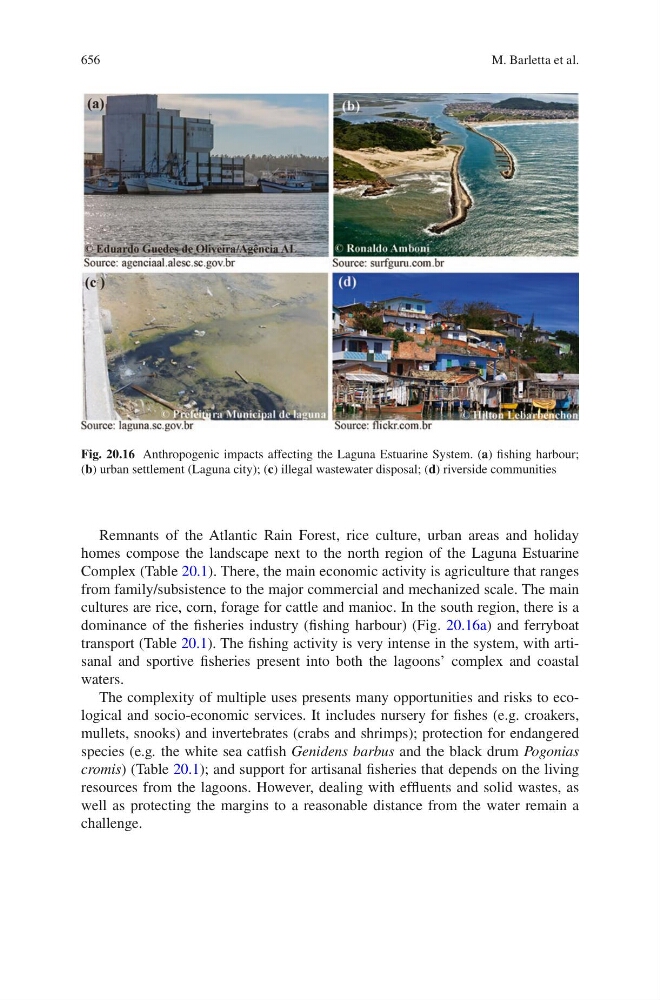
dominance of the fisheries industry (fishing harbour) (Fig. 20.16a) and ferryboat
transport (Table 20.1). The fishing activity is very intense in the system, with artisanal and sportive fisheries present into both the lagoons’ complex and coastal
waters.
The complexity of multiple uses presents many opportunities and risks to ecological and socio-economic services. It includes nursery for fishes (e.g. croakers,
mullets, snooks) and invertebrates (crabs and shrimps); protection for endangered
species (e.g. the white sea catfish Genidens barbus and the black drum Pogonias
cromis) (Table 20.1); and support for artisanal fisheries that depends on the living
resources from the lagoons. However, dealing with effluents and solid wastes, as
well as protecting the margins to a reasonable distance from the water remain a
challenge.
Fig. 20.16 Anthropogenic impacts affecting the Laguna Estuarine System. (a) fishing harbour;
(b) urban settlement (Laguna city); (c) illegal wastewater disposal; (d) riverside communities
M. Barletta et al.