

651
1970s (Fig. 20.14c). The polyculture of food completed the supply for the local
population, and supplied numerous municipal fairs in the region (Rieper 2000).
Other cultures, due to the low productivity achieved, were less significant (e.g. corn,
beans, cotton and manioc) (Table 20.1). Despite the decline in recent years, coconut
culture still ranks as an important part in the local economy. Few cultures remain
near the estuary, among them coconut, rice and manioc, especially in Sergipe State
(Fig. 20.14c and Table 20.1).
Fishing in São Francisco River has lower yields than expected for a river this size
due to the oligotrophic and depleted waters, a consequence form anthropogenic
changes made upstream (Knoppers et al. 2007, Oliveira et al. 2008). The lower river
and the estuarine system are the most productive areas (Araújo and Sá 2008). Fishes
migrate upstream to find suitable places to spawn, feed and protect larvae and
young, especially in wetlands and among aquatic macrophytes (Araújo and Sá
2008; Pompêo 2008). The estuarine area has a rich diversity of species, functioning
as nursery and shelter, promoting the recovery of the stock of several commercially
important species of fish, crustaceans and mollusks (Table 20.1). The fishing fleet
operates primarily in the estuarine region and adjacent coastal areas. The Families
Carangidae, Centropomidae, Gerreidae, Lutjanidae, Mugilidae and Sciaenids are of
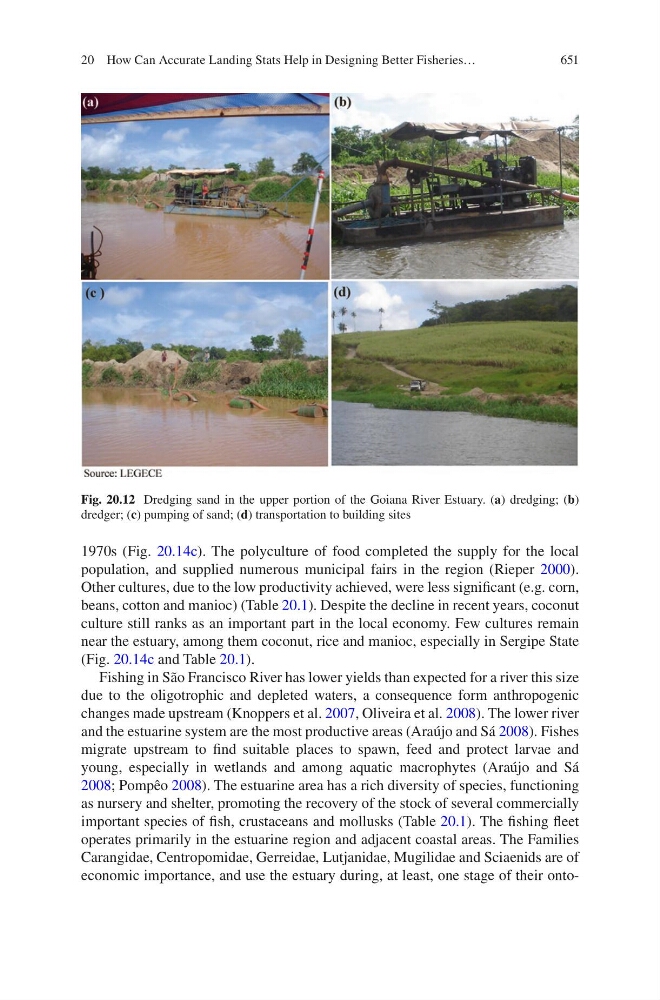
economic importance, and use the estuary during, at least, one stage of their ontoFig. 20.12 Dredging sand in the upper portion of the Goiana River Estuary. (a) dredging; (b)
dredger; (c) pumping of sand; (d) transportation to building sites
20 How Can Accurate Landing Stats Help in Designing Better Fisheries…